
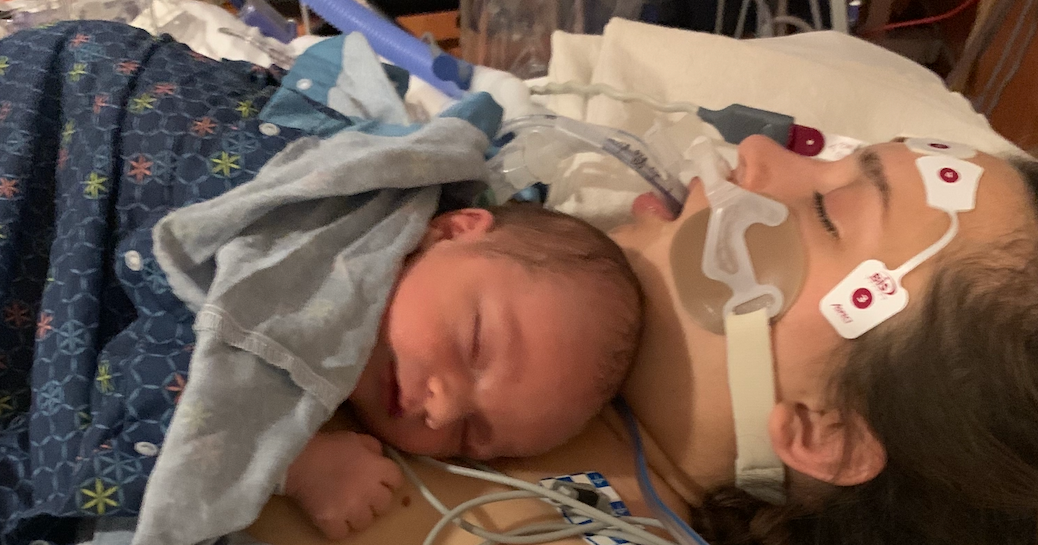
Casey Gould wanted to be a mom her entire life. For a long time, it seemed like her dream wouldn’t come true: She and her husband suffered three miscarriages, and infertility treatments weren’t helping. In January 2024, Gould and her husband decided to stop trying. A month later, she was pregnant.
Gould was worried, but her pregnancy was easy. She loved being pregnant. Her baby moved around all the time. There had been some swelling in the final stages of her pregnancy, but her doctors weren’t concerned. When she finally went into labor, she wasn’t worried about giving birth at all — she was just excited to meet her son.
“You think you’re in the home stretch. You’re good, you’re healthy, he’s healthy. All you have to do is get the baby here,” Gould, 33, said. She went into labor on Nov. 1, 2024.
Casey Gould
Her labor was long — it took 36 hours for her to be ready to push. At that point, “everything kind of felt wrong,” she said. Her vitals looked good, and an epidural was controlling her pain, but Gould was suddenly gripped by “a sense of dread.”
“I was telling myself not to freak out, and then right behind the doctor, as she walked by, I saw, like, a black shadow. It’s hard to explain, but if you looked in the corner of the room, it was almost like black shadows enveloping that corner,” Gould said. “And then I looked over to where the nurses were, and it started to happen over there too. When the doctor came back over to my bedside, I grabbed her, and I grabbed a nurse, and I said, ‘Something’s wrong. I think I’m about to die.'”
An emergency surgery and dayslong coma
Right after Gould spoke, her son’s heart rate dropped off. Gould was rushed to an operating room and sedated for an emergency C-section. Her son was delivered within minutes. Then doctors realized Gould’s heart was failing.
Cardiologist Dr. Amer Sayed was called in. He found Gould’s ejection fraction, the measure of how well the heart can pump blood, was just 13%. Normal ejection fraction function is between 55% and 70%, Sayed told CBS News.
There were only two options: Place a device called an Impella pump that would give her heart time to rest and see if that helped, or put Gould on the list for a heart transplant. Sayed decided to try the pump, and placed it through her femoral artery. Gould spent the next two days in a coma in the intensive care unit, on a ventilator. Slowly, her body began to recover.
When Gould awoke, she was thrilled to see her husband and newborn son. She had no idea what had happened.
“I thought maybe I hemorrhaged during the C-section or something. Nobody really explained that I was in the cardiac ICU until those doctors came in,” Gould said. “For them to explain to me that my heart had failed was really, really weird.”
Casey Gould 
What is peripartum cardiomyopathy?
Gould had experienced peripartum cardiomyopathy, a rare condition that occurs when the heart spontaneously weakens in late-stage pregnancy or shortly after giving birth, according to Dr. Adam Small, the associate medical director of NYU Langone’s Adult Congenital Heart Disease Program in New York and a member of the hospital’s cardio-obstetrics program. The condition occurs in about 1 of every 5,000 pregnancies, Small said.
It’s hard to predict who will be affected by the condition, Small said. Socioeconomic factors, higher maternal age and previous pregnancies can put a person at more risk. “You don’t really know when it’s going to happen, which is kind of what’s so scary about it,” Small said.
Small said patients may experience warning signs like shortness of breath. Gould’s feeling of dread could have been caused by fluid in her lungs or plummeting blood pressure, he said.
Not all peripartum cardiomyopathy cases require a C-section delivery, Small said. It’s only necessary when doctors think a pregnant patient’s heart would be put under too much stress during a traditional vaginal delivery. Patients who experience peripartum cardiomyopathy need to be stabilized, and then their heart needs to be given time to rest and recover, Small said. The Impella pump allowed that for Gould.
Impella / Abiomed 
A “pretty miraculous” recovery
Gould was in the ICU for nine days. Coming home was “really hard,” she said. Not only did she have to recover from major surgery, she and her husband were juggling a newborn. At first, she didn’t want to know more about what had happened to her. But soon, she started asking her family and reading her medical files.
“This was the most traumatic night of a lot of people’s lives. It’s been hard,” Gould said. “Learning about it, it doesn’t feel like it happened to me.”
Gould’s ejection fraction measurements are now back to normal levels. She continues to take medication and will regularly see a cardiologist for the rest of her life. However, she likely will not have another baby. Small said that even in cases where a person fully recovers from peripartum cardiomyopathy, future pregnancies are considered high-risk.
“The fact that I went from where I was to where I am now is pretty miraculous,” Gould said.
Casey Gould 
Through it all, being a mom “has been a dream,” Gould said. Her baby is now a happy, healthy 1-year-old who has started sleeping through the night and taking swimming lessons. She recently shared her story at a medical conference in Phoenix and was proud to bring her son onstage with her. She has also been invited to Impella’s Boston headquarters and is planning a family trip to Montana’s Glacier National Park.
“I get this chance to be his mom and be a wife and to still be here and do things. It’s just the little things, like going on bike rides this summer now that he’s big enough to sit in the bike carrier,” Gould said. “Every day feels like a gift. I know that’s silly, people say it a lot, but every morning kind of feels like Christmas.”
