
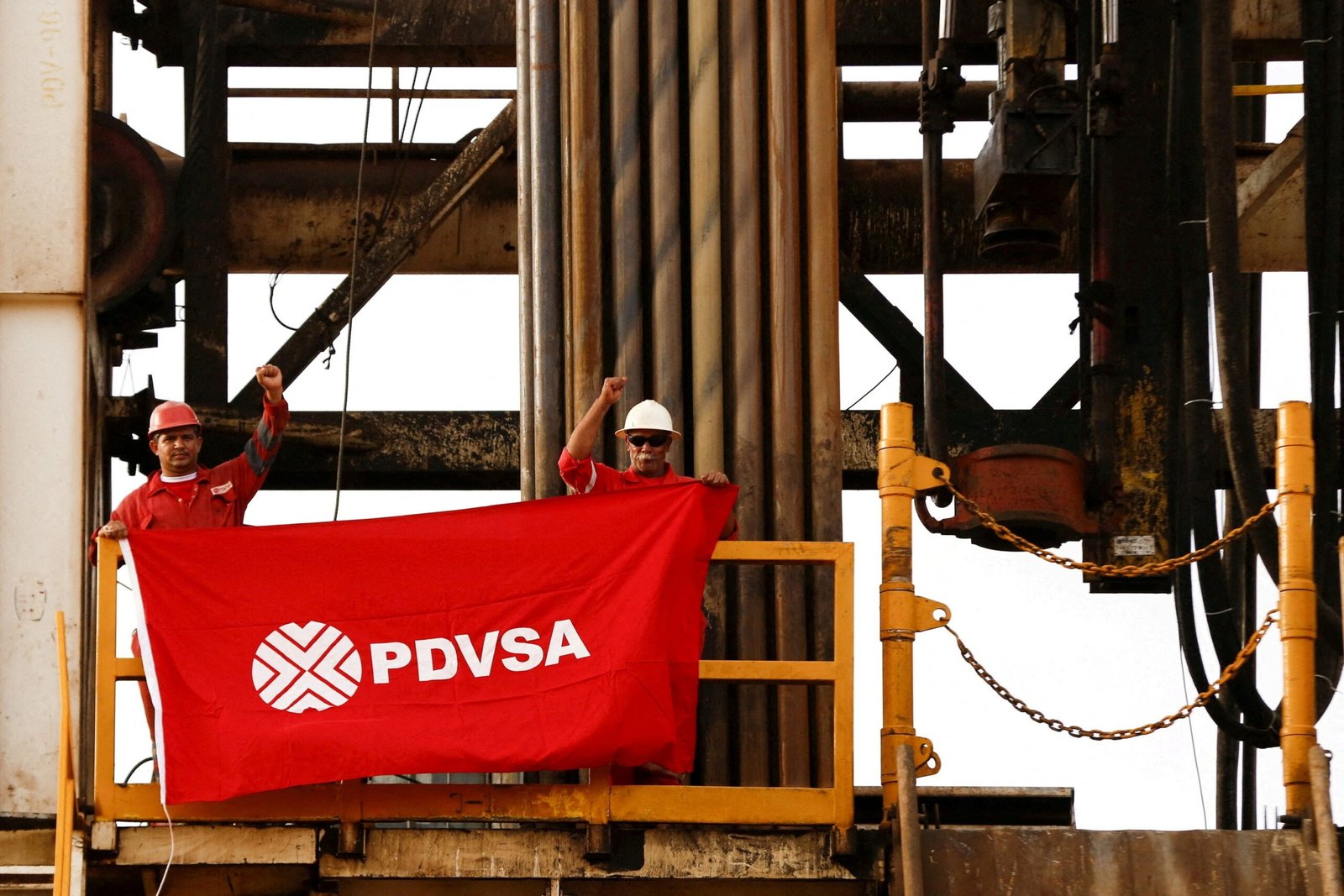
What will the oil sector be like in Venezuela? President Donald Trump’s statements about his intention to “take over” Venezuela’s oil sector, after the operation that removed Nicolás Maduro from power, placed the future of the state-owned PDVSA at the center of the debate. Venezuela holds around 17% of the planet’s proven reserves — more than 300 billion barrels, according to international entities in the energy sector — and maintained for years a near-monopoly in the sector after the re-nationalization promoted by Maduro’s predecessor, Hugo Chávez. 📱Download the g1 app to see news in real time and for free When arresting Maduro, Trump promised to restructure the oil industry, with investments of billions of dollars from American companies, and the fate of these reserves began to be closely monitored by governments, companies and investors. The initial excitement sent shares of American oil companies soaring. Chevron, which maintains operations in the country and is seen as one of the best positioned, rose 5.1% on Monday. As it was realized that any change would take time, the movement was reversed: shares fell more than 4% on Tuesday. In addition to the economic and geopolitical impacts, the debate is emerging about how Trump’s offensive could redesign the role of PDVSA and Venezuela in the international oil market. According to analysts interviewed by g1, the movement reflects less an immediate change in global supply and more the market’s reading of a new geopolitical scenario. What happens to PDVSA? Drilling platform at a PDVSA oil well in Orinoco, near Cabrutica, Anzoátegui Reuters Despite the military offensive, the Venezuelan state company continues operating. According to information from Reuters, production and refining activities continue normally, without damage to main facilities, although the port of La Guaira was severely affected by the attacks. The company’s main challenge, however, is not short-term operational, but structural. Welber Barral, partner at BMJ Consultores Associados and former secretary of Foreign Trade at the Ministry of Development, Industry and Commerce (MDIC), states that the state-owned company has been weakened over the years. “PDVSA ended up being dismantled due to lack of investment. Today, it exports only a third of the volume registered 20 years ago. It is a company scrapped due to poor management, but which still has enormous potential, because it holds large reserves”, he says. ➡️ Responsible for the exploration, production, refining and export of oil, Petróleos de Venezuela SA is the axis of a sector that has supported the country’s economy for decades. Oil and its derivatives account for around 90% of Venezuela’s export revenues, which makes the state-owned company central to public accounts. ➡️ Despite managing the largest proven oil reserves in the world, PDVSA is going through a long process of deterioration. During the governments of Hugo Chávez and Nicolás Maduro, the company suffered strong political interference, faced recurring cases of corruption, lost technical staff and saw foreign investors leave the country. ➡️ The impact was direct on production, which fell by more than 70% since the end of the 1990s. Operational problems, such as accidents in oil pipelines and refineries, worsened the situation, while sanctions imposed by the USA — especially from 2017 — restricted the company’s access to financing, technology and international markets. Even so, PDVSA managed to stabilize production at around 1 million barrels per day, partly thanks to special licenses granted to some foreign companies, such as the American Chevron. Faced with the American intervention, Rafael Chaves, former director of Petrobras and professor at the Brazilian School of Economics and Finance (EPGE) at Fundação Getulio Vargas (FGV), assesses that the Venezuelan state-owned company should not lose relevance, but should change its operating model, currently marked by isolation. “The most likely scenario is the construction of a new arrangement of rules, in which the state-owned company starts to operate in partnership with international companies. This does not represent a weakening. On the contrary, it could mean a strengthening, since isolation and monopoly tend to weaken companies”, he states. What Trump intends and the role of American companies At a press conference on Saturday (3), Trump stated that the US intends to “fix” the Venezuelan oil industry by opening the sector to large American companies, which would allow the country’s infrastructure to be recovered and Venezuelan oil to be placed back on the international market. “Our gigantic oil companies are going to come in, spend billions of dollars, fix the infrastructure and start generating profits for the country,” said the American president, defending direct participation of private capital in restructuring the sector. In a report, analysts from UBS BB point out that Trump advocates for the US to “manage” Venezuela during a transition period, with oil production led by American companies. The proposal, according to the document, would be to use this model to “recover losses” accumulated over the last few decades. Even so, this would not mean a nationalization of the sector. For Rafael Chaves, the logic is market-based. “The US usually operates with markets, not with nationalization. When Trump talks about ‘taking over’, he is probably referring to opening up to private companies, such as Exxon and Chevron”, he explains. In this context, Barral highlights the interest of American companies in Venezuelan oil. He recalls that, during Joe Biden’s government, exceptions were created that allowed limited operations for some United States companies in the country. “This presence, however, was timid, because no one makes large investments without legal security in the country.” Under the Trump administration, these authorizations were revoked, leading many companies to suspend their operations in Venezuela. Still, Barral states that the interest in resuming investments remains. To achieve this, the most likely path would be to conclude agreements with PDVSA. “These partnerships could involve the assignment of blocks or other partnership formats, to enable the production and export of oil. The main objective is to export to the south of the USA, where there are many refineries”, he explains. Therefore, the expectation of the opening of the Venezuelan market has boosted the shares of the main American oil companies since Monday (5). Effects on the oil market Analysts and experts consulted by g1 assess that developments in the Venezuelan oil industry tend to have a limited impact on international oil prices in the short term. The main reason is that the country’s production remains at around 1 million barrels per day, a volume well below its historical potential. For supply to increase significantly, a long process of investment, reconstruction of infrastructure and profound changes in PDVSA’s governance would be necessary. Furthermore, the global oil market is already operating under the expectation of oversupply and weaker demand in 2026, which reduces the likelihood of a rapid or significant impact on prices. In the opinion of Helder Queiroz, professor at the UFRJ Institute of Economics and former director of the National Petroleum Agency (ANP), even an optimistic scenario would point to a gradual recovery. “There is no possibility of a rapid increase. A return to the level of 3 million barrels per day would not occur in less than five years”, he states. Still, an eventual recovery in Venezuelan production would make the market more competitive, putting pressure on Brazil and Petrobras to accelerate the exploration of their reserves, according to Rafael Chaves. For him, Petrobras remains relevant, but needs to gain speed to transform energy potential into economic growth. The China factor and the geopolitical redesign US action in Venezuela also involves a strategic dimension in the geopolitical scenario. According to Gustavo Vasquez, oil and LPG manager at Argus, China is currently the main destination for Venezuelan oil, with purchases of around 430 thousand barrels per day, in addition to being a creditor of around US$12 billion in loans guaranteed by oil. In this context, the experts’ reading is that Washington seeks to reduce the influence of Beijing and Moscow over the South American country — which could lead other countries in the region to reevaluate their dependence on this financing. Despite this, Barral, from BMJ, assesses that there is still no clearly defined American strategy for the future of Venezuela. “There was the objective of overthrowing Maduro, but there is no clear guideline on what to do with the country after that.” “From a geostrategic point of view, the main interest is to move Venezuela away from alliances with Russia, China and Iran. The country was very aligned with these actors, and there is a clear interest in reducing this proximity”, he explains. In the opinion of analysts, the markets’ initial reaction reflects more of a reading of the new political scenario than concrete changes in the supply of oil or the structure of Venezuelan industry. “The market was more tense at first, but prices returned to the level of recent weeks”, says Helder Queiroz, indicating that, for now, the impact is more symbolic than practical, awaiting definitions on the next steps on the geopolitical and energy board. Tanks with the PDVSA logo at a refinery in Curaçao; photo from 04/22/2018 Andres Martinez Casares/Reuters
Source link
PDVSA under pressure: how does the state oil company fare with the US offensive in Venezuela?
58
