
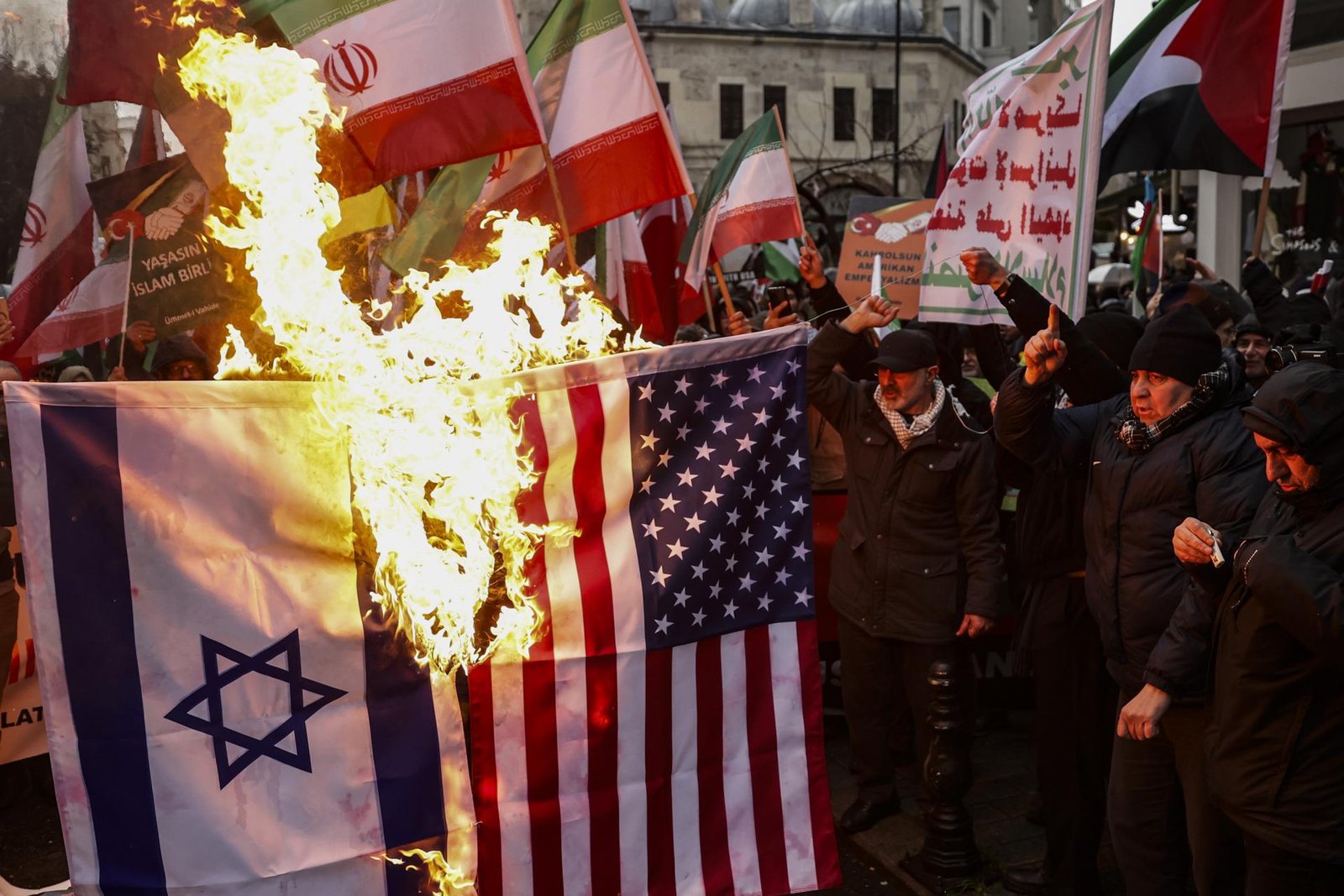
The long war sponsored by Iran against Israel and the recent attacks carried out by American forces last June have weakened the political and economic structures of the Persian country, drastically reducing its influence in the Middle East.
The escalation of tensions with Donald Trump’s government puts the ayatollahs’ regime back into focus, as experts try to assess the possible effects of a new conflict on Iranian soil, led by Washington.
For many, an American attack is seen as capable of decimating the Islamic regime. However, a quick victory is far from certain, even if the US strikes strategic Iranian hotbeds with military force. This is because the country’s current power structure is based on a complex coercive apparatus created in this way precisely to survive this type of crisis.
The annual survey of the Global Firepowera website that ranks the capacity of armies around the world, places Iran as the 16th country with the largest military force out of a total of 145 nations. Israel, for example, appears just one position ahead of Iranian forces, which highlights Tehran’s ability to respond to an American attack, even though the US maintains an indisputable advantage in this regard.
The regime has a well-known hierarchy, headed by supreme leader Ali Khamenei. But, in addition to this structure, there are councils and unelected positions that exercise immense power within the Iranian system, including influencing the choice of new leadership in different sectors of Islamic management. The American Secretary of State, Marco Rubio, admitted in a meeting with congressmen that there is no “simple answer” to deal with the situation in Iran.
The Iranian Revolutionary Guard is estimated to have hundreds of thousands of members. Furthermore, it has the support of regional militias, which have openly threatened to retaliate against any attack on their patron, for example, through bombings of American bases in the region.
Iran has more than 600,000 active military personnel and 350,000 in reserve to respond to potential Pentagon operations. In addition to the officers, there are also paramilitary groups that collaborate to maintain the order established by the regime – around 250,000 men, of which 190,000 are part of the Revolutionary Guard.
According to the portal War Power, Tehran also has approximately two thousand tanks, 550 aircraft and more than one hundred ships.
Last week, its Army expanded its military arsenal by supplying different military sectors with more than a thousand new drones. In total, it is estimated that there are 3,894 unmanned aerial devices available for use in conflicts.
Although a war between the US and Iran would have immeasurable consequences, the ayatollahs’ regime is experiencing its most critical moment since its rise in 1979 and its days may be numbered.
US and Iran signal de-escalation, but maintain military threats
The president of Iran, Masoud Pezeshkian, announced this Tuesday (3) that he gave instructions for his country to begin negotiations with the USA.
“I have instructed my Minister of Foreign Affairs that, as soon as there is a suitable environment – free from threats and irrational expectations -, he will seek fair and equitable negotiations, guided by the principles of dignity, prudence and self-interest”, he wrote on the social network X.
Trump in January ordered the deployment of a US Navy fleet to the Persian Gulf and warned that he would attack Iran if a deal was not reached that would prevent the Islamic Republic from developing a nuclear weapon.
Currently, American forces have positioned the aircraft carrier USS Abraham Lincoln and three guided-missile destroyers, accompanied by thousands of additional troops, near Iranian waters.
According to The New York Times, White House special envoy Steve Witkoff and Iranian Foreign Minister Abbas Araghchi will meet on Friday (6) in Istanbul (Turkey) to discuss a possible nuclear deal.
At the same time as signaling a de-escalation, the chief of staff of the Iranian Armed Forces, General Abdolrahim Mousavi, announced this Monday a change by Tehran to an offensive military doctrine.
“After the 12-day war and the continuation of harmful American-Zionist actions, we revised our defense doctrine, changing it to an offensive doctrine based on lightning and wide-range operations,” the military official said during an inspection of one of the Armed Forces units, as quoted by the Tasnim news agency, linked to Iran’s Revolutionary Guard.
