
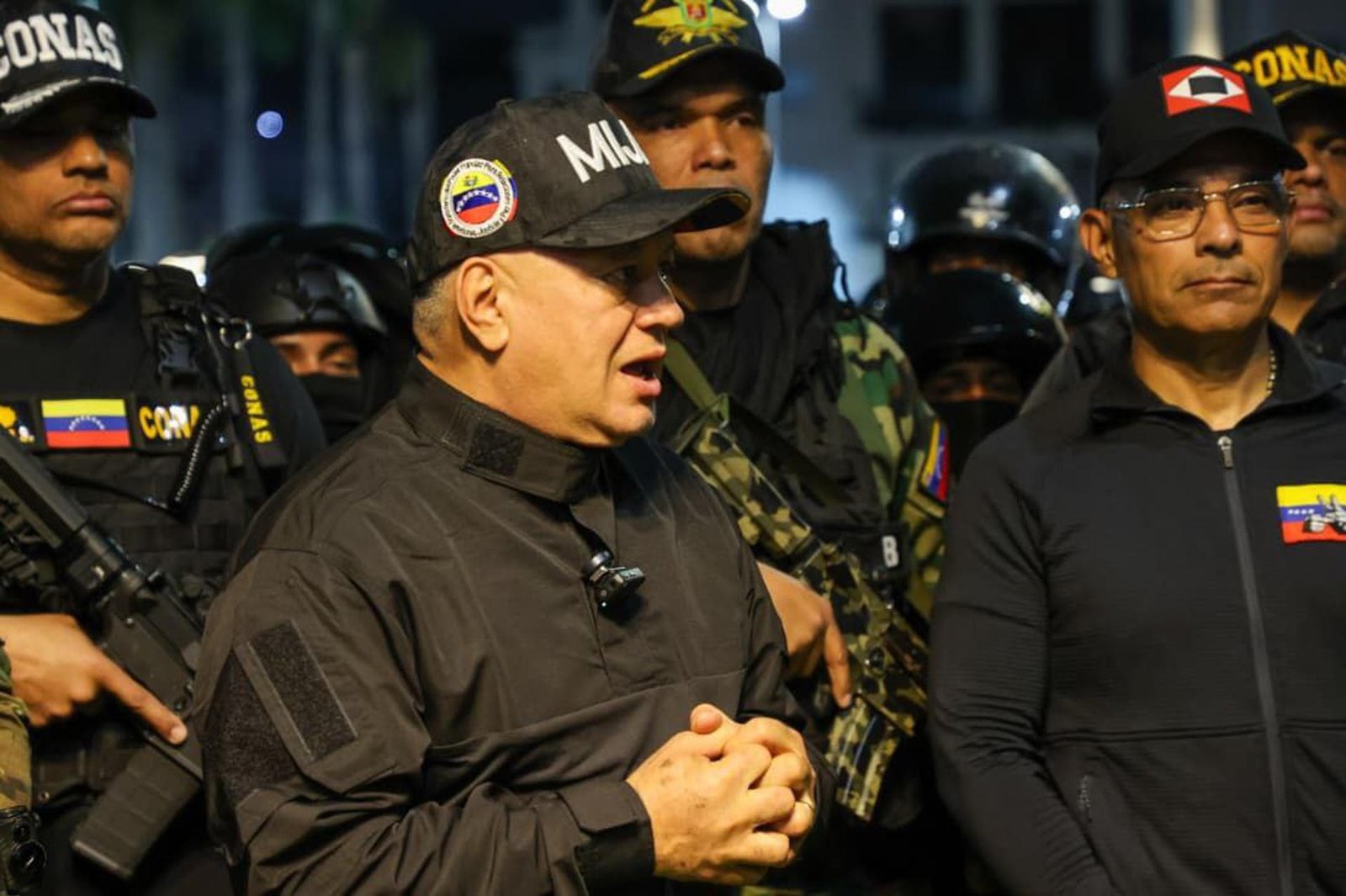
Last Tuesday (6), three days after the operation in which the United States captured the dictator of Venezuela, Nicolás Maduro, the Reuters agency published a report in which three unidentified official sources pointed out that the Donald Trump government gave a warning to Diosdado Cabello, Venezuelan Minister of the Interior, Justice and Peace, so that he does not hinder the transition process in the Caribbean country.
According to sources heard by the British agency, Washington warned that Chavismo’s number 2 “may appear at the top of its list of targets” if it does not help the interim dictator, Delcy Rodríguez, “to meet US demands and maintain order after the fall of Nicolás Maduro”.
However, even with the American warning, Cabello maintained her well-known defiant rhetoric in recent days.
Last Tuesday, he released a video, in which he appeared alongside a group of soldiers, saying that police controls had been reinforced and repeating the slogans “always loyal, never traitors” and “doubting is treason”.
Soon after, Cabello’s ministry released a statement in which it reported that the minister, on a visit to the Caricuao neighborhood, in Caracas, “reaffirmed the Bolivarian government’s commitment to the integral defense of the homeland and the protection of the people, in the face of imperialist attacks that seek to undermine the sovereignty and stability of all Venezuelans”.
On Wednesday (7), in her TV program, “Con El Mazo Dando”, broadcast by state broadcaster VTV, Cabello said that the American operation in which Maduro and his wife, Cilia Flores, were captured, left at least one hundred dead (a figure that has not been confirmed by independent sources).
“The attack against our country was terrible, that’s true, that’s a fact,” said the Chavista, who once again skewered the United States by calling those dead “martyrs” and dedicating the TV program to Maduro and Flores.
On Thursday night (8), a new provocation: Cabello stated, in an event at Plaza O’ Leary, in Caracas, that Venezuela is “at peace” because the Chavista regime maintains “the monopoly and full control of the Armed Forces” and called the operation in which Maduro was captured a “kidnapping”.
“We are recovering from the attack they carried out against our people, against the peace of the country, which ended with the kidnapping of our brother, the president of the Bolivarian Republic of Venezuela, Nicolás Maduro, and our companion Cilia Flores”, declared Cabello, according to the website Efecto Cocuyo.
“Owning weapons allowed us to maintain control, so that no group can claim responsibility for acts of violence other than those perpetrated by the United States in the early hours of January 3,” he said.
Cabello is so provocative that, even when he praises the rapprochement between Venezuela and the USA, he tries to criticize the Americans.
This Monday (12), at a press conference of the United Socialist Party of Venezuela (PSUV), of which he is secretary general, he said he approved the diplomatic rapprochement being negotiated between Caracas and Washington because this will allow Chavismo to “have consular representation” in the United States to “guarantee the safety and tranquility” of Maduro and Flores – suggesting that both are at risk in prison.
“That is the fundamental objective: to have someone there, because now we have no one. They are kidnapped there, and we have no one, except the lawyers, who are not Venezuelans, whom we thank, but we lack consular representation to supervise relations between the two countries and, in this specific case, to take care of the health of Maduro and Cilia”, he argued.
Who is Diosdado Cabello?
Cabello, 62 years old, is a retired military officer and an early ally of Chavismo. In 1992, when Hugo Chávez attempted a coup d’état, he was on the side of the future dictator. Both ended up arrested and Cabello was detained for two years.
When Chávez finally came to power in 1999, Cabello accompanied him. He held several positions in the Venezuelan government (director of the National Telecommunications Commission, minister of the Secretariat of the Presidency and vice-president) and even held the interim presidency for a few hours in April 2002, after the crisis in which Chávez was almost overthrown.
Afterwards, he was Minister of the Interior and Justice for the first time (2002-2003), of Infrastructure and Public Works and governor of the state of Miranda. As a deputy in the National Assembly (which he even presided over), he helped Chavismo sweep away the opposition, including after Maduro replaced Chávez after his death in 2013.
In August 2024, Cabello returned to the Interior and Justice portfolio, to coordinate the repression of protests against the previous month’s electoral fraud that kept Maduro in power.
Such loyalty was rewarded with many unseemly favors, and Cabello is accused of corruption, money laundering and drug trafficking.
In March 2020, the United States declared him wanted, accusing him of involvement in a narco-terrorist conspiracy between the Venezuelan Cartel de los Soles and the Revolutionary Armed Forces of Colombia (FARC).
He was indicted at the time in federal court in New York on charges of conspiracy to commit narcoterrorism, conspiracy to ship cocaine into the United States and related firearms charges.
The US State Department initially offered a reward of up to US$10 million for information leading to Cabello’s arrest and/or conviction. In early 2025, the reward was raised to $25 million. The number 2 of Chavismo was also the target of US sanctions.
