
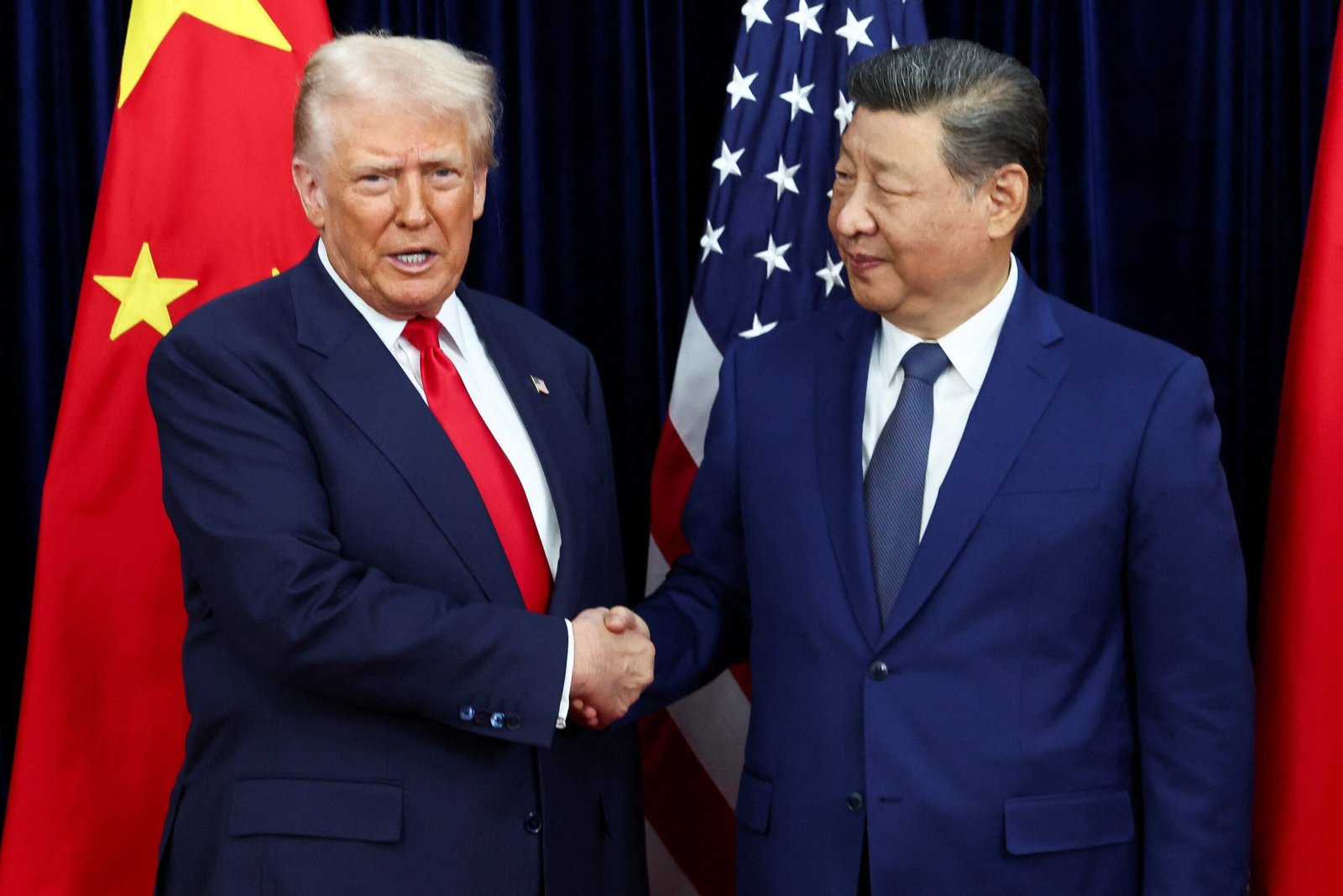
Donald Trump, President of the USA, in a meeting with Xi Jinping, President of China REUTERS/Evelyn Hockstein Report by the international NGO Human Rights Watch, released this Wednesday (4), indicates that 72% of the world’s population lives under authoritarian regimes and that the world is facing an “authoritarian advance” driven by the government of American President Donald Trump. 📱Download the g1 app to see news in real time and for free The analysis is part of the 2026 world report in which the NGO analyzes the human rights situation in more than one hundred countries. “Democracy is now back to 1985 levels, according to some studies, with 72% of the world’s population currently living under authoritarian regimes. Russia and China are less free today than they were 20 years ago. And so is the United States,” says the NGO. One of the documents cited by HRW is the study “25 Years of Autocratization – Does Democracy Triumph?”, carried out by the University of Gothenburg, in Sweden, in 2025, which analyzes the situation of countries since 1974. The document classifies almost 200 countries on five scales: closed autocracy (35 cases), electoral autocracy (51), gray zone autocracy (4), gray zone democracy (13), electoral democracy (46) and liberal democracy (29). The divisions are made as follows: Closed autocracy: there are no multiparty elections for the Executive Branch; lack of fundamental democratic components, such as freedom of expression, freedom of association and free and fair elections; Electoral autocracy: multiparty elections for the Executive take place; however, with insufficient levels of freedom of expression and association, and free and fair elections; Gray zone autocracy/gray zone democracy: countries where confidence intervals overlap and the classification becomes uncertain and less precise; Electoral democracy: There are multiparty elections for the Executive Branch that are free and fair; satisfactory levels of suffrage, freedom of expression and freedom of association; Liberal democracy: In addition to the requirements of electoral democracy, judicial and legislative restrictions limit the Executive, there is protection of civil liberties and equality before the law. Brazil is considered an “electoral democracy”, for example, while the United States, France and Spain are considered “liberal democracies”. Russia is identified as an “electoral autocracy” and China as a “closed autocracy”. See the regime of the countries below: World suffers ‘authoritarian advance’ The first year of Trump’s new term as head of the United States represented, according to the NGO, an “authoritarian advance” to the world. The document highlights that the American “encouraged authoritarian leaders and undermined democratic allies.” “While rebuking some Western European elected leaders, he and high-ranking officials expressed admiration for Europe’s nativist far right,” Human Rights Watch cites. In addition to Trump, the NGO highlights the “relentless pressure” from China and Russia against human rights around the world. Trump puts global human rights system ‘in danger’ HRW questions whether “human rights will survive the Trump era” and states that the United States president’s mandate stands out for a “flagrant disrespect” and “serious violations” of these rights. The report lists actions by the second Trump administration that “endanger” the global human rights system. The following are mentioned: attack on Venezuela and capture of Nicolas Maduro; deportation and sending immigrants to prisons in El Salvador, with attacks by federal immigration agents, ICE; attack judicial independence in the United States itself; undermine confidence in the electoral process; “erode privacy” and use government power to “intimidate political opponents” remove the US from the United Nations Human Rights Council; “destroy” food assistance programs and health subsidies; removing protections for trans and intersex people, among other actions. “Trump’s foreign policy has shaken the foundations of the law-governed international order that seeks to promote democracy and human rights, even if imperfectly,” the NGO states in the report. How should countries react? One possible response, according to the document, would be for the world to oppose the stance of Trump and the leaders of Russia and China to “preserve the international order governed by laws.” “To face this trend, governments that still value human rights, together with social movements, civil society and international institutions, need to form a strategic alliance to contain setbacks”, says HRW executive director, Philippe Bolopion. Brazil: confronting factions and concerns about security In the chapter on Brazil, HRW advocates a reformulation of the country’s public security policies in general, with emphasis on criminal factions and their entry, directly or indirectly, into the State. The NGO suggests that Brazilian authorities conduct “in-depth, intelligence-based investigations” to identify links between criminals and people who are part of public authorities. “Factions co-opt public agents to protect their illicit activities. This infiltration of public power sometimes also involves politicians, especially at the local level. This is a very dangerous face of organized crime, as it can corrupt institutions from within”, says the director of the NGO. The report also highlights that security will be an “important issue” in the election for President of Brazil, in October. The subject leads the topics of greatest concern to Brazilians, according to the most recent opinion polls. According to an Ipsos-Ipec survey this Monday (2), 41% of Brazilians consider crime and violence to be the main concerns in the country.
Source link
72% of the world’s population lives under authoritarian regimes, says Human Rights Watch
57

previous post