
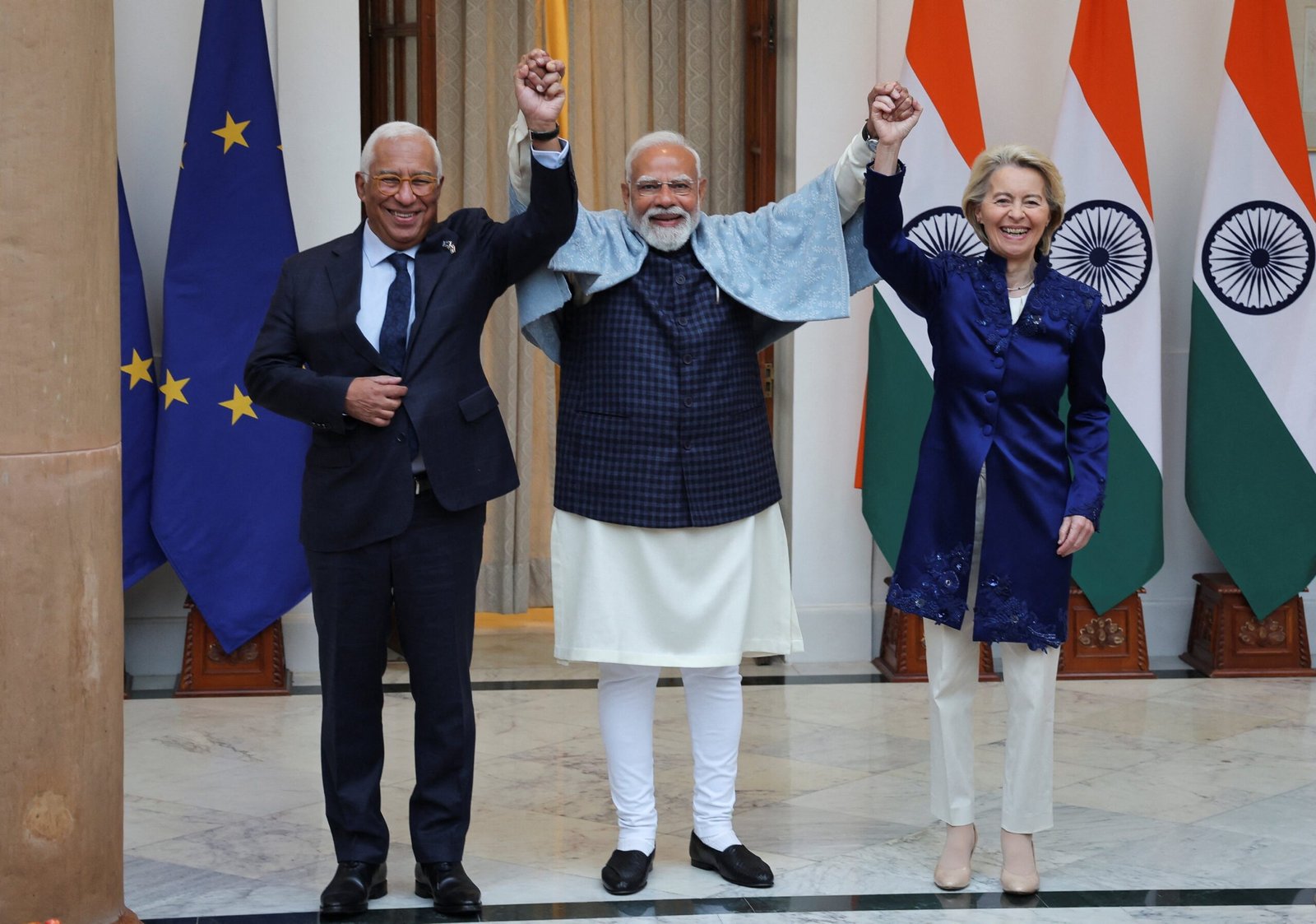
The President of the European Council, António Costa, the President of the European Commission, Ursula von der Leyen, and the Indian Prime Minister, Narendra Modi Reuters The European Union (EU) and India formalized this Tuesday (27) a major agreement that, after two decades of negotiations, will create a free trade zone for 2 billion people. In an uncertain geopolitical context, the pact aims to protect the parties from Chinese competition and the effects of the tariff war initiated by the United States. “The agreement will bring many opportunities”, celebrated Indian Prime Minister, Narendra Modi, before a meeting with the President of the European Council, António Costa, and the President of the European Commission, Ursula von der Leyen. “It represents almost 25% of world GDP and a third of international trade,” he added. “Europe and India made history today,” said Von der Leyen on the social network X. “We concluded the mother of all agreements. We created a free trade zone of 2 billion people that will benefit both parties,” he added. The last obstacles to completing the text were overcome on Monday, during final negotiations. India and the EU hope the pact will boost trade by reducing tariffs in many sectors. According to Brussels, the reduction in Indian tariffs on European imports should allow the EU to save up to 4 billion euros (4.75 billion dollars) per year. Germany praised the trade pact with India as a driver of “growth and jobs”. The announcement comes after the EU signed, on January 17, an agreement with the South American bloc Mercosur after more than 25 years of negotiations, which created another of the largest free trade zones in the world. The European Parliament, however, sent the document signed with Argentina, Brazil, Paraguay and Uruguay to the bloc’s courts to assess its legality, which suspended the ratification of the agreement for a year and a half. – Cars, wine, chocolate – With the EU-India agreement, the Asian giant’s tariffs on vehicles “made in Europe” will go from 110% to 10%, those on wine from 150% to 20% and those on pasta or chocolate, currently 50%, will be completely eliminated, according to European authorities. “The EU expects to benefit from the highest level of access ever granted to a trading partner to the traditionally protected Indian market,” said Von der Leyen upon landing in India on Sunday. She believes that the European bloc will double its exports. India hopes to strengthen exports of textiles, jewelry, precious stones and leather products, according to Modi. In 2024, the parties traded goods worth 120 billion euros ($142 billion, 751 billion reais, an increase of almost 90% in 10 years) and services worth 60 billion euros ($71 billion, 375 billion reais), according to EU statistics. Brussels is watching with appetite the immense market of the most populous country on the planet, with 1.5 billion inhabitants, and its strong growth, 8.2% at an annual pace in the last quarter. According to forecasts from the International Monetary Fund (IMF), India should surpass Japan as the world’s fourth largest economy this year, behind the United States, China and Germany. And the country will be able to reach the podium before 2030, according to the government. New Delhi considers Europe an indispensable source of technologies and investments needed for India to accelerate its modernization and create millions of jobs. The EU and India also intend to sign an agreement on the movement of temporary workers, the exchange of students, researchers and highly qualified professionals, as well as a security and defense pact. “India and Europe have made a clear decision. That of strategic partnership, dialogue and openness”, highlighted Von der Leyen in X. “We have shown a fractured world that there is another possible path”. In the defense area, New Delhi has diversified its purchases of military equipment, establishing a distance from its historical supplier, Russia, while Europe is trying to do the same in relation to the United States.
Source link
EU and India sign agreement for 2 billion people free trade zone
59
