
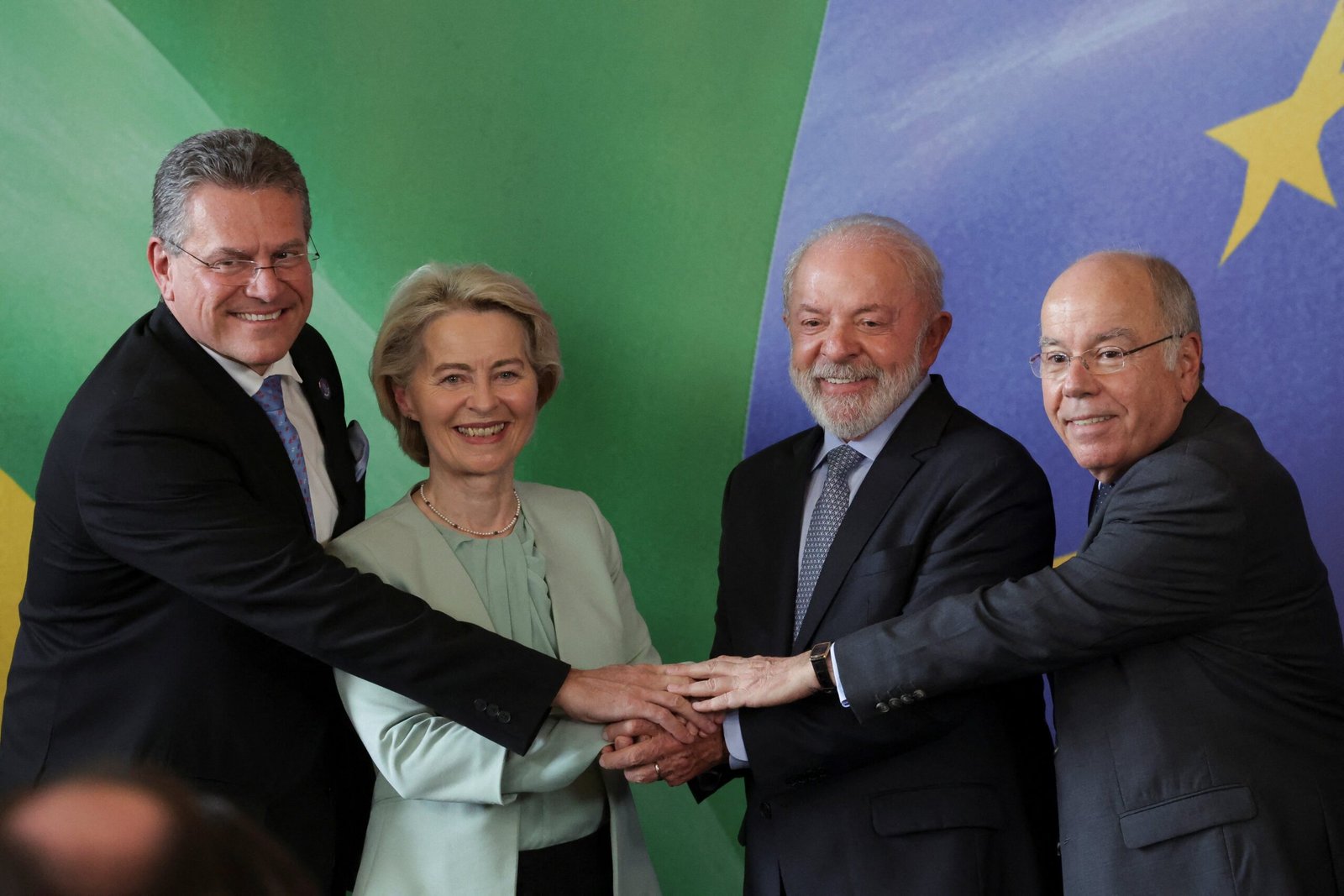
Faced with a changing international scenario, marked by rivalry between powers and the fragmentation of traditional alliances, Brazil can act as an agent of dialogue and stability in South America, experts say. The country’s geographic position, regional economic weight and diplomatic tradition allow it to exert influence on sensitive issues, such as: the crisis in Venezuela; the relationship with the United States; the strengthening of Mercosur. 🌎By maintaining open dialogue channels with different actors and defending negotiated solutions, Brazil seeks to reaffirm its role as a regional mediator in a time of uncertainty on the geopolitical board. g1 heard experts in International Relations to analyze how Brazil can act in this context: Carolina Pedroso, professor of the International Relations course at the Federal University of São Paulo (Unifesp); and researcher Larissa Wachholz, from the Brazilian Center for International Relations (Cebri). See the videos that are trending on g1 There is a consensus that respect for International Law has become even more relevant in a scenario in which great powers began to act in disregard of the mechanisms created after the Second World War. “Europe is also quite fragile with increasingly unilateral actions, both from Russia and the United States. Europe has lost a lot of protagonism”, says Carolina Pedroso. For Larissa Wachholz, Brazil’s space for action is not in direct competition with the great powers. “The country is not a pole of military or technological power comparable to the great powers, but it has relevant assets, such as territorial size, demographic weight, diversified economic base and diplomatic tradition”, assesses the researcher. In a fragmented scenario, Brazil can act as an articulator between different blocs, defending multilateralism, the reform of international institutions and negotiated solutions to conflicts, without automatic alignments. “It is very important that Brazil keeps its economic and social development priorities on the radar, and uses foreign policy as an instrument to face these challenges”, says Wachholz Crisis in Venezuela Chancellor says that Brazil could not have reacted differently to US action in Venezuela In the case of Venezuela, Brazil has sought to position itself as an interlocutor capable of encouraging political dialogue and reducing tensions in the region. For professor Carolina Pedroso, the Brazilian strategy must necessarily involve diplomacy. “In international politics, we don’t have friends, we have partners. And, in the case of Venezuela, this is evident: there are more than 2,200 kilometers of shared border and an intense flow of people entering the North of the country”, he states. She highlights that dialogue is essential both to protect Brazilian interests and to allow for possible mediation. “This existence of dialogue strengthens the Brazilian strategy, because it is essential for any negotiated solution to the current situation”, adds Pedroso. Larissa Wachholz highlighted that Brazil has a strong diplomatic tradition. “Brazil has a tradition of non-intervention, respect for sovereignty and the search for consensus, which supports the perception of reliability and ability to contribute to solving problems”, he states. According to her, this action requires coherence between discourse and practice, predictability in foreign policy and investment in regional dialogue mechanisms. Last week, the President of Germany, Frank-Walter Steinmeier, stated that Donald Trump, from the United States, is “destroying the world order” and asked that the world not become a “den of thieves”. When making the statement, he cited Brazil as an important player in “protecting the world order”. The crisis in the neighboring country directly impacts Brazil, whether due to the migratory flow or instability at the borders. However, there are practical limits to Brazilian action. “The country cannot act as a mediator if the parties are not open to doing so. There was no willingness on the part of Washington or Caracas for Brazil to have a greater role”, he assesses. Relationship with the United States President Lula condemned Donald Trump’s actions in Venezuela In its relationship with the United States, Brazil adopts a pragmatic stance. This strategy allows the country to dialogue both with Washington and with countries that face sanctions, taxation or disagreement with the North Americans, reinforcing the image of an independent actor and defender of multilateralism. According to Carolina Pedroso, this stance is fundamental to the defense of national sovereignty. “Brazil needs to clearly develop a strategy that includes elements of defense of sovereignty, so as not to be the target of any type of more violent influence on the part of any power”, he states. Larissa Wachholz adds that Brazil can exert relevant influence through so-called soft power, which is when a country has the capacity to influence other nations through persuasion, using culture, especially in strategic areas. “Issues such as agribusiness, clean energy, critical minerals and climate are central today, and Brazil is capable of exercising leadership in these fields”, he states, citing the country’s recent performance in forums such as G20, BRICS and COP30. Mercosur Lula says that the Mercosur-EU agreement is good for multilateralism and the democratic world Within the scope of Mercosur, Brazil sees the bloc as a central tool to expand its influence and promote economic and political stability in South America. Carolina Pedroso highlights that initiatives, such as the agreement between Mercosur and the European Union, gain even more importance in this context. “Seeking partnerships with countries with similar power to Brazil, such as other medium powers, is a way to ensure that our sovereignty is not directly violated”, he states. For Larissa Wachholz, the advancement of the agreement with the European Union reinforces the strategic relevance of the bloc. “The most important effects are not immediate, but in the medium and long term, with the increase in Brazil’s attractiveness as a destination for direct investments by global companies interested in the value chains of Europe and South America”, he assesses. She highlights that the European market imposes environmental and regulatory requirements, but that this can have positive effects. “The incorporation of these rules tends to improve the quality of Brazilian products”, he states. Challenges Lula talks on the phone with Xi Jinping about ‘defending multilateralism’ In a world marked by instability and constant rearrangements, Brazil’s main challenge is to transform its diplomatic capital into concrete results. For Carolina Pedroso, the commitment to dialogue is not only strategic, but necessary. “We are not interested in a problematic neighborhood. The more stable, developed and prosperous our neighbors are, the better for Brazil”, he said. Larissa Wachholz concludes that Brazil can be an important element in preserving South American stability, as long as it maintains an active foreign policy for the region. “This requires consistent engagement, promotion of economic integration and practical support for problem solving, without hegemonic intentions”, he states. Brazilian President Luiz Inácio Lula da Silva poses for a photo with European Commission President Ursula von der Leyen, Brazilian Foreign Minister Mauro Vieira and European Commissioner for Trade and Economic Security Maroš Šefčovič at the Itamaraty Palace in Rio de Janeiro, Brazil, on January 16. Ricardo Moraes/Reuters
Source link
Understand what role Brazil can play in current global geopolitics, according to experts
25
