
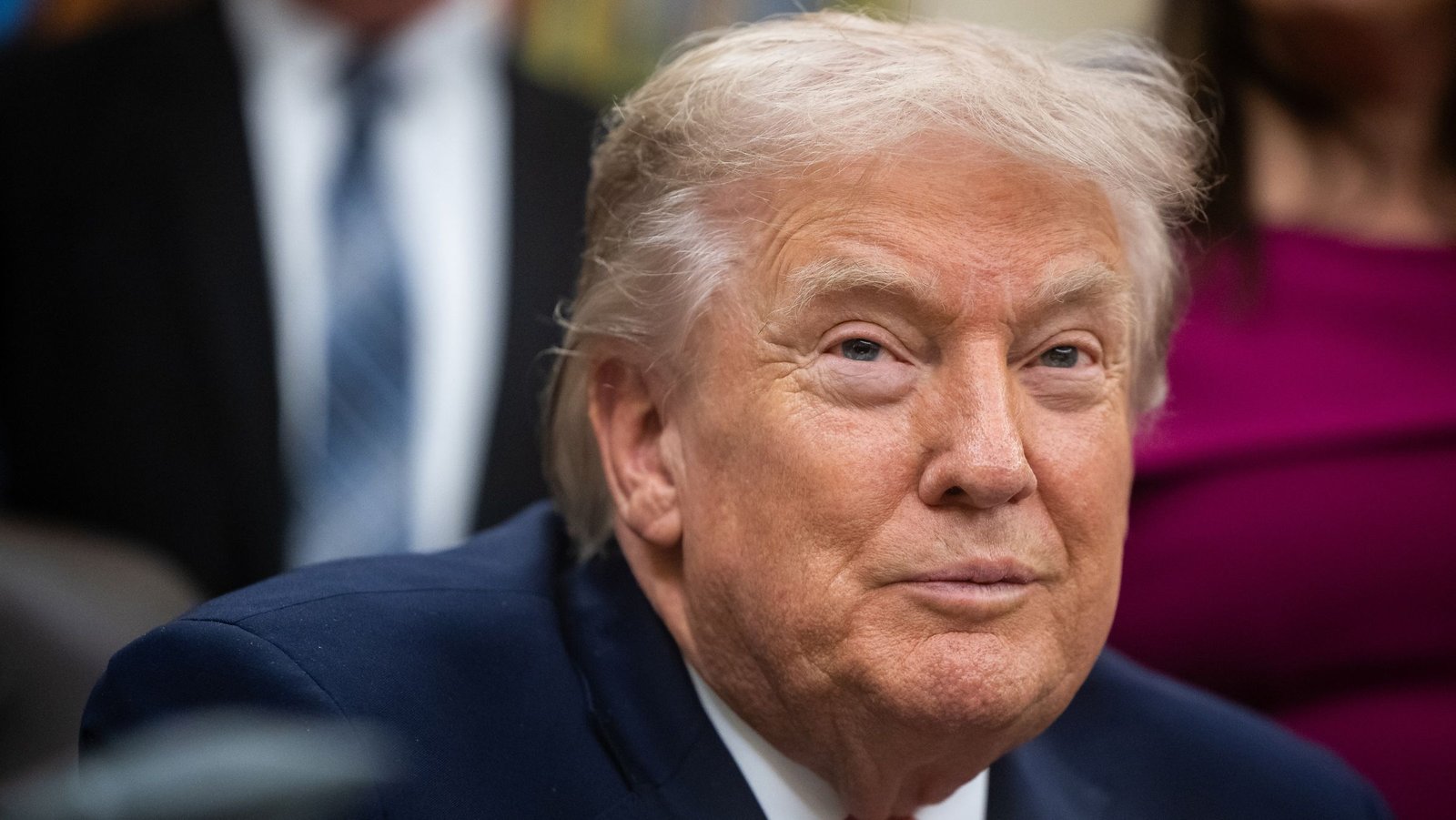
The guarantees given by President Donald Trump that the United States will provisionally control Venezuela and may adopt new military actions in the country reduce the risk of internal conflict and bloodshed in Venezuela after the fall of dictator Nicolás Maduro, according to analysts interviewed by People’s Gazette. The possibility that a fight between militias and factions of the Armed Forces for power would lead the country to a civil war had been used as the main argument by critics of Trump’s military action in the country.
The most serious scenarios were outlined by members of the Democratic party and American political analysts linked to left-wing wings. The fear was that rival groups in the Bolivarian Armed Forces and dissident militias from the FARC (Revolutionary Armed Forces of Colombia) and the ELN (National Liberation Army) operating in Venezuela would enter into an armed struggle for power after the removal of Maduro — who exercised strict control over all these factions.
Furthermore, there is a risk that forces loyal to Maduro will try to resist American control of the country. Public security researcher and head of the Law and Security Research Center (CEPEDES), Fabrício Rebelo, states that it is always very difficult to predict exactly what the consequences will be of the overthrow of a regime, no matter how illegitimate it may be.
He assesses that historical examples demonstrate that subsequent moments are prone to chaos, with social instability, waves of looting and justices anchored in a power vacuum. In the case of Venezuela, he assesses that everything will depend on the effective remaining power of the forces loyal to Maduro and how willing the population and the opposition are to confront them.
“In this equation, the balance will end up being the USA itself, which has already announced that it will provisionally take control of the country until the transition of power. If this is implemented, it is unlikely that we will see effective resistance from the Bolivarian forces, as the militias do not have enough power to face the American forces”, he stated.
On the other hand, there are no guarantees that the US will promote a complete democratic transition in Venezuela, with elections monitored by international auditors. In its National Security Plan released in December, the United States stated that it desired the installation of stable governments on the American continent, but not necessarily democracies.
President Donald Trump said this Saturday (3) that he will not leave the country leaving it in chaos, but that he will lead an adequate and safe transition.
“We’re going to run this through a group and make sure it’s done correctly,” Trump said. The US president also stated that he will ensure that “the people of Venezuela are supported; we will ensure that the people who were forced to leave Venezuela are also supported”, he added. Asked if he would send troops to Venezuela, Trump reaffirmed that there will be a team to lead the country after Maduro’s capture. “If we just let [a Venezuela]who will take over? There really is no one who can take over,” he said.
Possible candidates
Despite Trump’s declarations of confidence, experts began to assess the risks and limits of a transition led by the United States. Names of opposition politicians were evaluated as possible candidates to take power. However, the holding of free elections must still be on the horizon.
One of the possibilities is that Edmundo Gonzálezelected president of Venezuela, but whose mandate was usurped after fraud in the vote in favor of Maduro assuming the Presidency. However, this option does not appear to be viable — Trump did not even mention the name of González, who is in exile in Spain, during a press interview. On Maria Corina Machadowinner of the Nobel Peace Prize, Trump said he would not have domestic support.
Leonardo Paz Neves, researcher at FGV’s International Intelligence Center, understands that it would even be risky for the American government to hold elections at this time. He says he doesn’t know whether the population will readily support it or not, or whether there is a possibility that a transition will put someone else from Maduro’s party in power. “It seems to me that the American government will not want to risk that. I believe that they will make a transition, put in place a transition government that will hold an election in some time,” he says.
In the opinion of Gunther Rudzit, professor of International Relations at ESPM, it is very difficult to believe that there could be elections in Venezuela in a short space of time. “Even more free, effectively democratic elections,” he said. According to the professor, even so, even with Trump’s statements, the fate of Venezuela remains uncertain, especially due to the different internal groups, military and political, that made up Nicolás Maduro’s regime.
Main obstacle to Venezuelan transition has been removed
Rudzit still considers that Trump’s speeches could create divisions in the Chavista regime. “The announcement actually seems a little out of context, because it is very difficult to believe that members of the Venezuelan regime will accept to follow the lines proposed by the United States. Perhaps it is even another way of creating internal divisions and distrust so that the regime can fall on its own”, he assessed.
Even though the scenario remains marked by uncertainty, in Paz Neves’ view, the main obstacle for the US and its transition strategy to have support, Nicolás Maduro, has already been removed. The researcher assesses that it is still too early to see whether there will be internal pressure from Venezuela’s elite, including the Armed Forces, congressmen and other sectors of private capital.
“It is necessary to see how much they are in Trump’s boat, in the sense of accepting that it is time to change the government, time to change the direction in Venezuela. After all, Maduro, who in theory was one of the main obstacles, has already left the equation, it seems,” he said.
Venezuelan authorities would have no choice but to accept US terms
Trump used the success of the military attack that resulted in the arrest of Maduro and his wife to his advantage. During a press conference, the operation was extensively detailed and one statement was repeated emphatically: only the US could have operated that strategy as successfully as it did. Trump also stated that any Venezuelan authorities are subject to the same fate as Maduro. In other words, whoever opposes Washington could suffer the same fate as Maduro.
The American president also said that the Venezuelan vice president had spoken at length with Marco Rubio, having accepted all the terms proposed by the US. According to Trump, Delcy Rodríguez, who acted collaboratively during the call, would have no other option. Currently on a trip to Russia, the Venezuelan vice president released a message this Saturday morning that largely contrasts with these statements. She even called on the militias to take up arms.
Trump’s speeches demonstrate progression of US action
Before the press conference, this Saturday morning, in an interview with Fox Newsthe president said he was still deciding what would be done in Venezuela. In an early message to the Venezuelan authorities, he also stated that, in his last telephone conversation with Maduro, the dictator had shown himself open to negotiating, but that the US no longer agreed to go ahead.
In turn, Secretary Marco Rubio stated that the dictator had multiple opportunities to avoid capture and that he was offered “many generous offers”. “And instead [Nicolás Maduro] He chose to act like a savage and he chose to play,” he said.
In other words, with his statements and announcements, Trump clearly demonstrates that any authority linked to the Venezuelan regime has no other option than to collaborate with the US — unless they want to confront American power. The message also applies to paramilitary groups, military personnel and Venezuelan militias. The president, when talking about the attack, said that the US is ready for a second attack, massive and much larger than the first, if necessary.
He then added that he does not believe it will be necessary to attack the country again. The speech can be understood as the American president’s idea that a transition of power can occur without a large-scale invasion of the country.
Maduro would have signed a decree for militias to take up arms
It is true that, even at a disadvantage, some Venezuelan forces may try to oppose the US and its strategy. In her message this Saturday morning, the vice president of Venezuela, Delcy Rodríguez, stated that Maduro had been very clear about the risks of the country being attacked by the United States, due to American “energy voracity” — a reference to Trump’s intention to regain American control of companies that produced oil in the country after a wave of nationalization under Hugo Chávez’s dictatorship.
According to Delcy Rodríguez, Maduro left a signed decree, urging people to take to the streets. “Once the militias were activated, all plans were activated. He gave very clear orders to the Bolivarian National Armed Force so that, in a perfect military, popular and police fusion, all plans for the nation’s comprehensive defense were activated”, stated the vice-president, when mentioning the activation of the decree.
It is possible to have a less traumatic transition, analysts say
Despite the strong tone adopted by Trump, in Fabrício Rebelo’s view, the next few days will be crucial to understanding the developments of the episode, including regarding the existence of possible agreements between Washington and Chavista groups. The surgical execution of the operation as well as the lack of records of any movement in response to the US attack may indicate the existence of undisclosed information and negotiations.
Leonardo Paz, from FGV, also sees this possibility. The researcher believes that it would be very difficult for the operation to occur in this way, without there being people from the Maduro regime involved, whether military or not, to make the dictator vulnerable, being removed from the country with this ease or, at least, with this speed. Given this scenario, he states that it is possible to negotiate a peaceful transition of power in the country.
