
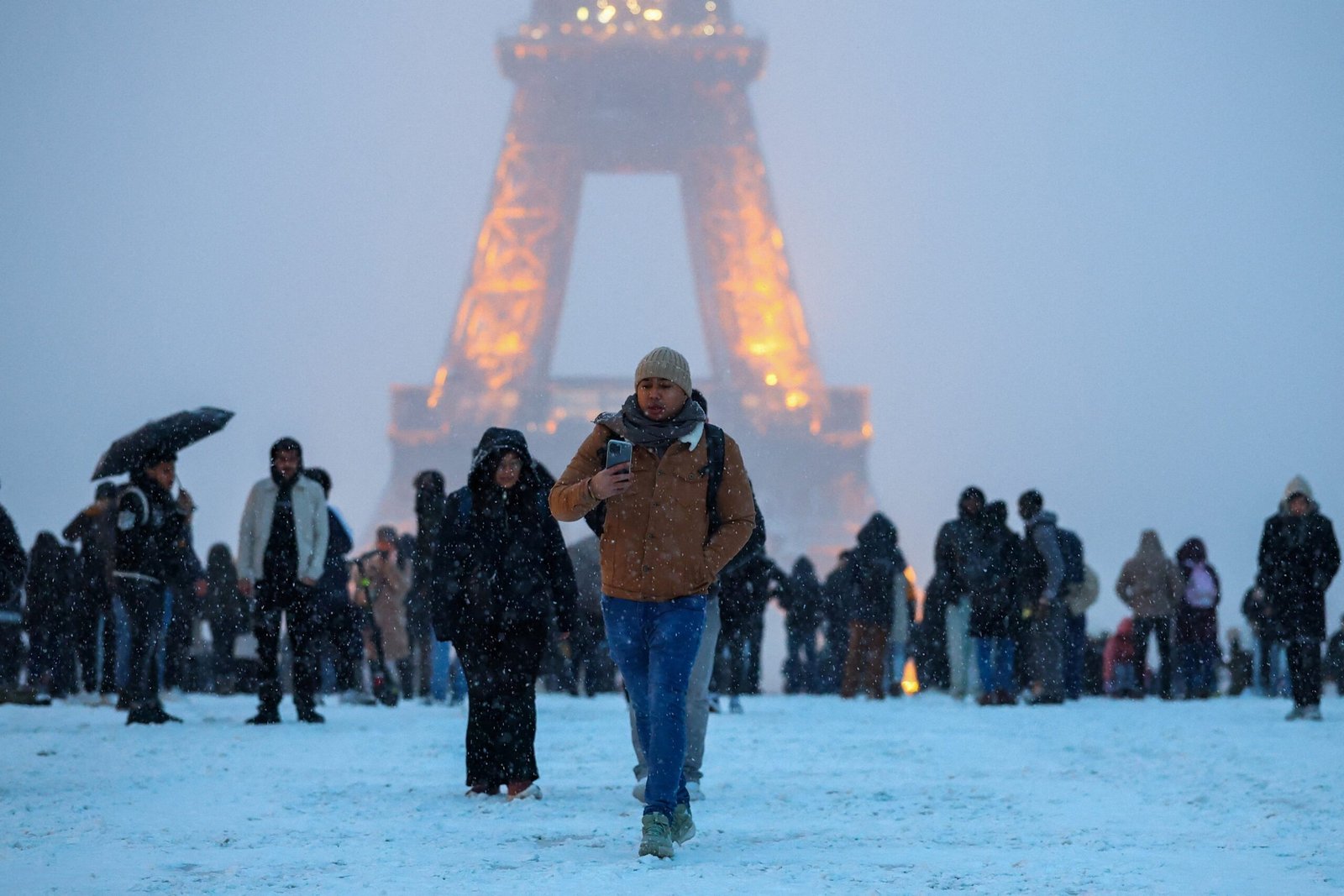
Maps show advance of record snow across Europe A sequence of images produced from meteorological satellite data shows the continued expansion of the area hit by intense snow in Europe, from the northwest towards the center and southeast of the continent. This advance is not the result of a simple cold wave, but the action of Storm Goretti, which went through a process of explosive cyclogenesis — known as a “weather bomb” — when the atmospheric pressure at its core fell by more than 30 millibars in just 24 hours, intensifying winds and reorganizing air circulation over the continent. According to the World Meteorological Organization (WMO), the episode is associated with a large-scale atmospheric system that maintains a mass of polar air dammed over the region — a pattern known as atmospheric blocking, typical of some European winters, but which in this case has unusual scope and persistence. GIF – Extreme cold paralyzes Europe and turns cities into snow scenes Gonzalo Fuentes/Reuters, Sarah Meyssonnier/Reuters, Temilade Adelaja/Reuters, Toby Melville/Reuters In practice, the storm worked as the dynamic trigger for continental snowfall: as it rapidly intensified, Goretti began to push warm and humid air against a mass of polar air already blocked over Europe, creating the conditions for the formation and persistence of snow on a large scale. This configuration favored the movement of extremely cold air to lower latitudes, producing extensive and long-lasting snowfall, different from the brief cold waves that usually dissipate in a few days. The spatial extent and duration of the phenomenon explain why impacts have been recorded simultaneously in countries such as France, the United Kingdom, the Netherlands, Spain, Ireland and regions of the Balkans. WMO experts point out that episodes like Storm Goretti are part of a context of greater climate variability in the Northern Hemisphere, with winters increasingly marked by alternation between abnormally warm periods and sudden incursions of polar air. People walk in the snow-covered Trocadero Square, near the Eiffel Tower REUTERS/Gonzalo Fuentes Warning of risk for the population The WMO has placed France, the Netherlands, Denmark and the United Kingdom under official warnings due to heavy snow, ice formation and strong winds, classifying the episode as posing a high risk to the population and transport systems. The phenomenon is not restricted to occasional snowfalls. The persistence of the cold core has caused significant accumulations of snow outside the traditionally affected areas. In the Balkans, for example, the city of Sarajevo recorded around 40 centimeters of snow, enough to knock down trees and increase the number of fatal accidents. View of snow-covered Velib’ Metropole public bicycles at a distribution point in Paris, as winter weather with snow and low temperatures grips parts of the country. REUTERS/Gonzalo Fuentes Environmental impacts beyond cities Although the most publicized images show tourist attractions covered in white, the environmental impact goes far beyond the urban setting. The weight of the snow has already caused trees to fall, as in the case recorded in Sarajevo, where a woman died after being hit by a log loaded with ice. In rural areas of the United Kingdom, fields covered in snow expose herds to extreme cold, increasing the risk of animal mortality and compromising pastures in the middle of winter. Taken together, the satellite data shows that Storm Goretti is not just another cold wave, but a large-scale climate event, with environmental effects distributed across almost the entire European continent.
Source link
Satellites reveal continental snowfall driven by atmospheric blocking in Europe
41
