
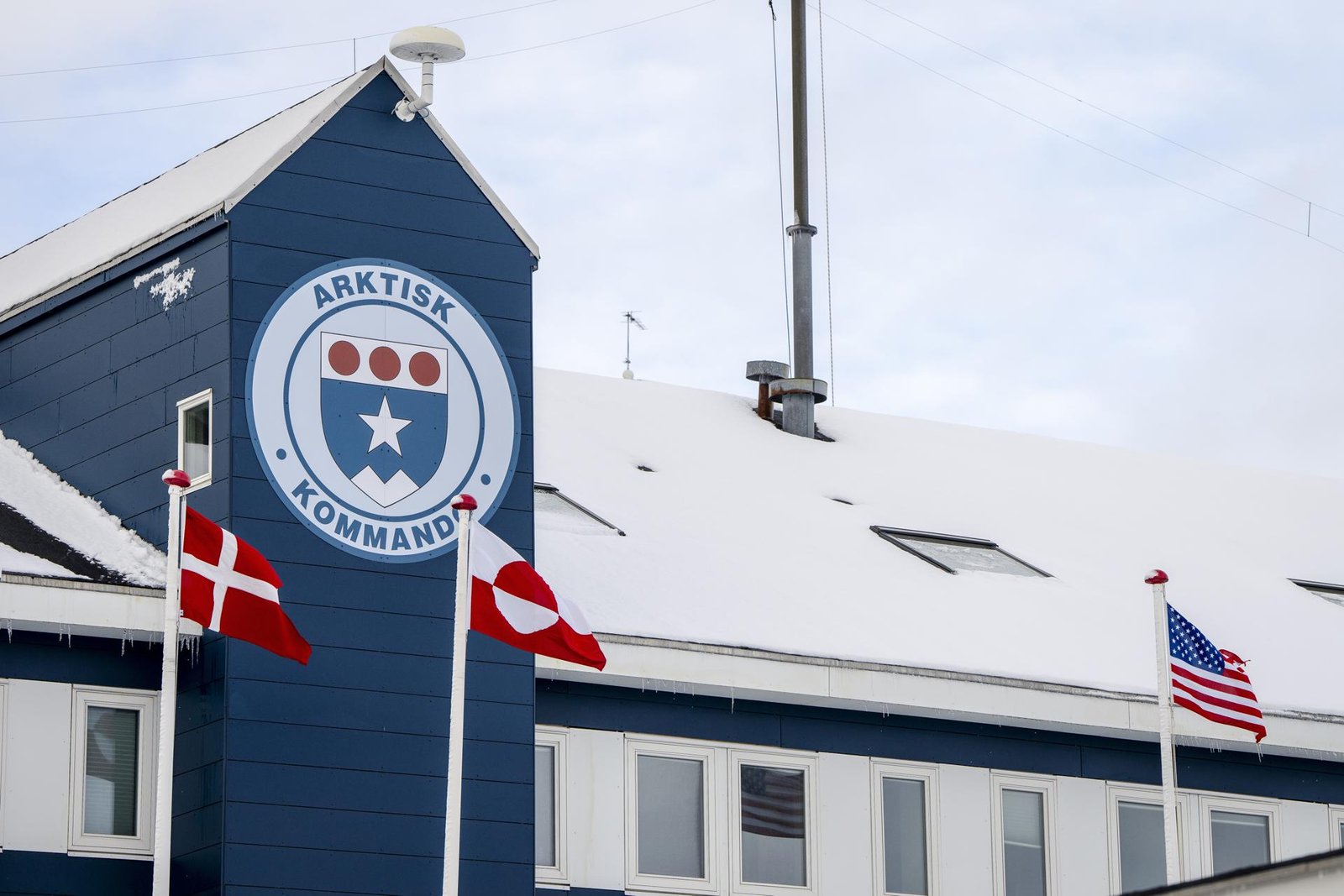
The US has expanded its territory throughout history through purchases and concessions that have shaped its current map. Now, Donald Trump’s government aspires to expand borders again with the annexation of Greenland.
Secretary of State Marco Rubio stated that the American president would be willing to buy the Arctic island, currently part of the Kingdom of Denmark, although the Republican leader did not rule out military intervention.
American interest in Greenland is not new. Since the mid-19th century, when then-Secretary of State William H. Seward floated the idea of purchasing Greenland and Iceland from Denmark, shortly after purchasing Alaska from the Russians in 1867, this had been Washington’s desire. In 1946, then-President Harry Truman offered Denmark $100 million for the island, an offer that was rejected.
With Trump’s coming to power in his first term (2017-2021), interest in the autonomous island was revived, but without progress. During his second term, which began in January last year, the Republican resumed his ambition, saying that the acquisition was a “necessity” linked to US National Security.
Igor Lucena, doctor in International Relations, assesses that Trump’s increased pressure for the annexation of Greenland is associated with a direct appeal from his political party, the Republican Party.
“If the justification is truly the issue of security, as Trump claims, Denmark would easily accept an agreement for the US to increase its military bases, its soldiers, and defense equipment in the territory. This is, in fact, very desirable for the Danes”, pointed out the political analyst.
But can the US buy land belonging to other countries? The rules governing international law answer technically yes. Despite the possibility, this practice fell into disuse in the last century.
How the purchase of territories between countries works
Luís Alexandre Carta Winter, professor of international law at the Pontifical Catholic University of Paraná (PUC-PR), explained in an interview with People’s Gazette how this acquisition of territories works.
“These are ways of acquiring property, similar to what happens in civil law. You can buy territory, you can lease territory. We have several territories that belong to other states, but which are leased by the USA, for example, or by England. So, this [compra e venda] It’s possible,” he said.
Even if the possibility exists, Denmark and Greenland have made it clear that the gigantic ice-covered island is not for sale.
Experts consulted by the BBC estimate that a transaction of this type would be extremely complex and unlikely, even with the approval of the Greenlandic and Danish governments.
Monica Hakimi, professor of international law at Columbia University, assesses that, even with the US and Greenland reaching an agreement on the terms of the transfer of the territory, “such a treaty would probably also have to involve Greenland’s participation in its self-determination process”.
According to an analysis by Joseph Blocher, professor of law at the American university of Duke, on the website How Stuff Works, the principle of self-determination establishes that, to be legitimate, any sale of populated territory must be based on the approval of the people who live in that territory. “So even if Denmark ‘owned’ Greenland, as the president said, the people of Greenland would still need to be consulted.”
In addition to international rules, the budget for an investment as large as the purchase of a territory would need to be approved by Congress. The acquisition of Greenland would also require the support of two-thirds of the Senate – which, according to experts consulted by the BBC, would be difficult to achieve.
This is because the estimate is that the USA would spend billions or even trillions of dollars on purchasing the Arctic island, an area still little explored rich in critical minerals and the target of disputes between powers such as Russia and China.
To move forward, the proposal would also need the approval of the European Union, another obstacle to be faced by Trump choosing this alternative.
Examples of US territorial acquisitions in recent centuries
Buy from Louisiana (1803)
The United States acquired the vast territory of Louisiana from France for $15 million in 1803. The agreement, pushed by President Thomas Jefferson and accepted by Napoleon Bonaparte, marked the beginning of a policy of growth that defined the modern American map.
The agreement allowed the country to double its size and consolidate its expansion to the west. It incorporated almost 1.3 million square kilometers, which represents 23.3% of its current surface.
Florida (1819)
Spain ceded eastern Florida to the United States through the Adams-Onís Treaty, signed in 1819 and ratified in 1821.
It did not consist of a direct purchase with payment in cash, but of a Spanish cession in exchange for US$5 million intended to settle claims by American citizens against the European country.
The Sabina and Arkansas rivers were chosen as the border between the Spanish and American possessions, a border line that was completed with the area determined by the 42nd parallel.
Texas and the Mexican cession (1845-1848)
Texas, which had gained independence from Mexico in 1836, joined the United States in 1845.
Three years after the Mexican-American War, the Treaty of Guadalupe Hidalgo established the so-called Mexican Cession: Mexico handed over large territories – today California, Nevada, Utah, Arizona and parts of Colorado and New Mexico – in exchange for US$15 million and the payment of debts worth US$3.2 million.
Alasca (1867)
The purchase of Alaska took place on October 18, 1867, when Russia sold this territory to the USA for US$7.2 million, equivalent to around US$4.73 per square kilometer.
The agreement was driven by Tsar Alexander II, who sought to prevent the British Empire from taking over the region after the Crimean War. The operation, considered the first case in which Russia ceded territory, was later seen as a strategic error, as Alaska turned out to be an area rich in natural resources and of great geopolitical value.
The Virgin Islands (1917)
In 1917, Denmark sold the Danish West Indies, now known as the American Virgin Islands, to the United States for $25 million in gold. The operation included the islands of Saint Thomas, Saint John and Saint Croix, as well as other smaller ones.
The transaction was part of American attempts to expand its influence in the Caribbean since 1867.
Other annexed territories
In 1898, after the war with Spain, the USA obtained Puerto Rico and Guam through the Treaty of Paris, and annexed Hawaii in the same year. Although not all of these incorporations were direct purchases, they were part of the country’s territorial expansion process.
