
The rapid North American action in Venezuela, which captured the dictator Nicolás Maduro in the early hours of this Saturday (3), will go down in history. But this was not the first time that the Americans did something like this. The United States is probably the most experienced nation in actions to capture dictatorial heads of state on foreign soil.
In Latin America, in 1989, the most direct parallel with the Venezuelan case occurred. In the Middle East, after months of war, Saddam Hussein was captured in Iraq.
During World War II, with the surrender of Japan in 1945 and the American occupation led by General Douglas MacArthur, Prime Minister Tojo was “imprisoned” in his home. And there was also a similar situation, in the Philippine-American War, in 1901.
Check out a summary of all these stories below and an “extra” on the hunt for a historic terrorist.
SEE ALSO:
USA x Maduro: the chronology of a military escalation
Operation Just Cause: capture of Manuel Noriega (Panama, 1989)
 Manuel Noriega “booked” by the North American authorities.
 It can be said that not even the Pope saved Manuel Noriega, dictator of Panama, during Operation Just Cause. Like dictator Nicolás Maduro, Noriega was accused of drug trafficking. At the time, the president of the United States was George Bush (“father”).
The Americans landed on December 20, with bombings against Panama City and the Panama Canal area.
Noriega sought refuge in the Vatican Embassy on December 24, 1989, but was forced to surrender: not by artillery, but by psychological warfare.
The American army set up a barrage of gigantic speakers playing rock music aimed directly at the window where Noriega slept, causing sleep deprivation and mental destabilization in the dictator. Black Sabbath, Alice Cooper, Kiss and other heavy metal groups rocked Noriega’s early mornings.
After almost 10 days, he surrendered. But until the surrender took place with Noriega cornered, in the first days of the invasion, the dictator was gone. He fled from property to property while the US bombed the headquarters (The Command) and offered US$1 million for his capture.
Noriega even asked for asylum, but was not granted. Inside the embassy, the situation was unsustainable. Under pressure, the Vatican said it could not guarantee his safety if the mob of angry Panamanians invaded the place. On January 3, he surrendered. Dressed in his military attire, he was searched, handcuffed, placed in a helicopter Blackhawk and taken to Florida.
Between the siege, the arrest and the eviction, more than 16 thousand Panamanian soldiers would have surrendered. But until the eviction, on January 31, 1990, around 2,500 people (the majority) died, according to the UN, and 20,000 were left homeless.
The goals of the United States have been to safeguard American lives, defend democracy in Panama, combat drug trafficking, and protect the integrity of the Panama Canal Treaty… General Noriega represents an imminent threat.
George H. W. Bush (1989)
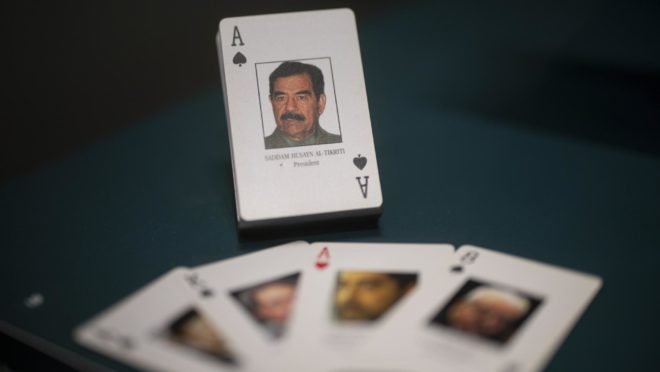
The hunt for Saddam Hussein after the invasion (Iraq, 2003)
 “Most Wanted Iraqis” deck (with Saddam Hussein highlighted) is displayed at the National Army Museum, in London
(Foto: EFE/EPPE/EPPE
About 14 years after Noriega, it was George W. Bush’s (“son”) turn to repeat his father’s feat.
The invasion of Iraq was led by the US and UK, beginning on March 20, 2003. The claim was that dictator Saddam Hussein’s regime might have weapons of mass destruction, which was never found.
The fact is that the regime fell and Saddam sought hiding. He fled with practically nowhere to go. The outcome was one of degradation: the man who ruled from golden palaces was found hiding in a small bunker underground, which became known as the “spider hole”.
Saddam was dirty and disoriented and the capture deconstructed the dictator’s image of invincibility before the world.
However, Saddam’s legal fate was different from Noriega’s. While the Panamanian general was taken to face judges in Florida, the US opted for a strategy of “Iraqi-anization” of justice for Hussein, albeit under strong US supervision and security.
End of story: Saddam was convicted of crimes against humanity and hanged in 2006. The choice of a local court served to legitimize the new political order imposed by the invasion. On the other hand, the country lived under the intensification of operations by Islamic terrorist groups.
The arrest of defeated dictator Hideki Tojo in World War II (Japan, 1945)
 O ditor Tojo
 Going back in time a little, the example of Japan’s surrender in World War II – after the dropping of the fateful atomic bombs on Hiroshima and Nagasaki – also brings with it a capture worthy of a film.
With the American occupation led by General Douglas MacArthur, the next US mission was to arrest Prime Minister Tojo in his home. It was expected that, as Japanese warriors did throughout military history, the defeated would attempt suicide.
It was no different with Tojo: to escape prison, on September 11, 1945, he attempted suicide, shooting himself in the chest. However, he was saved by US military doctors, including blood transfusions.
Ironically, Americans fought to save the life of the man who had ordered the attack on Pearl Harbor. Of course the objective was political, not humanitarian. It was judging Tojo alive. The outcome was conviction by the International Military Tribunal for the Far East for war crimes. He ended up hanging in 1948.
This trial took place in parallel to the Nuremberg trial in Europe and proved that the head of state’s immunity is not absolute. And it also showed that the survival of the defeated leader was necessary to legitimize the moral victory of the Allies.
Harsh justice will be meted out to all war criminals, including those who inflicted cruelty on our prisoners.
Harry S. Truman in the Potsdam Declaration (July 26, 1945)
The “Trojan horse” that captured Emilio Aguinaldo (Philippines, 1901)
 O Filipino Emilio Aguinaldo
 Another example of American capture occurred during the Philippine-American War. At the time, the US had “bought” the Philippines from Spain, but the Filipinos wanted independence.
Tanks did not exist. Much less helicopters. It was a special operation led by General Frederick Funston, in which soldiers disguised themselves as prisoners of war to infiltrate the camp of revolutionary leader Emilio Aguinaldo and capture him alive. Some today think that Aguinaldo would not become a “dictator”, but a “leader”.
He was hidden in the remote jungle of Palanan, very “Vietnam jungle” style, practically inaccessible to the American army.
In “Trojan horse” style, Funston sent an elite commando into enemy territory, pretending to be prisoners of war dragged by native soldiers loyal to Washington, the so-called Macabebe ScoutsFilipinos who fought under the American flag against their own countrymen. Somehow, the group managed to get close to Aguinaldo and stop the dictator.
Ironically, Aguinaldo swore allegiance to the US, left active revolutionary life and lived as a private citizen. He was accused of treason in favor of the Japanese during World War II, but was acquitted and died in 1964.
There was nothing to do but take them all [as ilhas]and educate the Filipinos, and elevate them, and civilize them, and Christianize them… and do the best we can for them, as our fellow men for whom Christ also died.
William McKinley (1899)
After all, is the capture of dictators legitimate?
According to lawyer and international relations specialist Manuel Furriela, the forced removal of a ruler from another country is not supported by international law, except in two cases: response to an armed attack or express authorization from the UN Security Council, neither of which, according to him, are present in the case of Venezuela in relation to the United States in the country.
Furriela explains that the US resorted to a third legal construction, framing Nicolás Maduro’s regime as linked to drug trafficking and international terrorism, going so far as to characterize Maduro himself as the leader of these organizations.
For Luiz Augusto Módolo, PhD in International Law from the University of São Paulo (USP), the principle of national sovereignty prevails even in extreme contexts, including when there are governments accused of genocidal practices or systematic violence against their own population. On the other hand, this structural limitation is reflected in the actions of the main multilateral bodies.
“In practice, neither the UN nor the International Court of Justice have real power to contain the strength of national states that decide to carry out a foreign intervention that they consider necessary”, he reinforces.
Módolo emphasizes that international law often operates more in the symbolic and normative field than as an effective instrument of coercion.
Post-doctorate in International Law Priscila Caneparo highlights that, although the Maduro regime is dictatorial – marked by political persecution, forced disappearances, serious deterioration of human rights conditions and vulnerability of the population – international law provides specific means to deal with this type of situation, which do not include the unilateral initiative adopted by Trump.
For the expert, although the attempt to classify Venezuela under the logic of United States anti-terrorism laws may even facilitate internal decisions, such as the exemption from authorization by the North American Senate, it does not confer international legitimacy on the action.
For Caneparo, central questions remain open, such as the political transition model in the country, the scope of military actions and whether the US Congress was fully aware of the operations, in an episode that marks the first time that the United States has carried out a direct attack against a South American country.
SEE ALSO:
- Milei provokes Lula in a video celebrating the US attack on Venezuela
In addition to dictators, the capture of bin Laden
 Osama Bin Laden (Photo: Disclosure/Abdel Bari Atwan – US Attorney’s Office)
Although questionable, would the capture of a terrorist be legitimate? The fact is that in May 2011, the USA, without permission, captured one of the most wanted men of all time: Osama Bin Laden, leader of Al Qaeda, and mastermind of the September 11, 2001 attacks on American territory.
The attacks on American soil, which resulted in the US invasion of Afghanistan in October 2001, are the origin of the terrorist’s final outcome. That moment marked the official beginning of the “war on terror”, a doctrine that reoriented American foreign policy and transformed Afghanistan into the first stage of a global manhunt.
However, what began as a conventional war of regime change against the Taliban soon metamorphosed into a decade-long obsessive quest. Bin Laden’s “head” was only captured in another country: with Operation Neptune Spear, in May 2011, in Pakistan.
Without any declaration of war on the Pakistanis, by locating Osama Bin Laden not in a remote cave but in a fortified mansion, the United States invaded the airspace of a theoretically allied country with helicopters. Washington’s justification that leaking information by Pakistani officials was a risk set a precedent that is echoed in the current crisis.
However, unlike the other captured dictators (even though the official order allowed surrender), the tactical execution resulted in the immediate death of the target.
The outcome of the operation against Bin Laden is also different, not to say bizarre. Unlike Saddam Hussein, whose hanging was filmed and leaked, or Mussolini, whose body was exposed in a public square, the US stated that it threw bin Laden into the Arabian Sea a few hours after his death.
The justification is that the “erasure” strategy sought to prevent a physical tomb from becoming a place of sanctuary for extremists.
It remains to be seen whether, with Maduro in custody, the strategy will be to expose him to media exhaustion or to isolate him so that his political capital disappears into oblivion in a federal prison.
SEE ALSO:

Venezuela closes border with Brazil after US action

