
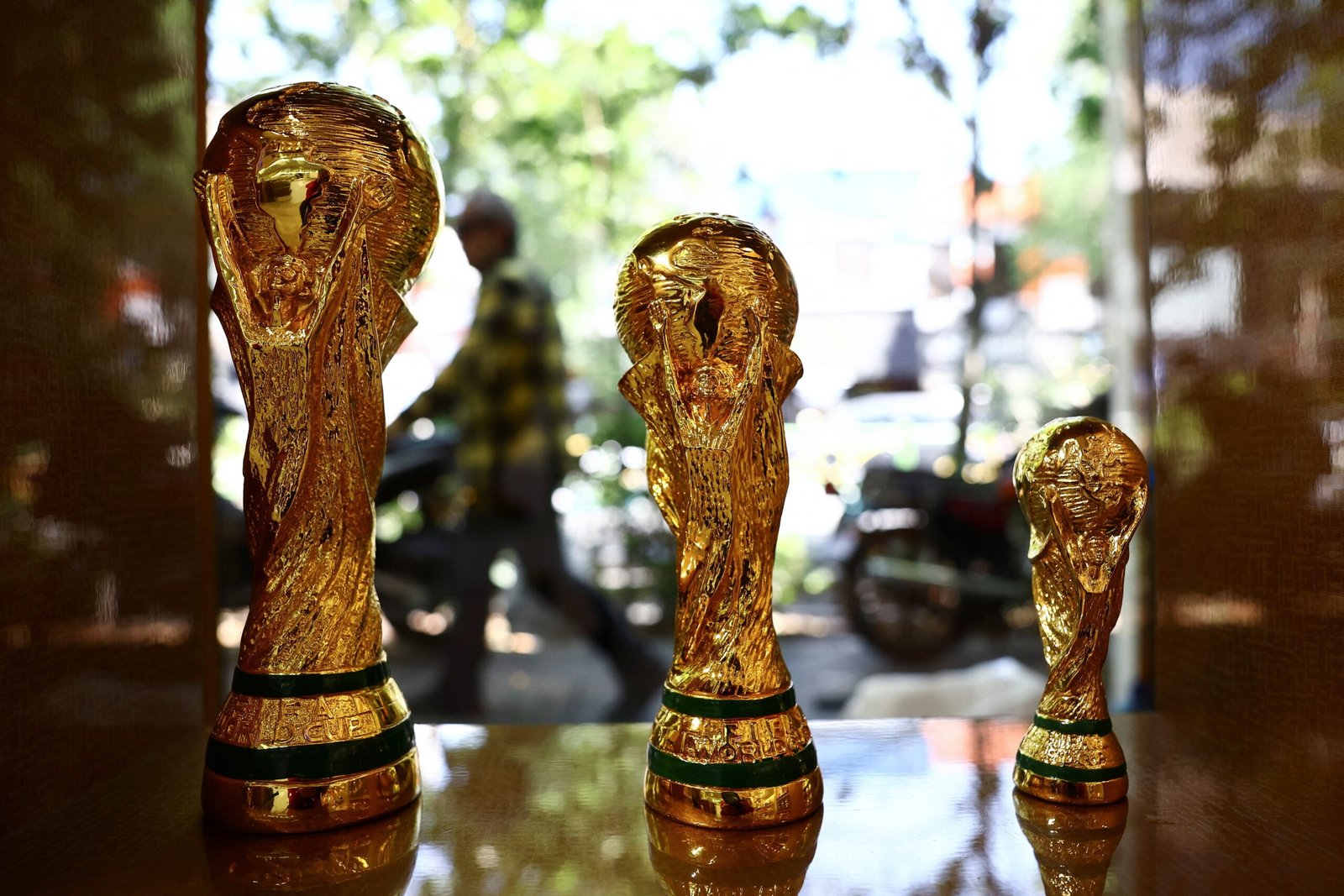
Replicas of the World Cup trophy are displayed in a store in Tehran, capital of Iran, on April 23, 2026 Majid Asgaripour/Wana/Reuters About 40 days before the start of the football World Cup, Iran’s participation in the tournament has once again exposed diplomatic tensions on the international stage. This week, FIFA President Gianni Infantino and United States President Donald Trump confirmed that the Iranian team will be present in the competition, despite the geopolitical controversies surrounding the country. During a FIFA congress held in Vancouver, Canada, Gianni Infantino was direct in confirming the presence of the Iranian team at the World Cup: “I want to confirm that Iran will participate in the World Cup”, declared the FIFA president. “And, of course,” he added, “Iran will play the United States.” Shortly afterwards, questioned by journalists in the Oval Office of the White House, US President Donald Trump responded in an ironic tone, directly quoting the FIFA leader: “If Gianni said that, then I agree”. ✅ Follow the g1 international news channel on WhatsApp To analyze the political context behind these announcements, the RFI report heard Raphaël Le Magoariec, doctor in Geopolitics from the University of Tours, in France, and specialist in the Middle East. According to him, Donald Trump was placed “faced with a fait accompli” and is uncomfortable with FIFA’s stance, which is trying to distance itself from geopolitical disputes, especially at a time of strong tension in the region. The president of FIFA, Gianni Infantino, speaks during the FIFA congress, in Canada, on April 30, 2026. Jennifer Gauthier/ Reuters “The American president was faced with a fait accompli and, above all, he is very uncomfortable with FIFA’s speech, which wants, as we saw last Thursday (30), to get out of geopolitics, especially this regional geopolitics in the Middle East, which is currently on fire.” FIFA’s interests above international conflicts Le Magoariec recalls that Gianni Infantino tried, during the FIFA assembly, to bring together the presidents of the Israeli and Palestinian federations, in an attempt at symbolic mediation. “We clearly see that the FIFA president, who awarded the first FIFA Peace Prize to Trump in December, is uncomfortable with the developments and with Donald Trump’s entire policy in the Middle East today.” Trending videos on g1 For the expert, the initiative was unsuccessful, but it reveals political ambitions of world football’s top leader. “It didn’t work, but we can see very well that he is trying; we can even wonder if he doesn’t have the desire to get the Nobel Peace Prize himself”, he suggests. Le Magoariec also highlights that, for Infantino, the institution’s financial interests have priority over international conflicts. “For him, what counts is profit and making FIFA ever richer. Therefore, all geopolitical rivalries must be silenced so that profit can prevail. This is his reality”, he says. Football and political power in Iran According to the expert, Gianni Infantino insists on taking on a political role on the international stage. In this context, Iranian football cannot be dissociated from political power, neither within Iran nor in other countries in the Middle East and the Persian Gulf. Raphaël Le Magoariec recalls that the team officially represents the Islamic Republic of Iran and that the sporting structure is directly linked to the regime, as “the Iranian federation is led by Mehdi Taj, a former member of the Revolutionary Guard”, details the expert. According to him, sport is used as a symbolic instrument of social control. “It is necessary to understand that football, fighting or volleyball are symbolic elements of social control for Iran.” This link between sport and politics is not exclusive to Iran, says Le Magoariec. “Even in other countries in the region, in the Persian Gulf countries, it is not dissociated from politics and is part of the symbolism of power, the staging of power and social control.” Le Magoariec also cites statements by the American Secretary of State, Marco Rubio, who expressed concern about the composition of the Iranian delegation that will travel to the United States. “That’s why Marco Rubio insisted that the problem was not the players, but the delegation. It is necessary to see who will be part of the delegation that will travel. That is what causes concern.” Where will Iran play? Despite the confirmation of Iran’s presence at the World Cup, doubts remain about the locations of the team’s games. Iran is in Group G, alongside Belgium, Egypt and New Zealand, with matches scheduled for Los Angeles and Seattle. For Raphaël Le Magoariec, an alternative would be to transfer the games to another World Cup host country, such as Mexico or Canada. “That’s really the solution: that they be moved to another country. Knowing that Iran should play especially in Los Angeles, where the largest Iranian community in the United States lives.” The expert emphasizes, however, that the Iranian team does not have unanimous support from the diaspora. According to him, “a part of the diaspora is against this selection”. Precedents and risks of contestation Le Magoariec recalls that the 2022 World Cup in Qatar took place after the death of young Mahsa Amini, detained by the Iranian morality police for allegedly not wearing the hijab properly. At the time, many Iranian fans booed their own team, seen as representing the regime. For the expert, FIFA does not show the same concern in this new World Cup. “FIFA tried to organize the games in places where there were many fans, but there is this issue of contestation, as a large part of the diaspora sees the team today as the Revolutionary Guard team.” Recent cases, such as the Iranian delegation’s withdrawal from participating in the FIFA congress in Canada, citing migration problems, reinforce how the upcoming World Cup remains deeply marked by geopolitics.
Source link
2026 World Cup: Iran’s participation reignites tensions in sport and global diplomacy
8
