
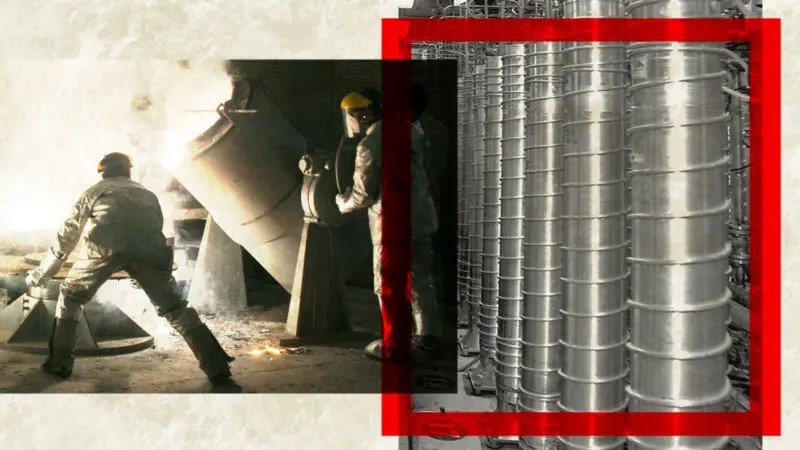
Would Iran still be able to make an atomic bomb with its stockpile of enriched uranium? Getty Images/BBC Iran’s stockpile of enriched uranium has once again drawn attention after US President Donald Trump announced that Tehran had agreed to hand it over as part of a deal to end the war. But, on Monday (20/4), Iran’s Deputy Foreign Minister, Saeed Khatibzadeh, denied the claim. He told the AP news agency that this idea is “unfeasible”. As the two sides negotiate a path to new peace talks, the future of the material will certainly be an important part of the discussions. But what is enriched uranium? And why is it so important? What is enriched uranium? Uranium is a natural element, found in the Earth’s crust. It is mainly composed of two isotopes: U-238 and U-235. More than 99% of natural uranium is U-238, which does not easily sustain a nuclear chain reaction. Only about 0.7% is U-235, an isotope that can split easily, releasing energy in a process known as nuclear fission. To transform uranium into a useful material, it is necessary to increase the proportion of U-235, through a process called enrichment. Initially, uranium is transformed into gas. This gas is introduced into centrifuges, which are machines that spin at extremely high speeds. As they rotate, the heavier U-238 moves slightly upward. The U-235, lighter, is closer to the center of the machine. This allows U-235 (the useful and rarest form of uranium) to be gradually separated from U-238. And this more concentrated uranium is removed through one end of the centrifuge. How the centrifuge separates uranium atoms BBC What is the difference between uranium used in nuclear reactors and weapons? Different enrichment levels make uranium suitable for different uses. Low-enriched uranium, typically 3 to 5% U-235, is used as fuel in commercial nuclear power plants. This level is sufficient to sustain a controlled chain reaction, but much lower than the level needed for the atomic bomb. Highly enriched uranium, with levels of 20% or more, can be used in research reactors, and military-grade uranium, for weapons production, is typically enriched to around 90%. This concentration creates ideal conditions for a nuclear reaction to go out of control almost instantly. And when there is enough of this material, atoms begin to divide extremely quickly, releasing immense amounts of energy in a fraction of a second. This point is what differentiates the civil and military uses of uranium. In a reactor, the fuel is only slightly enriched and the reaction is deliberately slowed and carefully managed. With this, the energy can be released gradually over several months or years. In a bomb, the objective is the opposite: to allow the reaction to accelerate as much as possible. An agreement signed in 2015 with six world powers — Germany, China, the United States, France, the United Kingdom and Russia — limited Iran to enriching uranium to a maximum of 3.67%. The deal also capped Iran’s stockpile at 300 kg, limited the number of centrifuges in operation and banned enrichment at its underground Fordo plant. But in May 2018, during Donald Trump’s first term, the United States abandoned the agreement. Uranium enrichment process BBC Why is the level of enrichment important? The higher the enrichment level, the closer the uranium is to being able to be used in a nuclear weapon. Reaching 20% enrichment is an important milestone. At this point, most of the technical effort required to produce military-grade material has been accomplished. Transforming natural uranium into a 20% enriched material requires thousands of repeated separation steps and a lot of time and energy. Enriching uranium from 20% to around 90% requires far fewer additional steps. This means that uranium enriched to higher levels can be refined to military grade relatively quickly. How much uranium does Iran have? A central point of the current negotiations is what will happen to Iran’s current stockpile of enriched uranium. At the start of the war, Iran held about 440 kg of uranium enriched to 60%, according to US officials. This material can be enriched relatively quickly to the 90% level required for military-grade uranium. Iran also has about a ton of uranium enriched to 20% and 8,500 kilograms to about 3.6%, normally used for civilian purposes such as energy production or for medical research. Most of the highly enriched uranium that could be turned into nuclear weapons material is believed to be stored in Isfahan. This plant is one of three underground nuclear facilities in Iran that were targeted by US and Israeli airstrikes last year. As the two sides negotiate a path to new peace talks, the future of the material will certainly be an important part of the discussions. Google Maps/BBC But it is not known for sure how much highly enriched uranium is stored elsewhere. Sources say Iran has rejected demands for a 20-year moratorium on nuclear enrichment. In response, the country proposed a five-year interruption, as had been proposed before the outbreak of hostilities. Tehran also rejected demands to hand over its stockpile of 400 kg of highly enriched uranium, maintaining its previous concession to dilute the enriched uranium to 60%. The head of the International Atomic Energy Agency (IAEA), Rafael Grossi, told the AP in October last year that this amount, if enriched, would be enough to produce 10 nuclear bombs. Is Iran building a nuclear weapon? Iran maintains that its nuclear facilities are entirely intended for peaceful purposes and the IAEA says it has found no evidence of an active nuclear weapons development program. The production of military-grade uranium is just one step in building the atomic bomb. An operational bomb also requires other complex steps, such as designing and assembling a warhead and developing a delivery system. “Iran did develop some warhead design capabilities until 2003, when it apparently suspended the program,” according to independent arms control expert Patricia Lewis. But she highlights that, “after the collapse of the 2015 nuclear agreement and the lack of negotiations for a new agreement, it is possible that Iran has decided to start developing warhead production again.” An assessment by the United States Defense Intelligence Agency stated in May 2025 that Iran could produce enough military-grade uranium for a single device “probably in less than a week.” But it also declared that Iran was “almost certainly not producing nuclear weapons,” although it had taken steps that would put the country in a position to begin production if it chose to do so. Israel said it had intelligence indicating that Iran had made “concrete progress” in developing components for the production of nuclear weapons. Collaborated by Nadia Suleman and edited by Mark Shea. READ ALSO: VIDEO: Iran displays ballistic missiles at military parade in central Tehran Trump says Iran canceled execution of eight women after his request US accuses China of pressuring African countries to block Taiwan president’s trip
Source link
Would Iran still be able to make an atomic bomb with its stockpile of enriched uranium?
10
