
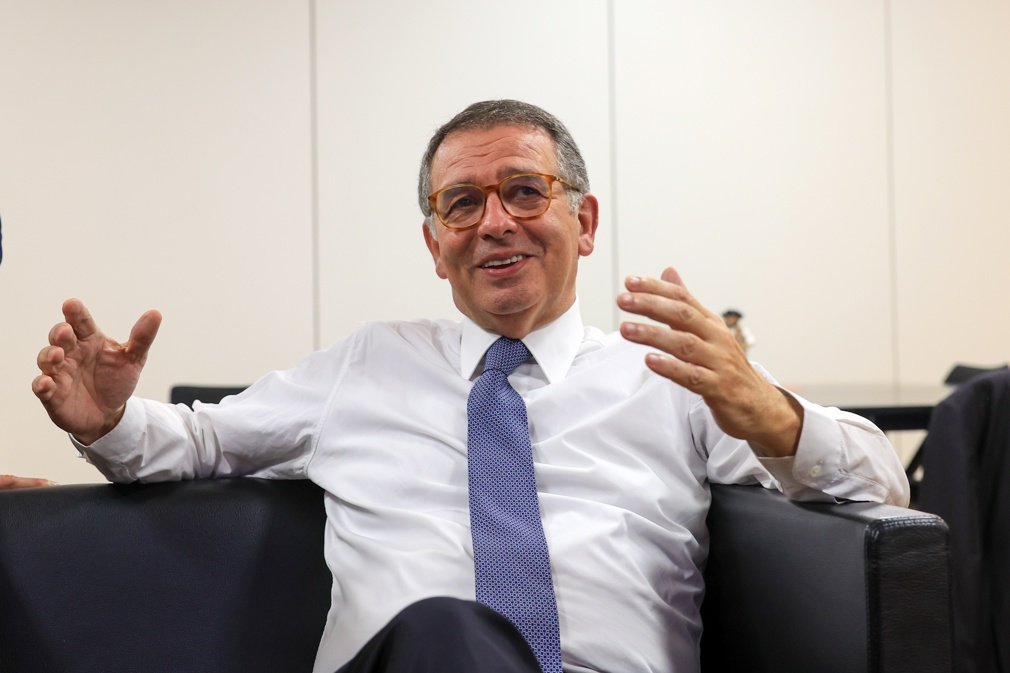
António José Seguro, from the Socialist Party, was elected president of Portugal this Sunday (8), defeating André Ventura, leader of the right-wing Chega party, by 66.7% of the valid votes against 33.3%. The inauguration is scheduled for March 9th.
In the first round, Seguro had already led the dispute with 31.11%, while Ventura came in second with 23.52%. Now, in the second round, the socialist received almost 3.5 million votes, becoming the most voted candidate in the country’s history in absolute numbers — surpassing Mário Soares, who received 3.4 million in 1991.
Voter participation, however, once again raised concerns: 49.89% of voters did not vote, as voting is not mandatory in Portugal.
Furthermore, voting was postponed in 17 parishes — small administrative units equivalent to neighborhoods or districts — due to heavy rains. Despite this, the National Elections Commission stated that the change should not alter the result, as the postponement involves around 37 thousand voters, some of whom had already voted in advance.
Lula and PT congratulate Seguro on his victory
President Lula publicly celebrated António José Seguro’s victory in the Portuguese elections. In a post on social media, Lula highlighted Portugal’s consolidation in the agreement between Mercosur and the European Union. “An election that took place peacefully and represents the victory of democracy at such an important moment for Europe and the world. And it consolidates Portugal’s position in support of the Mercosur–European Union agreement”, he stated.
The Workers’ Party (PT) released a note congratulating the new Portuguese president. According to the statement, “by electing António José Seguro, the Portuguese people unequivocally chose to defend democratic principles and social justice, rejecting the extreme right’s policy of division, hatred and intolerance”.
Seguro presented himself as a moderate candidate to preside over Portugal
Despite his long career in the Socialist Party, Seguro presented himself during the campaign as a moderate candidate, speaking of a “safe option” and pledging to dialogue with the center-right government currently in power.
His candidacy attracted broad and transversal support, including figures such as former president Aníbal Cavaco Silva, as well as ministers from the center-right government and the majority of candidates defeated in the first round. in addition to ministers from the governing coalition and most of the candidates eliminated in the first round. The movement reflected the attempt to contain the advance of the right, represented by André Ventura.
Seguro had left political life in 2014, after losing the leadership of the Socialist Party to António Costa. Outside of politics, he built business activities in the tourism, agriculture and food sectors. Now, he returns to public life with one of the most significant victories in Portuguese electoral history.
