
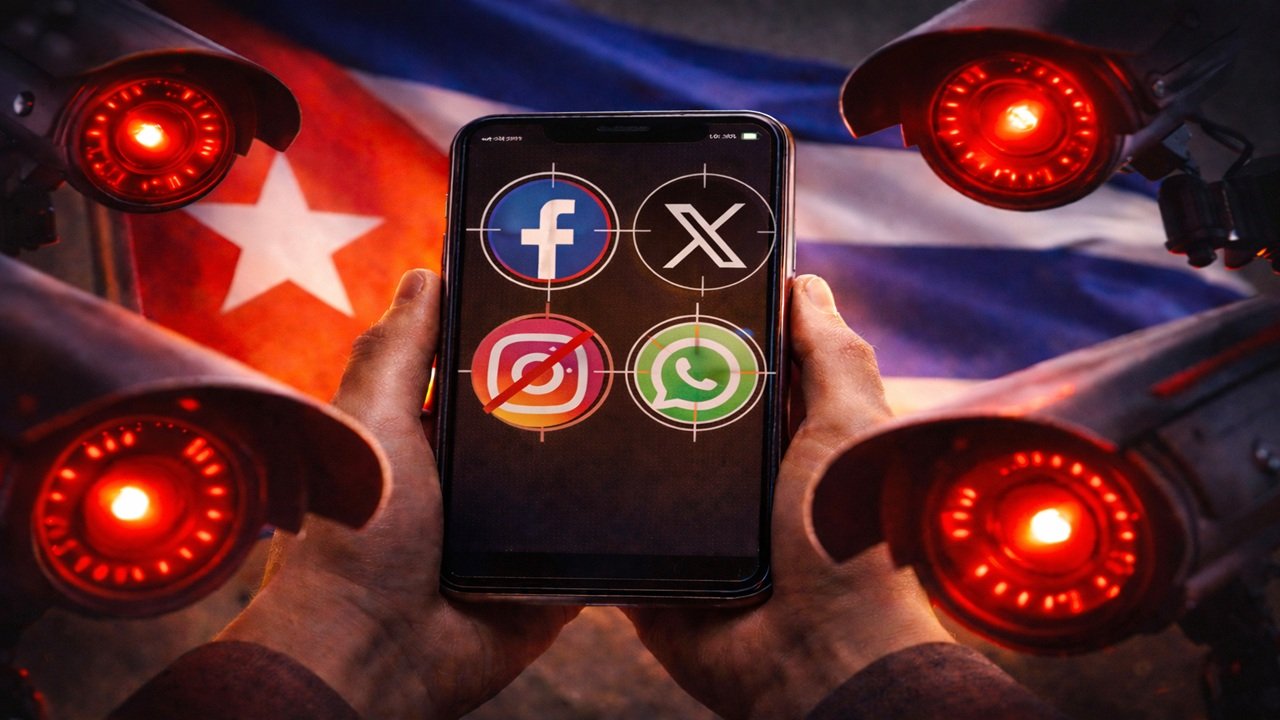
In Cuba, the communist regime has developed over the last few years a digital surveillance system that follows ordinary citizens from the online environment to the streets. All content published on the country’s internet – from posts on social networks to private messages – can be monitored, recorded and used as a basis for warnings, punishments, criminal proceedings or in-person intimidation actions.
A report published by the organization Prisoners Defenders on the 20th details the functioning of this apparatus and shows how digital repression has consolidated itself as a structural policy of the Cuban State, supported by the combination of technology, punitive legislation and the absence of independent judicial power.
The study is based on 200 interviews with Cuban citizens – residing on the island and abroad – carried out between November 2025 and January this year. The analysis indicates that 98.5% of those interviewed stated that they had already suffered, from the communist regime, some type of sanction, threat, police summons or indirect reprisal related to publications on social networks, exchanges of private messages or the use of other digital means of communication.
According to the report, the Cuban dictatorship currently maintains a permanent cyber patrolling system in operation, based on the systematic monitoring of social networks such as Facebook, WhatsApp, Telegram and other everyday platforms. In 76.5% of the cases analyzed, interviewees reported that communist regime authorities repeatedly cited digital content – public and private – during interrogations, using messages, screenshots and even personal audios as grounds for warnings, threats or punishments.
The report also points out that 84.5% of those interviewed stated that they had been the target of surveillance by the authorities after criticizing the communist regime in digital media. Witnesses reported that they began to notice the presence of regime forces in front of their homes, with recurring patrols, warning visits and, in the most serious cases, the installation of cameras directed at homes.
According to the document, 77.5% of those interviewed said they had suffered selective internet cuts, often targeting only specific lines, while other users in the same region remained connected. Blockings of social networks, independent media pages and even VPN services have also been reported, especially during protests, commemorative dates or after critical publications against the Castro dictatorship.
Additionally, almost half of respondents reported having identified suspicious sessions on their accounts, unauthorized password changes, or messages being sent in their name. Another 65.5% said they had been forced by authorities to unlock cell phones, provide passwords or allow the copying of personal content, without any court order.
More than half of those interviewed by Prisoners Defenders said they had reduced or abandoned political posts, deleted old content, left message groups or closed digital accounts for fear of reprisals.
Laws that enable repression
Cuban legislation itself is used as an instrument of digital repression. One of the main examples is Decree-Law 370, enacted in 2018, which allows the application of fines and administrative sanctions for publications considered “contrary to the social interest” or for “improper use of telecommunications”. Articles of the Penal Code released in 2022 are also used by communist authorities to investigate or prosecute citizens for content published on the internet.
Prisoners Defenders states that the data revealed by the report demonstrates that digital repression in Cuba is part of a deliberate state policy.
“Digital surveillance in Cuba does not constitute an isolated or circumstantial practice, but a structural policy of state control that evolved from the monitoring, for decades, of telephone and postal communications, in parallel with the expansion of access to the internet and information technologies”, says the organization in an analysis made in the report.
The document highlights that greater connectivity on the island was not accompanied by guarantees of rights.
“In the Cuban context, the expansion of connectivity was not accompanied by democratic guarantees, by effective frameworks for the protection of digital rights nor by independent mechanisms of judicial control. On the contrary, the digital space was progressively incorporated as a new field of supervision, control and widespread and unlimited political repression”, says the report.
