
This had been, by general agreement, the most predictable, least dramatic Cup of Nations in living memory. And that was true, until injury time in the final, when a video assistant referee decision contrived to produce perhaps the most ludicrous finale to any major final in history.
Senegal won it, but that is a tiny detail in the denouement that erupted. There was a walk-off in protest, a missed Panenka and a brilliant winning goal from Pape Gueye. When the final whistle went, players from both sides collapsed to the turf. For Morocco, extending the 50-year wait since their last Cup of Nations, this was agony.
The chaos began two minutes into injury time when Abdoulaye Seck was penalised for a slight push on Achraf Hakimi as he headed against a post. Ismaïla Sarr nodded in, but the whistle had already gone. Four minutes later, Adam Masina was penalised, following a VAR review, for a slight pull on Morocco’s Brahim Díaz as he defended a corner. For Senegal, already convinced there was a plot against them, that was too much and the majority of their players stormed off.
Sadio Mané seemed notably reluctant to go, and it was he who eventually ran down the tunnel to bring them back from the dressing-room after Claude Le Roy, a veteran French coach of eight African teams including Senegal, had materialised on the touchline to broker a solution alongside El Hadji Diouf; you know it’s a bonkers situation when Diouf is acting as a peacemaker.
In total, 15 minutes passed between the award of the penalty and it being taken. Díaz, having scored five in the tournament, stepped up. Who knows what must have gone through his mind as he waited for that fateful quarter of an hour? He had arguably been the player of the tournament and here was a chance to seal it, to end his country’s wait for a Cup of Nations.
He kissed the ball, placed it on the spot, walked back, puffed out his cheeks and tried a Panenka – and duffed his shot straight at Édouard Mendy who caught it calmly. In the stands there was pandemonium, and the advertising hoardings in front of the Senegal fans collapsed, prompting the deployment of at least 100 riot police.
A cagey game suddenly burst open. Four minutes into extra time, Neil El Aynaoui was dispossessed on halfway and the ball worked to Pape Gueye who surged through and lashed a shot into the top corner – a stunning goal, only rendered more remarkable by the absurd circumstances.
Senegal’s actions, obviously, were inexcusable and there will almost certainly be sanctions against their coach, Pape Thiaw, and perhaps some of the players. It’s arguable the game should have been awarded against them. But context perhaps offers some explanation.
Senegal had protested about a lack of security when they arrived at Agdal station in Rabat on Saturday morning, complained about a ticket allocation of around 2,800 in a 69,500-capacity stadium, changed hotel insisting the accommodation they were initially offered was inadequate, and been unhappy at being asked to train at the Mohammed VI complex in Salé just outside Rabat, seemingly for fear of being spied upon.
Although it is true that there was a large crowd at the station, many of them seeking selfies, it wasn’t entirely clear whether Senegal’s complaints were genuine or part of some broader strategy; certainly Cameroon and Nigeria in the previous two rounds had felt Morocco had enjoyed the benefit of various refereeing decisions and this may have been a pre-emptive strike against any skulduggery.
Such was the concern around officiating and the possibility one side or other might protest that Jean-Jacques Ngambo of DR Congo was only confirmed as referee for the final at around 10pm on Saturday night. More disruptive for Senegal was probably the fact that their right-back Krépin Diatta was ruled out at the last minute by sickness, replaced by Antoine Mendy. With their captain, Kalidou Koulibaly, and the midfielder Habib Diarra missing through suspension, that meant three of their back four were aged 21 or under. In terms of their defending, they were magnificent. Diatta seemingly tried to warm up before accepting he was too ill to play and, clearly distressed, was escorted off by sympathetic teammates.
The final, it is fair to say, was a slow-burner. Senegal’s policy throughout this tournament has been not to overcommit, not to take too many risks in possession, assuming that eventually one of their array of high-class forwards, a set play or a mistake would create something. Which was not much different to Morocco’s approach, just with slightly more of the ball. Senegal had marginally the better of the first half, Morocco the second, Ayoub El Kaabi skewing one glorious chance wide. Díaz is not the only Moroccan who will have sleepless nights.
Extra time was an entirely different issue. Forced to attack, Morocco fired cross after cross into the box. Nayef Aguerd thudded a header against the bar, Youssef En-Nesyri sent a diving header a fraction wide and Senegal made block after block. And, at the other end, Cherif Ndiaye somehow missed an open net from six yards. It was all hilarious, hysterical drama, all the intrigue of the tournament packed into its final 45 minutes.
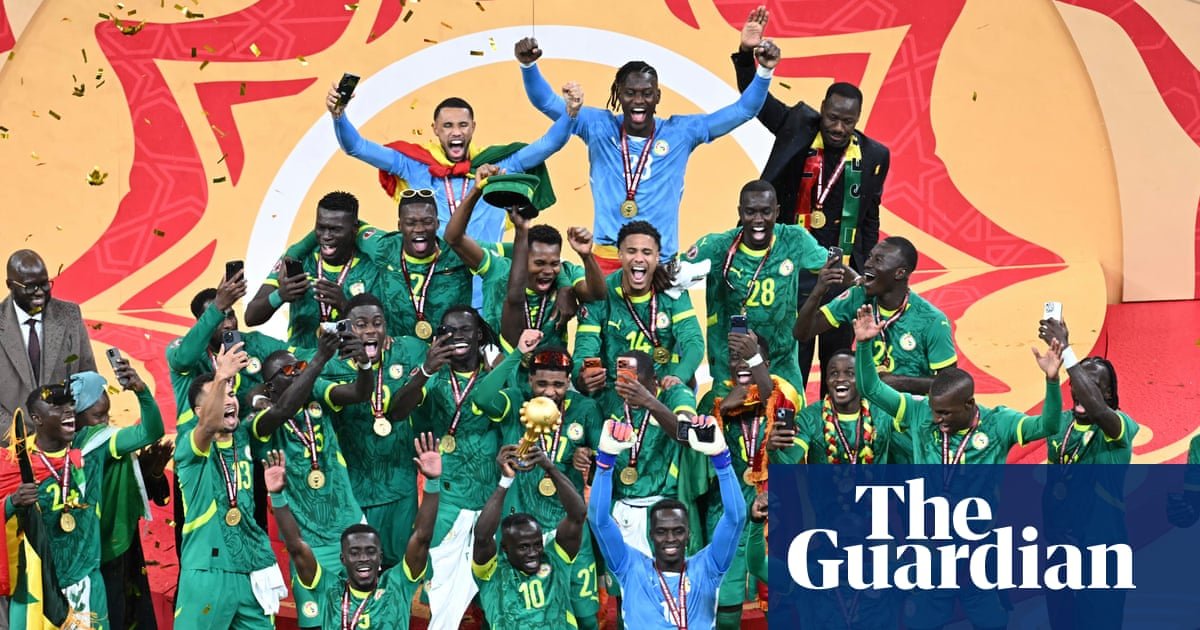
But Senegal held on. There will be repercussions for their walk-off – there must be – but history will record that they won their second Cup of Nations in Morocco, and that despite conceding a 98th-minute penalty when the scores were level. But the best football rarely makes much sense.
