
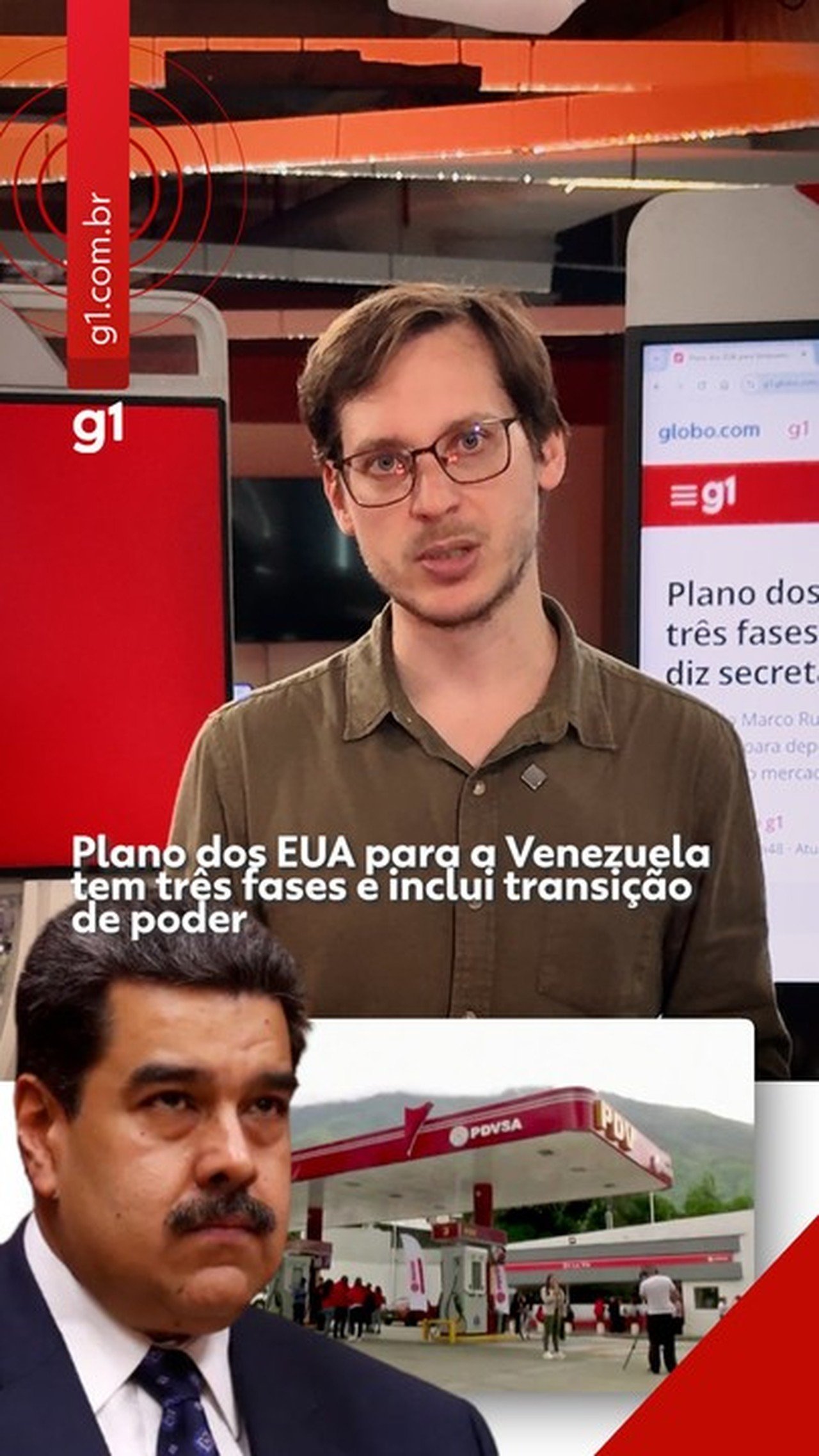
Flag of Venezuela AFP via Getty Images, via BBC “It’s as if one villain is saving you from another.” This is how Gabriel (not his real name) describes what he feels about the events of the last few days in his country, Venezuela. Gabriel is a migrant* (he left Venezuela), Latino and is part of the LGBTQIA+ community. He claims he represents “everything Donald Trump is against.” Therefore, he criticizes the policies of the President of the United States. But he is also a strong opponent of Nicolás Maduro. “Chavismo meant that I needed to emigrate from Venezuela overnight, with US$250 [cerca de R$ 1,3 mil] in my pocket”, he says. “I had to start from scratch in another country and I was unable to see my family for 10 years.” Gabriel says that, now, he feels in limbo. “It seems that people cannot understand how it is possible to be against both positions”, according to him. “It is difficult to make them understand this in-between point.” “In my close circle, we find ourselves in this internal battle. Without a doubt, I am happy to see Maduro in handcuffs. But, on the other hand, I need to thank Trump for this?” US plan for Venezuela has three phases and includes transition of power In the narrative of the current world, which seems to make everything black or white, Gabriel and the other people interviewed for this report are part of this wide variety of shades of gray that make up Venezuela. They are the people who, even though they are opponents of Maduro and Chavismo, are also against Donald Trump and the actions taken by the American government in recent days. All those interviewed spoke to BBC News Mundo (the BBC Spanish service) on condition of anonymity. ‘The foreigners invaded us’ “I woke up to the bombings,” says Ana, from her home in the Venezuelan capital, Caracas. “I’m close to Fort Tiuna. [um dos pontos atacados] and I thought: ‘Wow, the foreigners invaded us!'” “This is tragic, very painful. When I see the photos of the wreckage, I feel bad.” “On the first day of the invasion, I ended up crying with anxiety,” she recalls. “It’s very strong.” Due to the education she received, Ana is left-wing and against anything that resembles American interventionism. “Latin America has a terrible record every time the United States has some whim or believes that a president should not govern, as in the case of the former president of Chile, Salvador Allende [1908-1973]for example”, she recalls. “That’s why, every time I heard the idea that Trump could invade Venezuela, I tried to explain that this would be counterproductive for us”, says Ana. “For a politician to call for the invasion is the opposite of politics, as it means that you are incapable of achieving something.” Ana lives near Fort Tiuna and woke up to the bombings on January 3 in Caracas AFP via Getty Images, via BBC In this particular, Ana criticizes the leader of the Venezuelan opposition, María Corina Machado, for saying that “alone, we cannot get out of Chavismo” and for having invoked the TIAR [Tratado Interamericano de Assistência Recíproca] to intervene in the country. “What she wanted was for Maduro to be removed so that she could govern.” A trained eye on the shades of gray in Venezuela could perhaps say that Ana is Chavista, but she is an ardent opponent of the regime. “I never approved of the Chavistas,” she says. “I’ve always been a bit shy about Hugo Chávez [1954-2013] be military. And then he became more authoritarian and managed to manipulate the system to stay in power.” “We joked that there was nothing worse than Chávez. And we are left with Maduro — zero charisma and total brutality.” “Repression was the hallmark of his government, alongside the economic crisis, which exploded with him and was terrible”, laments Ana. Ana’s positioning caused her to be attacked countless times. In recent days, attacks have intensified on all those who step outside the line considered within a “Chavista stance” or an “oppositional stance” in Venezuela. Gabriel states that the number of comments and attacks was frightening, not to mention the exacerbation of xenophobia, observed mainly on social media. No celebrations People in Santiago de Chile, celebrating the fall of Nicolás Maduro on Saturday, January 3, 2026 Bloomberg via Getty Images, via BBC Currently, being Venezuelan means experiencing many emotions at a time. And, although images of Venezuelans celebrating Maduro’s photo “with handcuffs” have gone around the world, people like Gabriel don’t even think about celebrating. What we dreamed of so much is happening, but we feel a little guilty.” “Furthermore, we are cautious on social media, because the first reading they do is ‘here are Venezuelans celebrating imperialism’.” The same goes for Laura. Like Gabriel, she also had to emigrate from the country. Laura also did not celebrate what happened in the early hours of January 3. She lives with regret about interventionism, “both this from Trump and the clear intervention of Russia and China in my country.” “So I’m confused by everything that’s happening and I feel a kind of relief, a glimmer of hope, to see this man and his wife face justice. We feel a lot of things at the same time.” In each sector of Laura’s life, she tries to “serve as a bridge” between two positions that seem insurmountable, so that “Venezuela’s narrative is constructed in a complex way”, not just in a dichotomy between black and white. “They call me ‘lukewarm'”, she says. “And this comes from the radical left and the radical pro-Trump part.” “It’s not that I want to get along with everyone, but rather to talk about complex realities. And this does not diminish my moral and ethical integrity, on the contrary.” Laura recognizes that it is difficult to “maintain equanimity, as the experience of the dictatorship is embedded in the body, in the flesh itself, in what we had to see and live.” But, as a Venezuelan, she also lived “in polarization and how it was capitalized by power and political forces to strengthen a hatred that, in the long term, will harm us all.” Venezuela through two prisms Both Gabriel and Laura recognize that it was frustrating to observe that, in the latter, days, people tried to simplify the Venezuelan issue according to each person’s ideological perspective. “The migratory exodus, the protests of 2016 and 2017, the stolen elections of 2024, the problem of political prisoners in recent years, feeling that, on several occasions, we raised our voice, we asked people to help us spread awareness, to join the cause…”, recalls Gabriel. it seemed like no one had heard, read or seen.” Laura insists on her deepest feeling: the loneliness of the Venezuelan. “No one can say that we didn’t try everything”, according to her. “Public opinion and the international left kept us abandoned for years.” “We were abandoned by the State itself, for whom we were not a priority, not even for the United States. It’s heartbreaking.” Gabriel highlights that the attacks and misunderstanding don’t just come through social media. They are also brought by his acquaintances and co-workers. “It seems that the last few days have been reduced to ‘Venezuelans are celebrating the North American invasion because they simply hate Chavismo’. And the issue is more complex than that.” Ana takes stock of the entire situation. “What will the invasion bring us? Was it worth it?”, she asks. “All the lives lost, everything that was destroyed. What good was achieved?” “They took Maduro and Cilia Flores. I hate them. But, according to international treaties, no country has the right to interfere in another to kidnap a president.” “Now, we will be the neocolonial fiefdom of the United States, with Delcy Rodríguez in charge, but in a neoliberal way”, according to Ana. Laura highlights that, often, in the debate about the Venezuelan situation, “we lose sight of the fact that, in Venezuela, the priority is life, that there are people suffering and that there are things that are simple for many, but difficult to obtain, such as having electricity, water or speaking for telephone on the street.” “We forget that we are talking about people,” she concludes. * The names of all interviewees are fictitious, to protect their identity. For the same reason, the report does not specify the location of the two interviewees who left Venezuela.
Source link
Venezuelans who oppose Maduro and also Trump: ‘It’s like one villain saving you from another’
64

previous post