
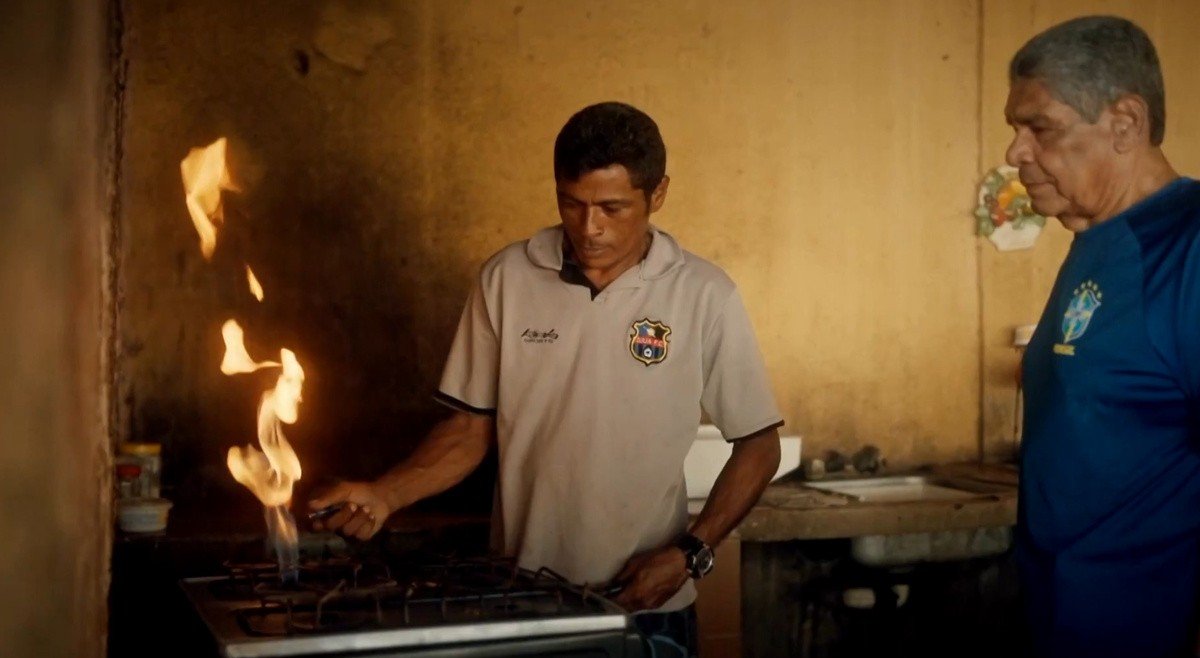
Gas comes directly from an oil well to the stove of a Venezuelan resident Reproduction / Fantástico In the Lake Maracaibo region, northwest of Venezuela, the wealth of the largest oil reserve in the world contrasts with the decadence of the resource’s exploitation structure. The surrounding population, impoverished, resorts to improvisation: the gas for the home stove comes piped straight from the well. The wear and tear of the state-owned PDVSA, corroded by corruption and lack of maintenance, added to the US sanctions. Lake Maracaibo is the birthplace of Venezuelan oil, but those who live nearby say it has little resemblance to Venezuela’s heyday. The workers who are still there do whatever they can. Gas from poor places in Venezuela comes piped straight from the well in the Maracaibo reserve, the largest in the world Reproduction Fantástico showed these images and explained the country’s recent history – see the video below. Documentary interviews former allies who were persecuted by Nicolás Maduro Venezuela, once an agricultural and exporter of coffee and cocoa, discovered the largest oil reserve on the planet underwater. The change led the country to become a scenario of extremes in the 70s: a lot of wealth, but high concentration, with a luxurious elite and a miserable majority. The country was a great ally of the USA and its oil companies. Venezuela experienced an era of prosperity: it produced 3 million barrels per day and had a quality of life comparable to that of Paris — but only for a small elite. The country was called “Saudi Venezuela”, in reference to the other major oil producers in the Middle East. Meanwhile, there were a huge number of slums and very poor areas. The immense wealth did not reach the population. Inequality became fertile ground for the revolution in the early 90s, led by Lieutenant Colonel Hugo Chávez. Caracas had an elite with a luxurious life in the 70s Reproduction / Fantastic The Chávez era After an attempted coup in 1992, Hugo Chávez was elected president in 1998. At his side, from the beginning, was Maduro. Oil played a fundamental role in the plan of the Bolivarian revolution. With oil money, nine million families had access to housing and many began to be able to dream of college. “We reduced poverty from 70% to 7%. These were important social advances”, says Rafael Ramirez, then Minister of Oil in the Chávez government. Maduro, then Minister of Foreign Affairs, articulated alliances with Cuba, Russia and Iran. With his health failing, Chávez chose Maduro as his successor. Months later, the announcement of his death came. Nicolás Maduro came to the presidency of Venezuela as heir Hugo Chávez, but over the 12 years he was in power, he used repression and propaganda to become an authoritarian and centralizing ruler. An unprecedented documentary shown by Fantástico this Sunday (4) reveals behind the scenes of the dictator’s trajectory, with testimonies from former allies who have now become adversaries, and shows how he became a target of Donald Trump. See the video above. The rise of Nicolás Maduro In the 1990s, Maduro was just a bus driver on the streets of Caracas. His rise began when he joined the Socialist Party and was sent to Cuba to learn from Fidel Castro. Decades later, he would apply these lessons as president of one of the most oil-rich countries in the world. In the 1990s, Maduro was a bus driver on the streets of Caracas Reproduction/TV Globo The Chávez era and the role of oil Nicolás Maduro and Hugo Chávez Reproduction/TV Globo Consolidation of power and repression Elected by a narrow margin, Maduro faced internal distrust. He appointed General Manuel Figuera to command intelligence. “He started to use this force as a political police force. It was like the GESTAPO was for Hitler”, says Figuera. Even former allies, such as Rafael Ramírez, were persecuted and forced into exile. “He ordered me arrested. Because he thought I was someone who could take his place. He invaded my house and forced me into exile.” In 2015, after losing his majority in Parliament, Maduro tightened his control. Attorney General Luisa Ortega, once a defender of the regime, broke away after denouncing executions and abuses. “More than eight thousand Venezuelans were executed by the police and the Army,” he stated. Documentary interviews former allies who were persecuted by Nicolás Maduro Reproduction/TV Globo Economic crisis and international pressure The abandonment of the oil industry and political instability were detected by the American radar. Donald Trump tried to overthrow Maduro in 2016, supporting Juan Guaidó as the “legitimate president”, but the coup attempt failed. “I think Maduro and his wife wanted to leave. But the Russians and Cubans told them to stay. Because they knew that if he left, the regime would collapse very quickly,” says John Bolton, former White House National Security Advisor. With the war in Ukraine and sanctions on Russian oil, Joe Biden lifted restrictions on Venezuelan oil, restoring Maduro’s relevance on the international stage and the West once again approached him. Until the return of Donald Trump, who wants to lower fuel prices in the United States at all costs. With sanctions on Russian oil, Maduro and Venezuela once again gained relevance on the international scene Reproduction/TV Globo Propaganda and political survival Between threats, articulations and luck, Maduro remained in power. He invested heavily in propaganda, even creating an animated superhero, “Super Mustache”, to reinforce his image as a defender of the people. Now, Venezuela lives with expectations: the people will continue to defend their “hero” or they will turn the page on this history. PLEASURE, RENATA The podcast ‘Prazer, Renata’ is available on g1 and the main podcast apps. Follow, subscribe and enjoy ‘Prazer, Renata’ on your favorite platform.
Source link
In the largest oil reserve in the world, in Venezuela, stove gas comes directly from the well; see images
63
