
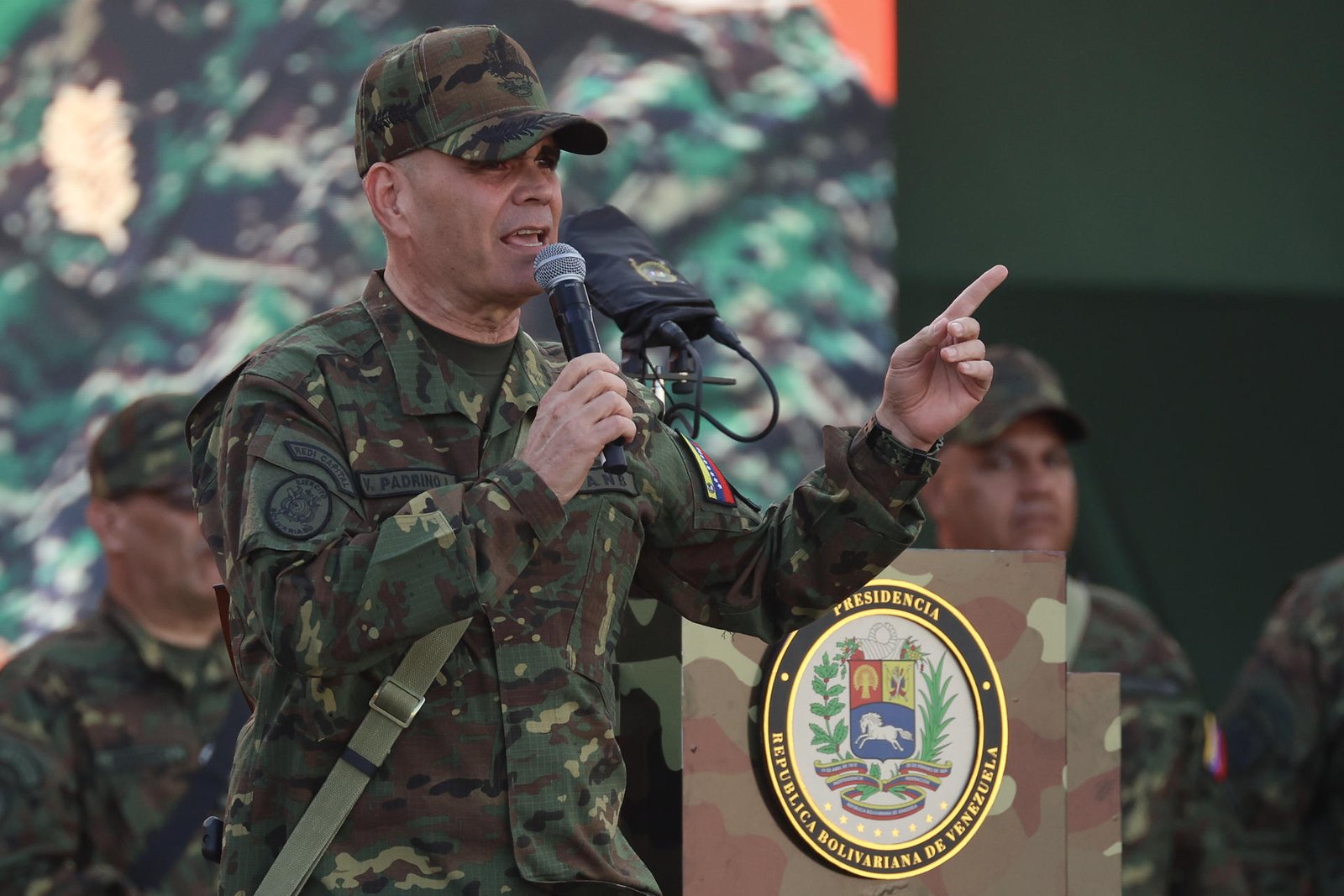
The Venezuelan Armed Forces should be one of the main factors in defining the course of the country’s political transition after the capture of dictator Nicolás Maduro and his wife, Cilia Flores, by United States forces.
Hours after the American operation carried out on Saturday (3), the Minister of Defense, Vladimir Padrino López, confirmed that the Armed Forces recognized Delcy Rodríguez, then Maduro’s deputy, as the new interim head of the Executive. The declaration consolidated the institutional alignment of the Venezuelan Army with the nucleus of remaining Chavismo, even after Maduro’s removal from power. Under this blessing, Delcy was officially sworn in this Monday (5) as interim dictator of Venezuela.
The Venezuelan opposition even tried this weekend to pressure the military into supporting a democratic transition. Opposition leader Edmundo González Urrutia published a video on social media where he publicly claimed his legitimacy as elected president and asked the Venezuelan military to recognize the mandate granted to him in the July 28, 2024 elections, rigged by Maduro.
In the message, González Urrutia stated that the loyalty of the Venezuelan Armed Forces must be “with the Constitution, with the people and with the Republic”, not with Chavismo. Despite the appeal, the military did not give a public sign of support for the opposition’s demands.
HAS People’s GazetteEduardo Galvão, professor of Public Policy at Ibmec, stated that “the Armed Forces have always been the true axis of support for the Chavista regime” and that, with the fall of the dictator Maduro, the central issue became the redefinition of this loyalty. The professor recalled that the capture of Maduro by the US “does not automatically mean the collapse of Chavismo”.
“In more than twenty years of analyzing regimes under stress, I have learned that removing the leader is only the first act, not the outcome. Long-lived authoritarian regimes tend to survive the fall of a central figure because real power is usually distributed in networks, and not concentrated in a single name,” he said.
According to Galvão, the behavior of the Armed Forces in scenarios of rupture, such as Venezuela, tends to follow a pragmatic calculation.
“Militaries negotiate when they realize that the cost of sustaining the status quo exceeds the cost of a controlled transition”, he stated. This calculation, according to the professor, involves “guarantees, preservation of positions, asset protection and personal security”.
For Galvão, if there are clear signs, in this case from the opposition, of risk reduction, the Venezuelan military may even consider supporting an agreed democratic transition. Otherwise, he warned, “if the environment” supported by opponents “is one of indiscriminate punishment and uncertainty, the tendency is towards closure and resistance”, that is, the maintenance of military support for the current Chavista power arrangement.
In analysis at the broadcaster DWpolitical scientist Víctor Mijares stated that the tendency is for the Venezuelan Armed Forces to “align themselves with the pole of power that presents the greatest capacity to maintain itself”, that is, the group that demonstrates greater institutional control, capacity to govern and real chances of maintaining power in the new political scenario. At this moment, the political group that demonstrates the most strength internally is Chavismo itself.
HAS AFPformer Venezuelan officer Williams Cancino said that Venezuela’s current military leadership “is totally loyal to the Chavista regime”, an indication that, despite Maduro’s fall, Chavismo may be far from losing effective control of Venezuela.
