
The President of the United States, Donald Trump, and his advisors gave more details on how the operation that resulted in the capture of dictator Nicolas Maduro took place this Saturday (3). More than 150 aircraft attacked anti-aircraft defenses and transported special forces soldiers who detained the dictator and his wife in a security unit in an action called “Operation Absolute Resolution”.
According to General Dan Caine, aircraft departed from at least 20 bases spread across the continent. A force of helicopters took off on Friday night (2), at 10:46 pm local time, from helicopter carriers in the Caribbean Sea such as Iwo Jima, Fort Lauderdale and San Antonio. They approached the Venezuelan coast flying 30 meters above the sea to avoid radar detection.
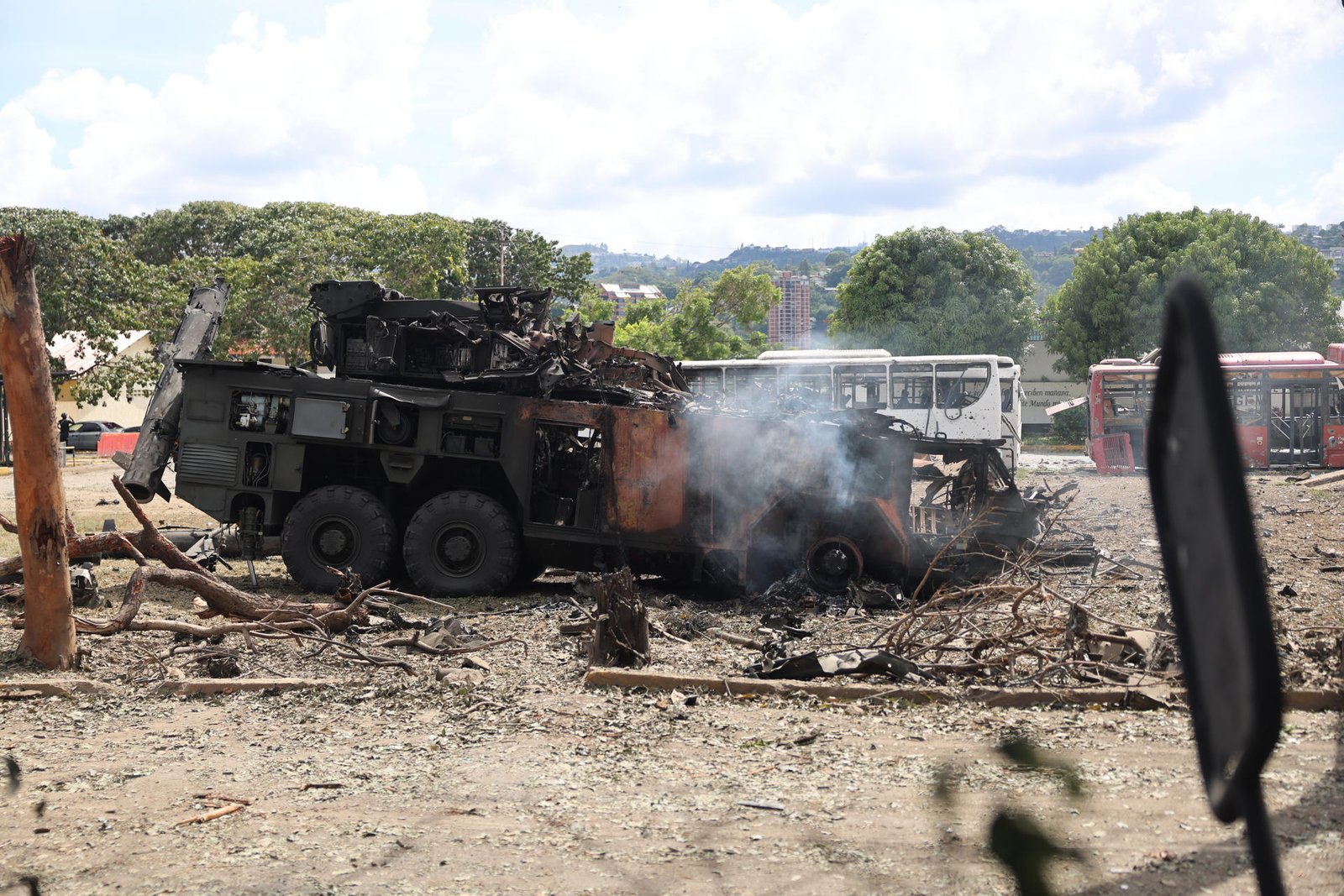
“Stealth” fighter planes and “mother ships,” capable of launching smaller drones, then invaded Venezuelan airspace to destroy Soviet-made S-300 missile launchers and other long- and medium-range anti-aircraft defenses. American authorities did not say whether there was destruction or combat with Sukhoi 30 fighters that Caracas had before the attack. Images of at least one destroyed missile launcher were published in media outlets.
The La Carlota air base, which is located in the east of Caracas, was the target of attacks. At least one anti-aircraft rocket launcher was destroyed at the scene.
The helicopter force then approached a security facility where Maduro was staying at 1:01 am local time. According to analysts, the initial assault against short-range anti-aircraft defenses would have been carried out by attack helicopters and drones, while commando troops disembarked from heavy Chinnok helicopters, capable of carrying 50 fighters each or even light armored vehicles. One of the American aircraft was hit by anti-aircraft fire but managed to return to base.
“Upon our arrival in the target area, the helicopters came under fire and they responded to the attack with overwhelming self-defense force,” General Caine said.
Trump said Maduro was arrested before he could close a steel door to the room where he slept with his wife. “He couldn’t get to the door because our guys were too fast,” said the American president. “Did we take them by surprise? Kind of a surprise, but they were expecting something. There was a lot of opposition. There was a lot of shooting,” Trump said.
Nicolás Maduro and his wife Cilia Flores then surrendered and were taken away in one of the helicopters while fighter jets and drones protected the extraction. A photo released by the US of a captured Maduro appears to have been taken aboard a Chinook aircraft. At 3:29 am on Saturday, all aircraft had already withdrawn from Venezuelan territory. The one carrying Maduro landed on the Iwo Jima helicopter carrier, positioned in the Caribbean Sea.
SEE ALSO:
- Trump announces that the US will govern Venezuela until a new president takes office
- What is the “Cartel de los Soles”, for which Maduro will answer in US justice
Fort Tiuna military base was targeted
The US did not make it clear where Maduro was exactly in the city of Caracas. It was only said that he was in a secure room at a defense facility.
One of the targets in the city was Fort Tiuna, which is the main base of the Venezuelan Army. It is located in the south of Caracas and also houses the Bolivarian Military Academy. Its neutralization by air strikes would be a way to immobilize Venezuelan troops, neutralizing the military control center and hindering communications. The idea was to give more freedom of action to commandos and special forces to carry out missions in other parts of the capital.
Other troop concentration areas in the capital and communication antennas were also bombed with the apparent aim of making the Venezuelan reaction unfeasible.
Airport and port in La Guaíra
The province of La Guaíra is located in the north of Venezuela, on the coast of the Caribbean Sea, 70 kilometers from Caracas. It houses the Simón Bolívar airport, the largest in the country, and the port of La Guaíra.
The attacks on these regions seem to have had a more strategic and secondary function in relation to the capture of Maduro. As they are very close to Caracas, the port and airport would be crucial for disembarking troops for a more prolonged invasion of the country. Trump mentioned that a second wave of attacks could happen but it has been ruled out for now.
