
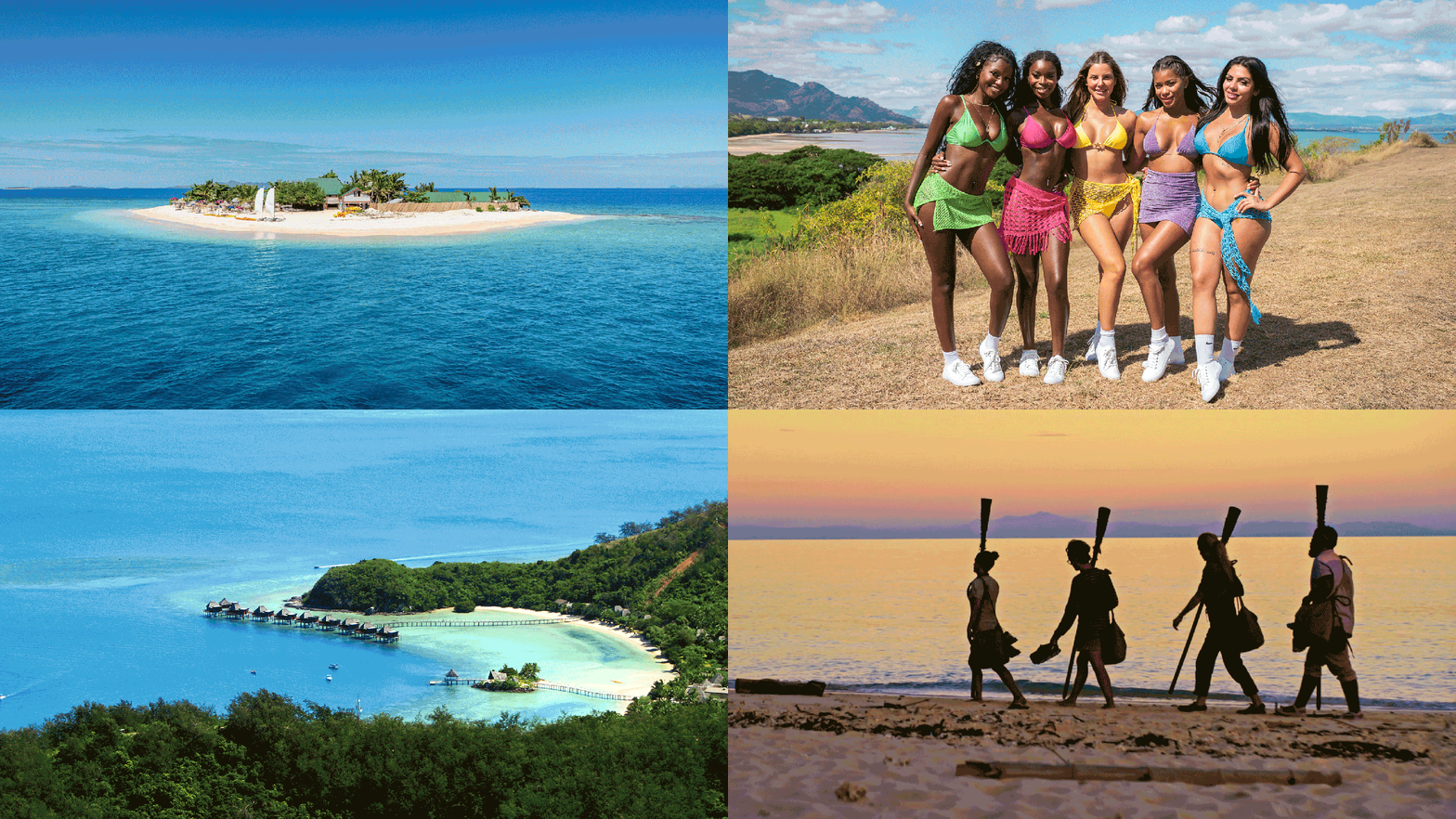
Just over a decade ago, Fijian director Tulia Nacola was eking out a living as a carpenter. She specialized in intricate driftwood chandeliers, which hung in resorts along Fiji’s Coral Coast, an 80-mile stretch of white sand beaches and verdant palm forests that fringe the main island of the South Pacific Ocean archipelago. Nacola’s work caught the eye of a visiting art director for a reality TV show, Beauty and the Geek Australia. He asked for some of her pieces, and she helped him build his set.
An English-lit major, Nacola, 41, was quietly writing her own stories, gaining a following in Fiji for her novels highlighting the experiences of indigenous Fijians, or iTaukei. In 2024, she shot her first short film on a secondhand smartphone; its reception showed a thirst for local stories, and soon Nacola gained financial backing for a feature film. However, there was a hurdle: Fiji, a developing country with a population of about 930,000 spread across 300 islands, has a fledgling film industry, and Nacola wanted to direct it herself. She had to learn, and fast.
Enter Love Island USA. Nacola contacted her friend, the art director, who was now Love Island’s production manager. She got a job dressing sets. Then, for six months last year, between running errands, she observed it all: the hierarchy, the urgency of shooting, the dealing with stars and their emotional upsets. “I went on set knowing that I needed education in this filmmaking world, I needed a crash course,” Nacola says. “I had an ulterior motive — I wasn’t just there to put up flowers and earn money.”
Season 7 of Peacock’s hit series ‘Love Island USA.’
Kim Nunneley/Peacock
Her film, Adi, released in February, is the first feature film shot entirely in iTaukei. It premiered in a sold-out cinema in the Fijian capital, Suva, and is out for submission at global film festivals. “Everything became clear to me on that set,” she says of working on Love Island USA, “and I would not have been able to make my film if I had not had that experience.”

Fijian director Tulia Nacola (standing, second from left) on the set of ‘Love Island Games‘ in Fiji with international and local crew. She says her time on ‘Love Island’ sets gave her the knowledge to complete her own film.
Courtesy of Tulia Nacola
With its crystal-clear waters, offshore reefs and waterfalls plunging into mist-filled valleys, Fiji has a storied history of hosting film productions. Most famously, Brooke Shields and Tom Hanks washed up on its picture-perfect shores in The Blue Lagoon (1980) and Castaway (2000), respectively. In more recent years, it has become increasingly popular with reality television shows, who see the relative ease of access (there are direct, 11-hour flights from L.A.), the Fijian government’s film rebate scheme, and competitive Fijian dollar as drawing cards, according to Film Fiji chief executive Jone Robertson. “The scheme works, the dollar goes a fair way, and it’s like filming in paradise,” he says.
However, along with benefits to the economy and the local film industry come questions about the impact of film crews and tourists on an increasingly fragile environment — especially at a time when the Pacific Islands are some of the most vulnerable in the world to climate change.
“This old model of constant [tourism] promotion without thinking about how to manage the negative, carbon footprint, that’s a model that needs to change — and these production companies coming into developing countries need to leave something positive behind,” says Susanne Becken, a professor of sustainable tourism at Griffith University in Australia. “Is there proper waste management, sewage treatment, do they use plastic bottles? What do they deliver for these islands?”

Contestants of ‘Survivor 46′ on Mana Island.
Robert Voets/CBS via Getty Images
Since the first tribal council lit their torches in Borneo in 2000, Survivor has been a reality series staple watched in hundreds of countries. For the past decade, it has set up shop in Fiji’s Mamanuca Islands, where it films two seasons a year back-to-back from January to July. Over that period, it employs hundreds of Fijians across all aspects of production — from set design and camera operation and security — and is estimated to inject $25 million Fijian dollars (a bit more than $11 million USD) into the economy each year. Love Island USA first began filming in the country in 2019, with its last three seasons filming in the Mamanuca Islands in a custom-built villa and at a local resort.
Productions are eligible for a 20 percent cash rebate for all spending in Fiji, capped at $4 million Fijian dollars, and have to meet certain criteria including employing a certain number of locals, engaging film students from Fiji’s National University as interns, and having elements of scripts vetted by Film Fiji. Robertson says the agreements are mutually beneficial, with the film commission helping to scout locations, smooth the visa process and provide local crew, while locals get the benefits of working on international productions. “Our biggest competitor in terms of location is Thailand, who offer a 35 percent rebate, so our focus is on creating great relationships with the productions we do have to get them to keep coming back.”

‘Love Island USA’
Ben Symons/Peacock
Fijians who have worked on reality shows who spoke to The Hollywood Reporter for this story say that their earnings have averaged around $200 Fijian dollars ($90 USD) a day, a comparatively high rate in a country where many still live in rural poverty on $1.25 Fijian dollars (60 cents) a day. Workers use income to build houses, send children to school or buy land. “Especially younger boys, working on these shows gives them purpose and direction,” Nacola says. “They can help their families.”
Almost all of Nacola’s crew on her feature film had previously worked on reality TV shows shot in Fiji, including Love Island USA, Love Island Games and Survivor, and they used equipment they’d bought off those sets. Her director of photography, Lanza Coffin, has worked on Survivor for 10 years. “I was a wedding photographer, and now I have my own production company,” Coffin, 42, who is about to fly out for a four-day documentary shoot, tells me when I call. “I found a career path, working up from being a personal assistant to a camera assistant and now a camera operator.”

Crew on ‘Survivor,’ shot in Fiji’s Mamanuca Islands, in 2023. Lanza Coffin (third from right) has worked on ‘Survivor’ for a decade and now has his own film production company, Video Factory.
Courtesy Lanza Coffin

Fijian camera operator Coffin on the set of ‘Fight to Survive,’ a reality television series shot in Fiji.
Courtesy Lanza Coffin
He estimates about 60 percent of the crew are from Fiji, and over time key roles that used to be filled by international crew are now being done by Fijians, due to the generosity of knowledge-sharing among the Emmy-winning crew. “That’s the advantage of coming back again and again,” he says. In addition to running his production company, Coffin is part of the Fiji Film Collective, which will start workshops for locals in the coming months. “Now we have the technical know-how, but we’re missing the writing and producing and the funding. So that’s next.”
Tourism Fiji chief executive Dr. Paresh Pant says that the organization is happy with the global promotion of Fiji that has come from film and television productions, paired with their contribution to the local economy. The most recent statistics put this economic injection at $76 million Fijian dollars ($34 million USD) for 2023.
Tourism Fiji leverages these shows, with a recent marketing campaign celebrating the 25th anniversary of Castaway and a pop-up event in New York to mark 50 seasons of Survivor. “These initiatives help convert entertainment exposure into real travel interest,” says Pant. “These productions are part of a broader ecosystem that helps keep Fiji one of the most recognizable island destinations in the world.” To promote responsible travel, tourists are asked to take part in a “Loloma hour,” giving an hour of their trip back to the environment by beach cleaning, coral planting or learning about Fijian culture.

The seascape near Tokoriki Island Resort, a beachfront property located on an island within Fiji’s Mamanuca Islands.
R+A Creative

A beachfront pool villa at Tokoriki Island Resort.
Courtesy Tokoriki Island Resort
In 2024, just over a million international travelers visited the country, a record number. And online ticket agency Ticket Source, analyzing Google Search results, found that searches for flights to Fiji more than doubled compared to previous weeks during Love Island USA’s popular season 7 run in 2025.
But Griffiths says tourism in general puts islands like Fiji in a paradoxical position. Tourism makes up 40 percent of its GDP, earning the country $2.5 billion in Fijian dollars ($1 billion USD) last year. However, growth at all costs can’t be the default position when the Fiji government is also asking for global funding to address the impacts of climate change, according to Griffiths. “When countries like Fiji market to Europe and America you have long-haul travel, and that really exacerbates the problem,” she says. A recent study in Nature showed carbon global emissions due to tourism grew 3.5 percent from 2009 to 2019, double that of the worldwide economy.
Research has consistently shown the Pacific Islands are among the most vulnerable to climate change, with warming sea temperatures causing large-scale coral die-offs and rising tides threatening homes and livelihoods. Some resorts in the Mamanuca Islands are set to lose entire wings to the sea in the coming years, and drinking water in villages is already being infiltrated by salt from seawater seeping into ground bores.

Beach area on Monuriki Island, part of Fiji’s Mamanucan Islands.
Getty Images
The country is also home to endemic species, many of whom are under threat, including the critically endangered Fijian crested iguana. Irreversible damage can be done to wildlife and habitats by tourists and production companies who aren’t careful. “If they’re coming in and they’re not sustainable, they’re not doing things that are helping, it’s a lot for us to fix,” says Mamanuca Environmental Society project manager Marica Vakacola. “Most of these foreshores are being inundated with tides, and not even high tides, and many communities are seeing the drastic impacts of climate change.”
University of Auckland Indo-Fijian researcher Danian Singh has been documenting the relocation of Fijian villages due to climate-change-related coastal erosion and inundation. He has visited Vunidogoloa multiple times, which was the first iTaukei community to be relocated 14 years ago on Vanua Levu, Fijian’s second largest island, one of more than 40 that are due to be shifted in coming years.
“It’s a massive challenge relocating all these people. There is very little budget for this — even the village of Vunidogoloa has no electricity, one kerosene-run fridge, and there are no resources in terms of the basic necessities. They don’t have money to repair their houses, over time leaks have developed, rivers are running through them.”
It was a difficult experience for villagers who were emotionally and culturally attached to the land, which their families had inhabited for centuries, and who continued to visit even as the graves of their ancestors drowned and crumbled away. Some residents, like those in the village of Vunisavisavi, told Singh they would never leave even when their houses were under the sea.

The Mamanuca Islands: An aerial view of Tavarua Island, a popular resort for surfing and ocean sports.
Getty Images
Environmental and cultural programs that educate tourists on conservation are beneficial but need to be amplified, according to Singh. “One resort put a turtle in a bathtub for tourists to see, for example, and that turtle got really stressed. Local conservationists protested and it was returned to sea, but tourists can be aware of that kind of thing too,” he says.
The planting of mangroves, which have solid roots that help to mitigate the impact of heavy waves and prevent the flow of trash from inland to the sea, is a priority for the Fiji government, along with coral replanting. Local villages are actively monitoring the oceans and reefs in their environment, and backlash to a recent plan from a billionaire Australian to build a giant plant to incinerate rubbish in Fiji was loud and well organized, says Singh. “In the past, the national economic outcomes have usually outweighed the community needs, but now it seems to be changing.”
The Mamanuca Environmental Society’s team, which includes tourist operators and villagers, has its own initiatives to plant mangroves. They also check coral reefs, plant heat-resistant coral species, aid resorts in reforestation and waste management projects, and teach ecology programs in schools.

‘Survivor’ host Jeff Probst
Robert Voets/CBS ©2025 CBS Broadcasting, Inc
When it comes to productions, the environment society holds meetings with teams ahead of shooting so they understand the impact, says Vakacola. Survivor, which is shot mainly on Mana Island with the cast staying on satellite islands, has been respectful and donated to the organization. “Before they came there was consultation done, they informed us what island they’d be working on, they work directly with the local communities and the villages.” Traditional landowners are paid for the use of their land. If forest is cleared for a scene, trees are selected that can grow back, and the production employs its own biosecurity personnel on site, she says.
CBS, who produces Survivor, declined to take part in this story. A representative for Love Island production company ITV America says it has partnered with BAFTA Albert, a screen industry organization for environmental sustainability, to track its carbon footprint. This helped the show reduce its CO2 emissions by 65 percent over the last season by using grid power as well as battery generators (instead of diesel). The production composted food waste, did not use plastic water bottles and other single-use items, recycled pieces of set for local schools or families instead of sending them to landfill, and ran a can-recycling program.
This June, the eighth season of Love Island USA premieres, with a group of “Islanders” once again thrown together to see what steaminess and drama might ensue. In 2025, it was the most-streamed TV show in America; Fiji’s dramatic coastlines will once again form the backdrop for romance. Interest in tourism to Fiji may likely spike again.

The poster for director Nacola’s feature film, ‘Adi.’
Courtesy of Tulia Nacola
And while it might be set in the same country, for many Fijians, it’s a world away. Before she finishes speaking with THR, Nacola talks about the personal importance to her of making her film, which tells an indigenous story of a chiefly family where the woman has to step up to the lead role. “Knowing I can tell my own stories grounds me in my culture,” she says.
While she will always be grateful for her time on reality TV sets, she’s not interested in the shows themselves. “Fijian culture is not usually portrayed at all, or they have artifacts that aren’t Fijian. There are things that aren’t culturally appropriate — it’s foreign ideas that they’re piecing together for television, like a fake place and a fake world but being very generally tribal, like any indigenous place.”
“What about the entertainment value of Love Island, for example?” I ask Nacola. Do you like it? “I don’t know, to be honest,” she says. “I’ve never watched an episode.”
