
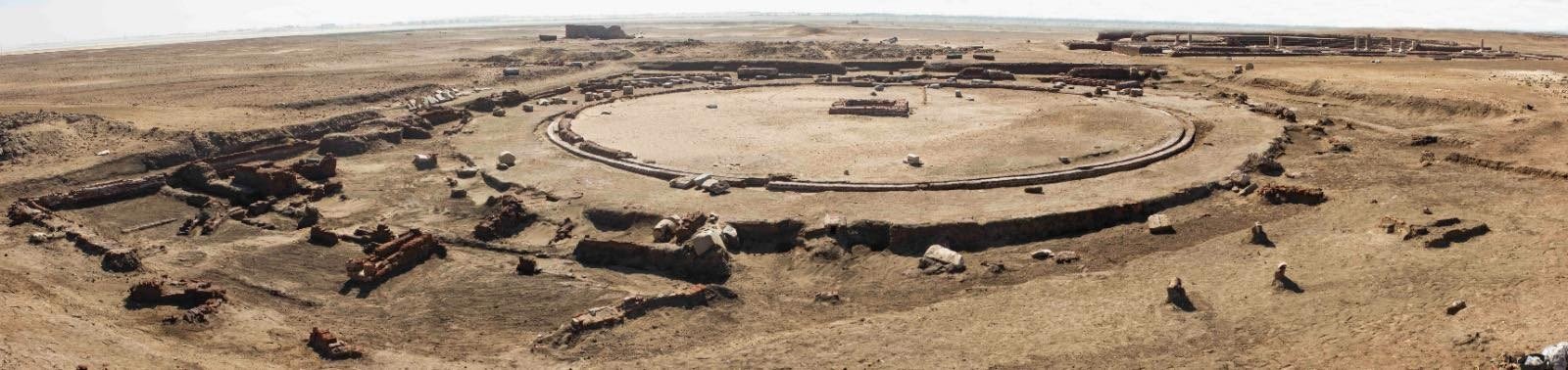
Archaeologists in Egypt have discovered the ruins of a 2,200-year-old temple dedicated to the god Pelusium at the Tell el-Farma site in the ancient city of Pelusium in the north of the Sinai peninsula. Evidence indicates that the site was used continuously between the 2nd century BC and the 6th century AD, with little change over time. According to the country’s Ministry of Tourism and Antiquities, the religious structure can rewrite the city’s history and its role in the ancient world. The announcement was made in early April in a post on the ministry’s Facebook, which also released images of the discovery. 2,200-year-old religious temple dedicated to the god Pelúsio. Egyptian Ministry of Tourism and Antiquities It took six years of excavations at the site, until the archaeological mission of the Supreme Council of Antiquities revealed the remains of a unique building, associated with the cult of the local god. The building’s central element is a circular basin about 35 meters in diameter, surrounded by a system of drainage canals connected to a branch of the Nile River. In the center of the temple, there is a square base that may have supported a colossal statue of the god Pelusium. In the center of the temple, there is a square base that may have supported a colossal statue of the god Pelusium. Egyptian Ministry of Tourism and Antiquities According to the head of the Egyptian Antiquities Sector, Mohamed Abdel Badie, the huge basin was filled with water laden with silt from the river, in a symbolic reference to the deity — whose name derives from the Greek word “Plus”, which means “mud”. According to the secretary general of the Supreme Council of Antiquities, Hisham El-Leithy, the find highlights the role of Pelusium in the spread of religious and cultural ideas in the ancient world. He explained that the temple features a unique architectural design, which combines Egyptian traditions with Hellenistic and Roman influences. The temple has a system of drainage canals connected to a branch of the Nile River. Egypt’s Ministry of Tourism and Antiquities The huge basin was filled with silt-laden water. Egypt’s Ministry of Tourism and Antiquities The Minister of Tourism and Antiquities, Sherif Fathy, said that the discovery reinforces the strategic and archaeological importance of North Sinai, highlighting that the region still holds many promising sites. He also highlighted the ministry’s commitment to continuing excavations and scientific studies, considered fundamental to expanding historical knowledge. Religious temple has the shape of a basin 35 meters in diameter. Egypt’s Ministry of Tourism and Antiquities Mission supervisor Hisham Hussein explained that the discovery began in 2019, when around 25% of a circular brick structure was found. Initially, it was believed that the site was the old city’s Senate building. However, subsequent excavations revealed the entire construction, considered today a complex architectural work. Construction is considered a complex architectural work. Egyptian Ministry of Tourism and Antiquities The temple has entrances on the east, south and west sides, while the north part was heavily damaged. After field studies and comparisons with architectural models from the Hellenistic and Roman periods, researchers concluded that the building was not a civil structure, but rather a sacred water installation linked to religious rituals.
Source link
In Egypt, archaeologists discover a 2,200-year-old temple dedicated to the god Pelusium
11

previous post