
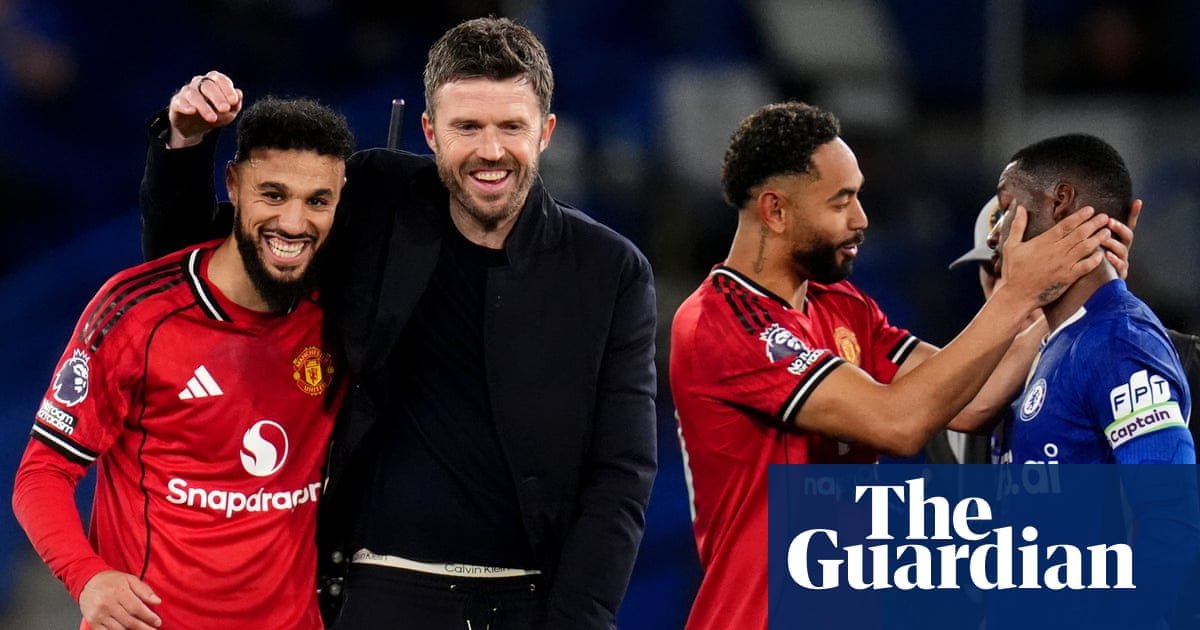
Michael Carrick is the calm Manchester United interim manager who moves ever closer to being appointed the seventh permanent leader of the post-Sir Alex Ferguson era. To coin the cliche: it is certifiably the 44-year-old’s to lose.
Having guided United to third place and eight points clear of Brighton in sixth, two wins from their last five games will all but seal a Champions League berth due to superior goal difference. Defeat Brentford when Keith Andrews’ team visit Old Trafford on Monday and the champagne can be iced.
Entry into Europe’s top-tier competition means a treasure chest of millions, so the Glazers and Sir Jim Ratcliffe, United’s owners, will be cock-a-hoop if Carrick does execute the primary task he was employed for.
There is a nagging question, though. One that Jason Wilcox and the director of football’s department could really do with an answer to before offering Carrick the permanent post: how will he be in a crisis, mini- or full-blown? Because they both tend to come to United and will define his suitability for a job that can be akin, to paraphrase David Moyes, to a hydra-headed monster.
In this sense Wilcox is in classic damned if he does, damned if does not territory. The former Blackburn winger is paid handsomely, primarily for recruitment, starting with the appointment of the first-team manager, so no tears should be shed for him. But Carrick’s success – thus far – places Wilcox in a certifiable pickle.
Carrick has lifted United from seventh position since taking over in early January, returning an impressive 26 points from the 36 available in his 12 matches, the highest in the division in that period.
Impressive, sure. But the 17 matches Carrick will have piloted by the end of the season at the elite level of the sport is a minuscule sample size. Factoring in the previous, three-match caretaker spell of November-December 2021, makes 20, or just over half a season.
So the great unknown is how will Carrick face down a sustained dip in form at a club where weathering storms is a key demand of this post-Ferguson era. Fast forward to the start of next season and it is easy to picture United losing a couple or more of their opening games. Ruben Amorim began this season with three reverses and only one win in the first five, including the humbling Carabao Cup defeat on penalties at Grimsby Town.
If Carrick oversees something similar after being installed by Wilcox, he and the director of football will need tin hats for the brickbats flung their way. Suddenly Carrick’s callowness will be scrutinised and flagged as the obvious reason why not to have appointed him. Assuming Champions League qualification, the impressive 17-match stewardship that got them there will be ancient history. And cited as job-threatening folly from Wilcox; a shortsightedness that assessed the dour dog days of Amorim, the Portuguese’s awkward 3-4-3 shape and emotional media conferences, and fooled the director of football into a rush to sign his antithesis: the mild-mannered Carrick whose lineage as a garlanded player under Ferguson marked him out as steeped in how United must perform.
Throw in the glaring precedent of Ole Gunnar Solskjær, whose own successful time as caretaker presaged a turbulent tenure as full-time head coach, and you can see how the line of criticism will run.
There is, of course, zero logic in presuming Carrick will mirror how the Norwegian fared. As he says: “You can compare to all sorts of different situations [with] managers and coaches and teams. It just depends on what you choose to compare. But it’s irrelevant really. That’s not a negative or a positive. It just doesn’t have a link at all.”
Yet you wonder if Carrick’s level-headedness means he will prove one-note when challenged. Are there different moods and tactical gears to move through if the side starts to flatline? Can he rouse players on the training ground if defeats start to spiral? Does he have the charisma to inspire, lift spirits?
Here, the 2-1 loss by Leeds a fortnight ago may be examined by Wilcox. The defeat is not the point, the manner of it is, as, 2-0 down at half-time, Carrick seemed to freeze before the Old Trafford crowd, waiting until 70 minutes to make substitutions. In the last game, the 1-0 win at Chelsea, United were again flat, relying on a smash-and-grab Matheus Cunha strike for victory. Are these outliers or evidence of an inability to react? Again: very difficult to know when he is so inexperienced.
Since Ferguson walked away in May 2013 United have hoped Moyes, Louis van Gaal, José Mourinho, Solskjær, Erik ten Hag and Amorim could replace a genius and add a 21st league title (at least) to United’s trophy room. All failed, so now it may be Carrick’s turn.
Ideally Luis Enrique, Paris Saint-Germain’s head coach, or Thomas Tuchel, the England manager, would be recruited next. But United never, truly, go for the best in class. Wilcox et al must believe Carrick can join the Spaniard and the German as an elite head coach, or what would be the point of hiring him?
