
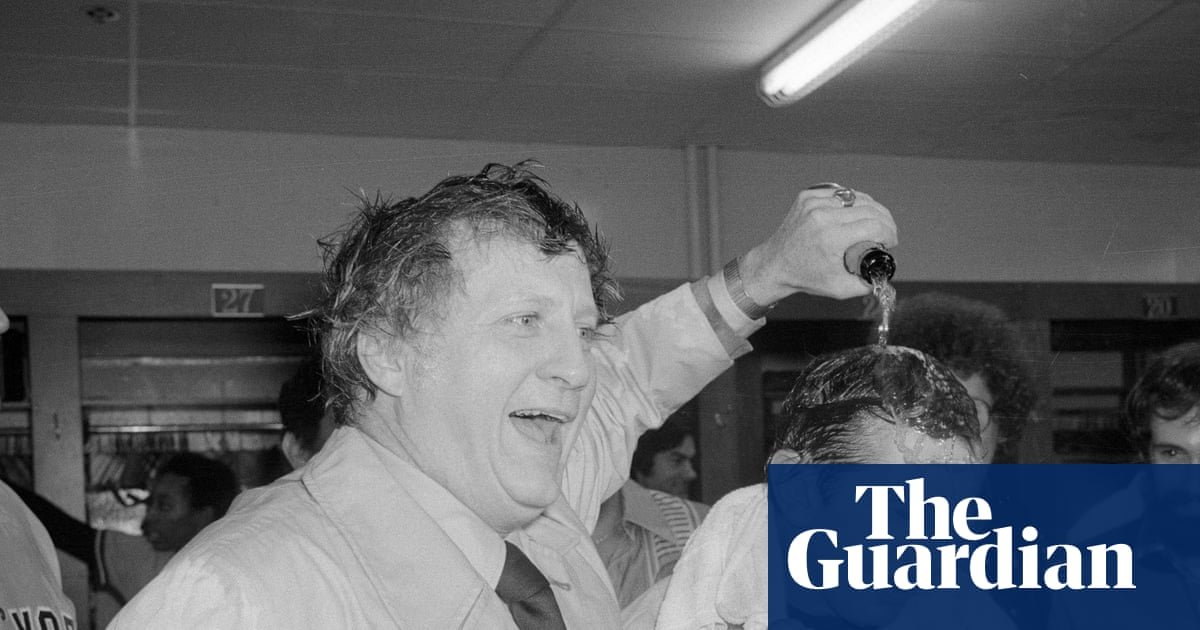
George Steinbrenner could be quite the pitchman – whether selling New York to free agents or starring in Pepto-Bismol TV ads alongside Billy Martin. And now a new book remembers the late Yankees owner and the dynasty he founded.
The Bosses of the Bronx: The Endless Drama of the Yankees Under the House of Steinbrenner flows from the pen of sports journalist and author Mike Vaccaro. As the New York Post’s lead sports columnist for more than two decades, Vaccaro has witnessed the Steinbrenner dynasty from a rarefied perspective – the journalistic equivalent of a seat along the third-base line.
Vaccaro remembers the first one-on-one phone call he got from Steinbrenner. It came at 3.30am when he was covering the 2003 Super Bowl in San Diego for the Post. Steinbrenner was on the other side of the US, driving to the Yankees’ spring training facility in Tampa.
Despite the three-hour time difference, “he was terrific,” Vaccaro says, “a fun interview. I had [previously] been around him in group settings, but that was my first one-on-one with him.”
The book divulges the contents of that interview, including Steinbrenner’s appraisal of Larry David’s performance as him on Seinfeld: “I don’t think it sounds like me. But my wife told me, ‘George, that sounds more like you than you do.’”
Vaccaro says he was on good terms with Steinbrenner despite the usual friction between a journalist and a sports executive. “We maintained a pretty good relationship the rest of my career,” Vaccaro says. “I was fair to him. I did not always agree with the things he did. I think he respected that.”
Over the course of 30 chapters, Vaccaro shares the story of Steinbrenner – his full name was George M Steinbrenner III – and the son who succeeded him in running the Yankees, Harold Zieg “Hal” Steinbrenner.
In January 1973, the elder Steinbrenner, a Cleveland shipping magnate, purchased the Yankees from CBS for $8.8m, as the then-relatively unknown head of a group of partners. The Yankees would win seven World Series championships under Steinbrenner’s watch, backed by stars such as Reggie Jackson and Derek Jeter. Yet the man nicknamed “The Boss” was also suspended from baseball on two occasions – a two-year ouster in 1974 for illegal campaign contributions to Richard Nixonand a lifetime ban in 1990 for paying gambler Howard Spira in an attempt to discredit Yankees star Dave Winfield. Each time, Steinbrenner ultimately navigated his way back into baseball. Yet throughout his ownership, he displayed a notably combative approach – hiring, firing and sometimes rehiring in his quest for another championship. Exhibit A was Martin, who served five separate spells as Yankees manager and, according to Vaccaro, was in line for a sixth stint before his untimely death in a Christmas Day car crash in 1989.
“Both of them hated losing even more than they liked winning,” Vaccaro says. “It was sort of their driving fossil fuel. They were also incredibly stubborn. I don’t think Billy could ever quite wrap his head around the fact George was the boss. From day one, George referred to himself as ‘The Boss.’ It drove Billy crazy.”
In tackling this complex overall narrative, Vaccaro credits his book’s editor with some good advice about making each chapter like one of his newspaper columns: “Make them conversational, make them interesting, make them fun, not like a textbook, ‘on that day, this happened.’ Play all the hits – and the stories behind the stories, that may not be quite so well-known.”
Did you know, for instance, that George Steinbrenner spotted promise in Hal early on, due to his son’s response to a Burger King promo in the 1980s? According to the book, Burger King offered Yankees cards with a Whopper, fries and shake, and 12-year-old Hal noted that the lineup omitted popular Yankee Lou Piniella. The fast-food chain was notified, the Piniella card became a prized collector’s item, and Steinbrenner Sr noted his adolescent son’s business acumen.
The book also explores the contributions of two Yankees executives who played notable roles during Steinbrenner’s periods of exile: Gabe Paul in the 1970s and Gene “Stick” Michael in the 1990s. Paul, a former Cleveland Indians general manager, took over in a similar role at the Yankees early in Steinbrenner’s tenure. When Steinbrenner was suspended for his contributions to Nixon during the Watergate investigation, Paul got more leeway to make franchise-altering moves; according to the book, he did receive clearance from then-baseball commissioner Bowie Kuhn to get Steinbrenner’s approval before successfully courting free agent Catfish Hunter.
Years later, in 1993, with Steinbrenner again out of baseball, it was a new GM – Michael – who got credit for a deal he didn’t make. The Yankees were looking to reunite with one of their exes, Rickey Henderson, but the Blue Jays swooped in first. Michael was thinking longer-term, and Vaccaro explains that the Oakland A’s demands for Henderson included a list of Yankees prospects at the time: not only Jeter, but also on future stars Andy Pettitte, Jorge Posada, Mariano Rivera and Bernie Williams.
“For two and a half years Michael could protect the crown jewels without fear of the Boss going behind his back to ransom them,” Vaccaro writes in the book.
It all ended up working out quite well for Steinbrenner and the Yankees: The Boss returned in 1995. A year later, under new manager Joe Torre, the Yankees returned to the World Series, which they won, starting a string of four titles in five years. On the business side, the team entered into a short-lived cross-sport partnership with the New Jersey Nets and New Jersey Devils, and into the lucrative world of TV with the regional sports titan YES Network. Vaccaro estimates the Yankees’ current value at $7bn-$10bn, and he believes their fairly new stadium has quashed any fears of a move to New Jersey.
There have been some fissures in the firmament in recent decades though. The Yankees’ long-time foes, the Boston Red Sox, got the better of the rivalry in Steinbrenner’s last years – notably in 2004, when Boston came back from a 3-0 deficit to stun the Yankees in the ALCS en route to ending an 86-year World Series drought and an almost-as-long run of humiliation against the Pinstripes. The Yankees have not won a championship since 2009, and according to the book, some fans worry about Hal Steinbrenner’s leadership compared to his father, muttering that current GM Brian Cashman and manager Aaron Boone might have faced more pressure to win “if only George were still alive.”
“Yankees fans are passionate – spoiled, maybe, too used to success,” Vaccaro says. “They really have a serious belief about what the Yankees should be – which Hal does have.”
These days, he adds, “it’s not quite as easy … the Dodgers are supposed to be invulnerable … [yet] they should have lost the World Series three different times last year. It’s something of a crapshoot when you get your team into a playoff series.” Wryly, he adds, “Yankees fans – and George Steinbrenner – would not like to hear that.”
