
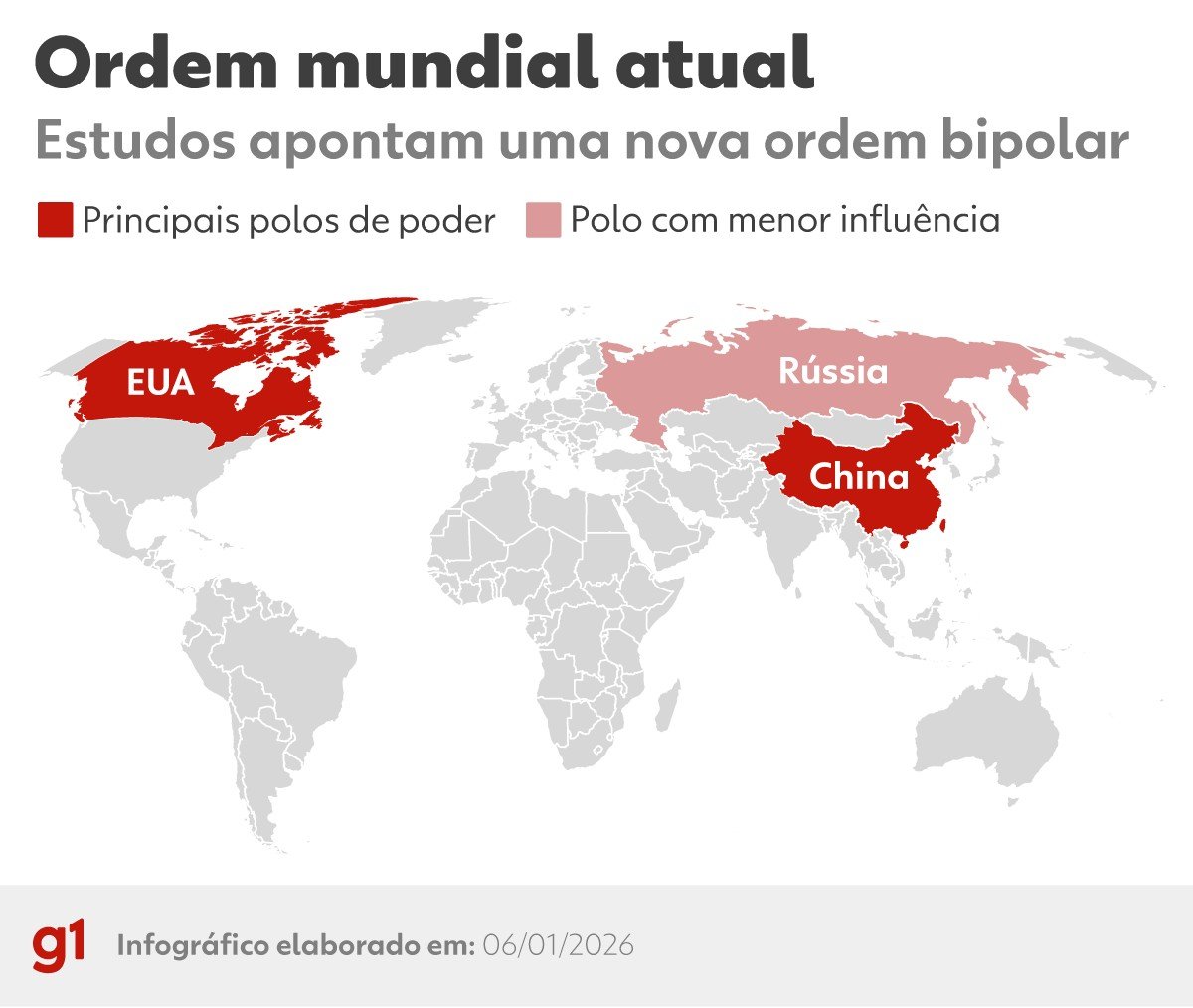
Miriam Leitão: Trump’s threats put NATO at risk. The United States’ attack on Venezuela didn’t just change the regional game. It also shook up the order that has governed geopolitical chess around the world since the end of the Cold War. With the offensive, the planet is now entering a new world order, in the opinion of experts interviewed by g1. ✅ Follow the g1 international news channel on WhatsApp “We woke up on January 3, and the world had already changed,” ESPM International Relations professor Leonardo Trevisan told g1, in reference to the day that US troops bombed Caracas and captured Nicolás Maduro. ➡️ Trump’s offensive, according to analysts, made it clear that the United States, China and, to a lesser extent, Russia, are the great poles of power in the world and compete for forces, disrespecting borders, institutions and agreements that governed global geopolitics until now. The analyzes are based on the following evidence: the USA and China, the two great economic powers, in addition to Russia, have demonstrated their intention to expand their territories with concrete actions; Russia invaded Ukraine in 2022; the Trump administration has entered Venezuela’s air and land space and threatens to seize Greenland from Denmark; China has already been accused of invading the waters of neighboring countries to build artificial islands for military purposes (read more below); Military actions take place in nearby countries under the pretext of “protecting” the areas of influence of the 3 great powers; The “bosses” of current geopolitics have acted in disregard of the main agreements made after the Second World War, such as the UN Charter and the principles of international law. 📖 After the end of the Cold War, the collapse of the Soviet Union and a period of United States hegemony, the world entered a new world order, the multipolar one, in the view of many scholars. This means that power was distributed across multiple “poles” around the planet — mainly the United States, but also Europe, Japan, China and, later, Brics countries like Brazil. Everyone collaborated and competed with each other, governed by multilateral institutions created after the Second World War to establish order in relations between countries, such as the United Nations (UN) itself, in addition to the World Trade Organization (WTO) and the World Health Organization (WHO). Although experts still disagree on the type of new geopolitical chess configuration, the consensus is that this model is collapsing and that Donald Trump’s offensive in Venezuela over the weekend cemented the change once and for all. For Professor of Political Science at Yale University in the United States, Oona Hathaway, Trump’s action put an end to “an era of historic peace and threatens to return us to a world where force prevails.” A new world order arte/ g1 arte/ g1 Russia: regional influence or the ‘3rd power’? There is still a lack of consensus among experts as to whether the world has plunged into a bipolar order, dominated by the United States and China – and with Russia’s influence to a lesser extent at the regional level, or whether we live in an era with these three countries as the three great spheres of influence. This is because, despite having one of the largest military arsenals in the world, Russia is still far from the USA and China in terms of military technology and logistics. Furthermore, it is the 10th largest economy in the world, well behind, in absolute terms, the USA and China, which are at the top of the ranking of the largest GDPs on the planet. Even so, Vladimir Putin’s government has been waging a war for almost four years in its neighboring country, negotiating on an equal footing with the United States and, faced with threats to Eastern Europe, the European Union has had to increase its defense budget, leading to an unprecedented arms race since the end of the Second World War. For Leonardo Trevisan, despite Putin’s threats, Russia must limit itself to exercising only regional influence, and the order is now bipolar, as in the post-World War II era, in which the USA and the Soviet Union dominated the poles of power. This time, however, with a difference: Russia leaves, China enters, he says. “The world, which was multilateral with some centers of power, has become bipolar,” he said. “Russia will have a regional influence China’s ‘backyard’ The rapid growth of the Chinese economy and even the military expansion of the Asian giant have already meant that, in recent years, experts and research institutes have begun to point out that the world could be returning to a bipolar system of power. In addition to being the second largest economy in the world, just behind the USA, China has also been expanding its military power in recent years — one of the hallmarks of the current administration of the country’s president, Xi Jinping. Formally, the Chinese government follows a policy of non-intervention and criticizes military activities carried out without the approval of the UN Security Council – such as Trump’s offensive in Caracas, which did not even have the consent of the United States Congress itself. In practice, however, Beijing has shown signs that it can do exactly the same. The military exercises around Taiwan are the most obvious example. sale of weapons that the US made to the autonomous government of the island, which is also the most important chip manufacturer in the world. The Chinese government said that the exercises were a “stern warning” of “external interference”. But China’s geopolitical “backyard” is not limited to Taiwan. Xi Jinping’s government has invested in the construction of artificial islands and is accused by several governments in Asia of invading the waters of neighboring countries. of artificial islands in a way that makes it impossible to invade,” said Trevisan. This change in stance, according to the ESPM professor, points to a cycle of expansion in the Asian country, focused on commercial expansion, but also on protecting its territory from eventual attacks. “China has cycles in which it spreads international power and cycles in which it closes down. Clearly, they are now in a cycle of expansion,” he said. ‘This is our Hemisphere’ Nicolás Maduro on board the USS Iwo Jima, in a photo shared by Trump. REUTERS And it was precisely with an eye on Beijing that the Trump administration ordered the military to invade a Latin American country, capture its president and remove him from power. For Professor of International Relations at Fundação Getúlio Vargas (FGV) Oliver Stuenkel, the action cemented the transition “to a world of spheres of influence.” “More than a bipolar or multipolar world, the weekend’s events suggest the transition to a world of spheres of influence, in which great powers have the freedom to do what they want in their determined ‘backyards,'” Oliver Stuenkel, professor of International Relations at Fundação Getúlio Vargas (FGV), told g1. Speaking hours after the operation, Donald Trump clearly said that his government intends to rescue and expand the Monroe Doctrine – the policy applied by the United States 200 years ago to expand dominance over Latin America, in an attempt to prevent Soviet expansion on the American continent. On Monday, supporting Trump’s speech, the United States Department of State stated, in a publication on its social networks: “This is our Hemisphere”. “We are seeing several countries invading other territories and tearing up the UN charter. International law is no longer respected, and that starts with the country that has a seat on the Security Council,” said Brustolin, in reference to the United States. Trump x Xi Jinping Another factor that, according to analysts, indicates a change in the world order is the constant power struggle between the two major poles. The tariff war that Trump and Xi fought over the past year was just one battle of this arm wrestling, which also involves accusations in the diplomatic sphere. This week, after the offensive in Venezuela, China’s top diplomat accused the According to sources heard by the American TV network ABC, Trump has pressured the Venezuelan interim president to cut ties with the Chinese government, one of the main buyers of Venezuelan oil. and for the West, China demonstrates its commitment to these relationships through trade and investment, even in difficult circumstances,” he said. “Rhetorically, Beijing will be very important in mobilizing public opinion against the US.”
Source link
The ‘chiefs of power’: after Venezuela, do we have a new world order?
78
