
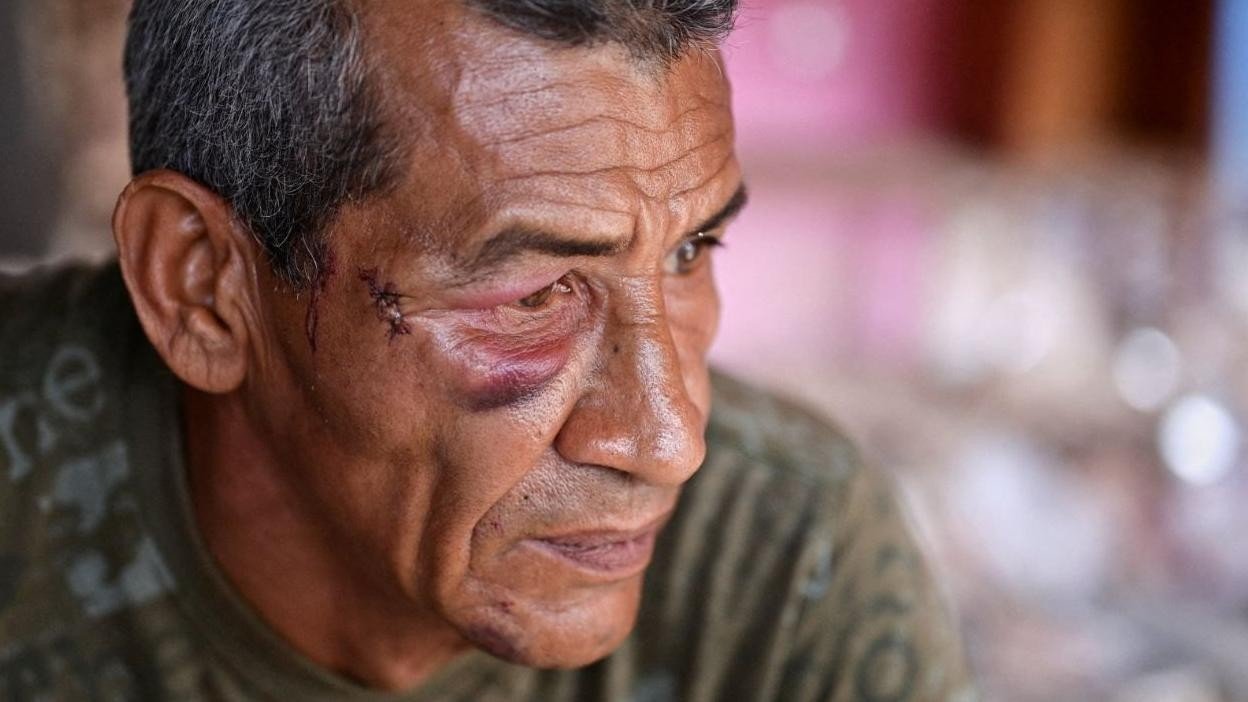
The impact of the missile threw Wilman González against the wall, while his aunt Rosa lost her life. Reuters via BBC It was 2am when a missile hit his apartment. “The blast wave threw me against the wall,” recalls Wilman González. Falling to the ground, he opened his arms looking at the sky and said goodbye: “God, forgive all my sins.” At that moment, “I felt like I had died,” he recalls. But, moments later, González realized that a splinter of wood that had come loose from the door had been buried in his face. “I got up as best I could and went to help my brothers, who were stunned by the impact,” the 54-year-old electrician tells BBC News Mundo (BBC Spanish service). Still with his right cheek purple, he can hardly believe what happened to him and his family last January 3, when the US Armed Forces attacked Venezuela, capturing President Nicolás Maduro and his wife, Cilia Flores. Explosions are reported in Caracas, Venezuela González lived in Block 12, an old building located very close to an important Venezuelan military base, the Bolivarian Navy Academy, in the coastal city of Catia La Mar, about 35 km from Caracas. Inhabited mainly by elderly people in a popular neighborhood, Block 12 — or what remains of it — is now a symbol of one of the biggest events in Venezuela’s recent history: the bombing ordered by United States President Donald Trump. This is one of the civilian buildings hit by the attack, whose main target was military and communications installations. While Maduro remains detained in a New York prison, facing charges related to narcoterrorism, Venezuela’s interim president, Delcy Rodríguez, took over the country’s reins this week, under the tutelage of the United States. Venezuela’s Interior Minister, Diosdado Cabello, reported that the American operation caused the deaths of around 100 people, including civilians and military personnel. González is one of the survivors. But his 79-year-old aunt Rosa slept in the next room and wasn’t as lucky. “She started screaming ‘oh, what a pain, what a pain in my arm’,” he recalls. “There was a washing machine on top of her. A washing machine that, on impact, went flying and fell on top of her.” The nephew managed, with difficulty, to remove the machine and place his aunt in a chair. It was at this moment that Rosa said she couldn’t breathe. Desperate, family members took Rosa González to a hospital, where she received emergency care. But despite all efforts, it was too late. With the coffin half-open for people to say goodbye, two days after the bombing, family and friends mourned Rosa González in a small chapel with white walls, in front of a crucifix. Wilman González now lives at his brother-in-law’s house. He stops in front of what was once his home and looks at the rubble, unable to explain what happened. “See how it turned out… It’s not fair, this fate isn’t fair,” he laments deeply, while pointing to the remains of Block 12. “Most of the projectile remained in my aunt’s room.” Block 12, where Rosa González died from the impact of a North American missile. BBC He says that the government took the remains of the American missile. But the trauma of the experience remains. “We’re scared, we’ve never been in a war,” he says, disconsolately. “Gentlemen, no to war, no to war! We don’t need war, what we need is to eat and live”, shouts González, angrily, in front of the building. Before your eyes, there are only demolished walls, broken glass, pieces of personal objects and the remains of a life that will never return to the way it was before. His neighbor Jorge Cardona, 70, was in the living room of his apartment when the missile hit. He suddenly heard a noise, and then the impact came. “I heard the explosion and everything went flying,” he recalls. Cardona was thrown into a hallway. “The neighbor’s wall came to my house and ripped out furniture, took everything.” When he managed to react, he began to shake off the dust and debris that had fallen on his body. Cardona quickly put on pants, put on his shoes and went to talk to his neighbors. “I thought they were attacking us, but I never thought they were going to attack me,” he says. Cardona says that the missile “fell on the ceiling above, in the hallway and went through the neighbors’ bathroom window. We are alive by miracle. It was something that you only experience once in a lifetime and you only see in Hollywood movies, when the boy is saved.” To the ground, throw yourself to the ground! Aircraft are seen flying low during explosions in Caracas Jesús Linares is 48 years old. He was sleeping and was woken up by a loud buzzing noise. His first guess was that it could be fireworks from New Year’s celebrations. His 16-year-old daughter was sleeping in the same room. When the impact came, she asked, “Daddy, what’s happening?” He replied: “Daughter, we are being invaded.” At that moment, he took her out of bed and, as he headed towards his mother’s room, he felt a new buzzing sound. It was the missile that hit the building, destroying the main entrance to the house. “The wave of expansion threw me to the ground and I felt something hit my head,” he says. “When I got up, I shouted to my daughter, ‘Get on the ground, get down on the ground!'” Barefoot, he stepped over pieces of glass to look for shoes. He managed to pack some clothes for himself, his daughter and his 85-year-old mother. He then entered his neighbor’s apartment and found her lying on the floor, completely disoriented and with wounds on her body. A firefighter colonel with 28 years of service to the institution, Linares realized that the woman needed immediate help. And, using a sheet, he improvised a bandage on his head and another on his leg, to stop the bleeding. Fortunately, her mother and daughter only suffered minor injuries. Recalling what happened that night, he concludes that he had automatically applied the protocol used in the event of an earthquake. This allowed him to rescue his neighbor alive and protect himself and his family. Now, Jesús Linares collaborates in the reconstruction tasks of Block 12 and remains accommodated in a relative’s house, alongside his daughter and mother. His expectation is to return home. Although he is used to dealing with difficult situations, the missile crash into his building left consequences in Linares. Since the attack, he has gotten up every day around 2 a.m. — the time the missile hit his home. At that time, “the film comes back” and he remembers what he experienced on the day the United States attacked Venezuela, hitting the top of Venezuelan power, but also Block 12.
Source link
‘I never thought they would attack me’: survivors of missile attack during US bombings of Venezuela
83
