
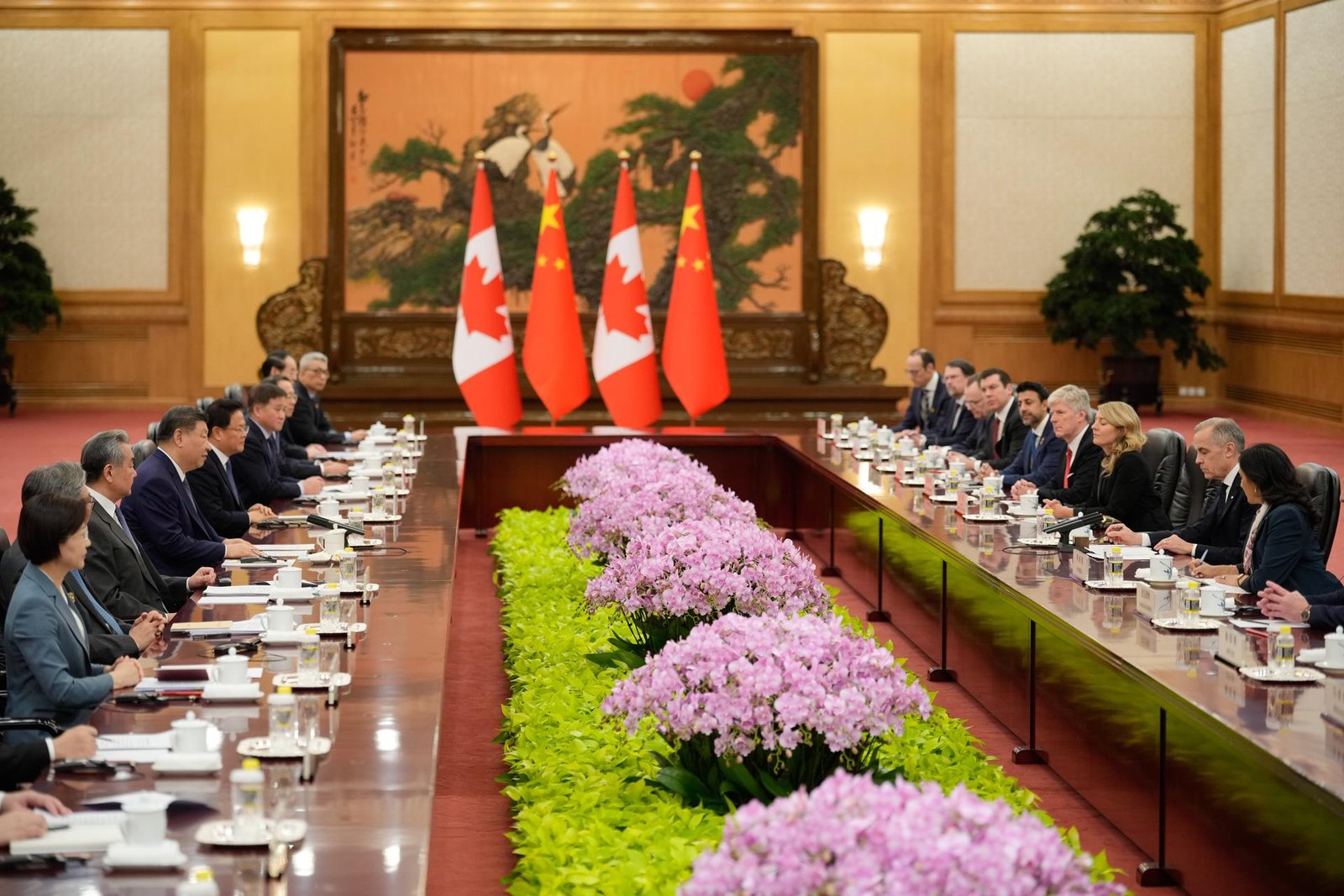
Canadian Prime Minister Mark Carney announced this Friday (16) that Canada and China have signed a preliminary trade agreement to reduce tariffs and remove surcharges on several Canadian agricultural products, which Ottawa expects to come into force on March 1, after two days of meetings in Beijing.
Speaking to the press at the end of his meeting with dictator Xi Jinping, Carney said that China plans to reduce tariffs on Canadian canola to a combined rate of around 15% – a significant drop from the current level of 84%.
In addition, products such as peas, lobsters and crabs will no longer be subject to “discriminatory tariffs” from March 1st, remaining so at least until the end of this year.
According to the head of the Canadian government, these measures could generate almost US$3 billion in new export orders for the country’s farmers, fishermen and processors.
The Canadian Prime Minister stressed that the agreement is preliminary in nature, but assured that his Executive has a “high degree of confidence” in its implementation.
“We expect that, from March 1, before the planting season, tariffs on canola will fall from around 85% to a combined rate of approximately 15%,” he said, referring to the technical formulation of the understanding reached.
Carney framed these measures as an expansion of bilateral trade, especially in the agri-food sector, which he described as one of the traditional pillars of the relationship between nations.
“For more than six decades, Canada has been a reliable partner for China in food exports,” he noted, recalling that Canadian agricultural sales to the Chinese market exceed US$7 billion annually.
The leader of the Canadian Liberal Party added that the agreement could facilitate advances in other segments of the primary sector. “We hope to see a resolution to many long-standing obstacles in a number of important agricultural sectors, from beef to pet food,” he said.
Electric vehicles and industrial investment
In addition to the agricultural sphere, Carney announced advances in industrial trade by confirming that Canada will allow the entry of up to 49,000 Chinese electric vehicles per year into its market, under the most favored nation tariff of 6.1%.
The Prime Minister detailed that this volume “represents a return to the levels observed in 2023” and is equivalent to “less than 3% of the Canadian automobile market”. The head of government defended that the agreement foresees that a growing part of these vehicles will be located in the lower price segment.
“An increasing portion of these exports will correspond to electric vehicles with an import price of less than US$35,000”, he declared, highlighting that the understanding opens the door for Chinese investments in Canada for the local production of vehicles in the coming years.
Carney linked these measures to a broader objective of commercial and industrial diversification, maintaining that the agreement provides for a review of its terms in the medium term. “This agreement provides for a review after three years, in any case within a reduced volume in the Canadian market as a whole,” he explained.
The Canadian Prime Minister’s visit to China – the first by a head of government from the North American country in almost a decade – comes after years of commercial and political frictions that significantly affected bilateral exchange, particularly in the agri-food sector.
Ottawa is now seeking to normalize these flows in an international context marked by trade tensions and the reconfiguration of global supply chains.
With the new agreement, Canada seeks to diversify its trade and reduce dependence on the USA, a country with which it has been facing friction for almost a year. On the other hand, China seeks to attract former partners of the Americans who are frustrated with the protectionism of the Donald Trump government.
