
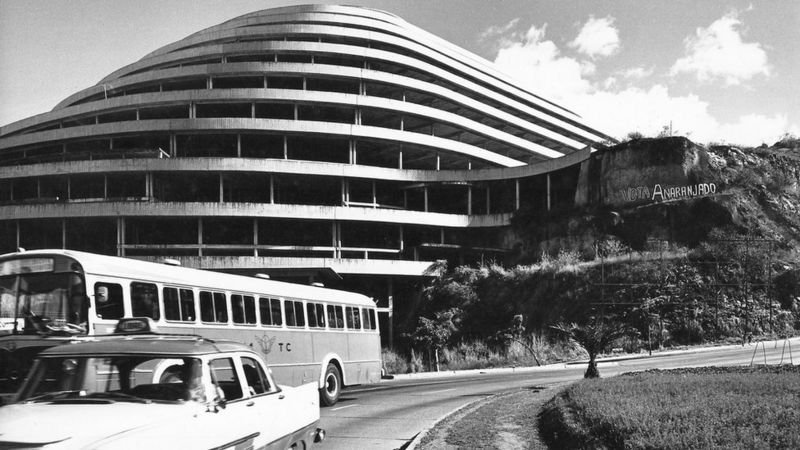
The original project was an ode to capitalism. In the 1950s, it was supposed to be a luxury shopping center in Caracas. Consumers could even drive their car to the store’s doors, drive-thru style. There were spiral ramps leading to 300 stores. Under the shadow of Chavismo, the concrete dream became a nightmare: welcome to El Helicoide.
In 1984, the site became the headquarters of the Dirección de los Servicios de Inteligencia y Prevención (Directorate of Intelligence and Prevention Services, DISIP), the country’s first intelligence service. With Chávez’s arrival in power at the end of the 1990s, the environment was transformed: the former spaces reserved for stores became cells. The rooms, centers of repression and torture of the dictatorial regime.
With the capture of dictator Nicolás Maduro in the early hours of this Saturday (3), a new doubt hangs over the dark slopes of this structure.
What will be the future of El Helicoide?
For now, the inmates, of course, remain. The uncertainty about the fate of the political prisoners who remain there is agonizing. But, looking ahead, will the building return to its original vocation as a capitalist shopping mall? Or should it be preserved as a solemn “Museum of Memory”, an eternal monument so that future generations will never forget the crimes committed in the name of the Bolivarian revolution?
The building’s history is, in itself, a metaphor for Venezuela itself. Started during the government of General Marcos Pérez Jiménez, the work stopped after his fall in 1958. It was abandoned. Taken by homeless people. Until the State decided, in the 80s, to install its security agencies there.
With the rise to power of Hugo Chávez in 1999, and then with Nicolás Maduro in 2013, year after year the Chavista regime was literally throwing cells of 12×12 common criminals, suspected of “treason” and political opponents into cells.
Who was in Helicoide
In recent decades, Helicoide’s makeshift cells have received forced guests such as María Oropeza, a member of the campaign team of Venezuelan opposition leader María Corina Machado, winner of the 2025 Nobel Peace Prize. Opereza was kidnapped by the regime in August 2025 and kept without communication for months.
Alfredo Díaz, former governor of the state of Nova Esparta, died in Chavista custody in December 2025. Accused of “terrorism”, he was apparently denied medical care. Officially, he died of a heart attack.
Rocío San Miguel is another well-known “guest”. Lawyer and human rights defender, arrested in 2024, accused of conspiracy.
Rosmit Mantilla, Venezuela’s first openly gay deputy, arrested in 2014, also passed through there. Another example is Roberto MarreroJuan Guaidó’s chief of staff in 2019, another opponent of Maduro who was recognized as interim president by several countries.
In addition to them, there are students, military dissidents and ordinary citizens who spent days and nights literally in the depths of a spiral of hatred.
What is hell called Helicoide?
Reports compiled by Venezuelan journalist Sebastiana Barraez and international investigations, such as the production of a BBC documentaryseem like a description of Dante’s Inferno. The journalists who passed by saw and heard from prisoners: Helicoide does not have adequate cells, ventilation or sanitation.
Offices, bathrooms and warehouses became dungeons. There are places with names that sound like bad jokes, like “The Aquarium”. Another, apparently the worst, is the sector known as “Guantánamo”: a 12-meter warehouse with no light, no water and no bathroom. There, according to reports, the regime gathered up to 50 people simultaneously. The smell is described as unbearable, with inmates forced to urinate in plastic bottles and defecate in bags.
Inhuman rights and institutionalized torture
The “humane treatment” charade was only for international visits. Maduro had the torture center “cleaned” before a visit by the United Nations (UN) human rights commissioner, Michelle Bachelet, in 2019.
But without the illustrious visitors around, Sebin’s interrogation methods sought confessions at all costs, recalling memories of former South American dictatorships.
There is no shortage of reports: systematic use of electric shocks applied to sensitive parts of the body, such as testicles and stomach; plastic bags covering heads (even with bags containing human feces; brutal beatings; “crucifixion” with people hanging by the wrists; psychological torture, such as mock executions with guards laughing at others’ despair.
Helicoide’s infamy went beyond the boundaries of journalistic denunciation and became the subject of study and documentary. The production “El Helicoide: The Shopping Mall That Became a Torture Prison” (BBC News) is an example. The work details how this icon of Venezuelan modernity became the symbol of its ruin.
As we witness the downfall of Nicolás Maduro, the Helicoide remains there, static, like a concrete scar in the Venezuelan capital. At least until he gains a new, less dark destiny.
