
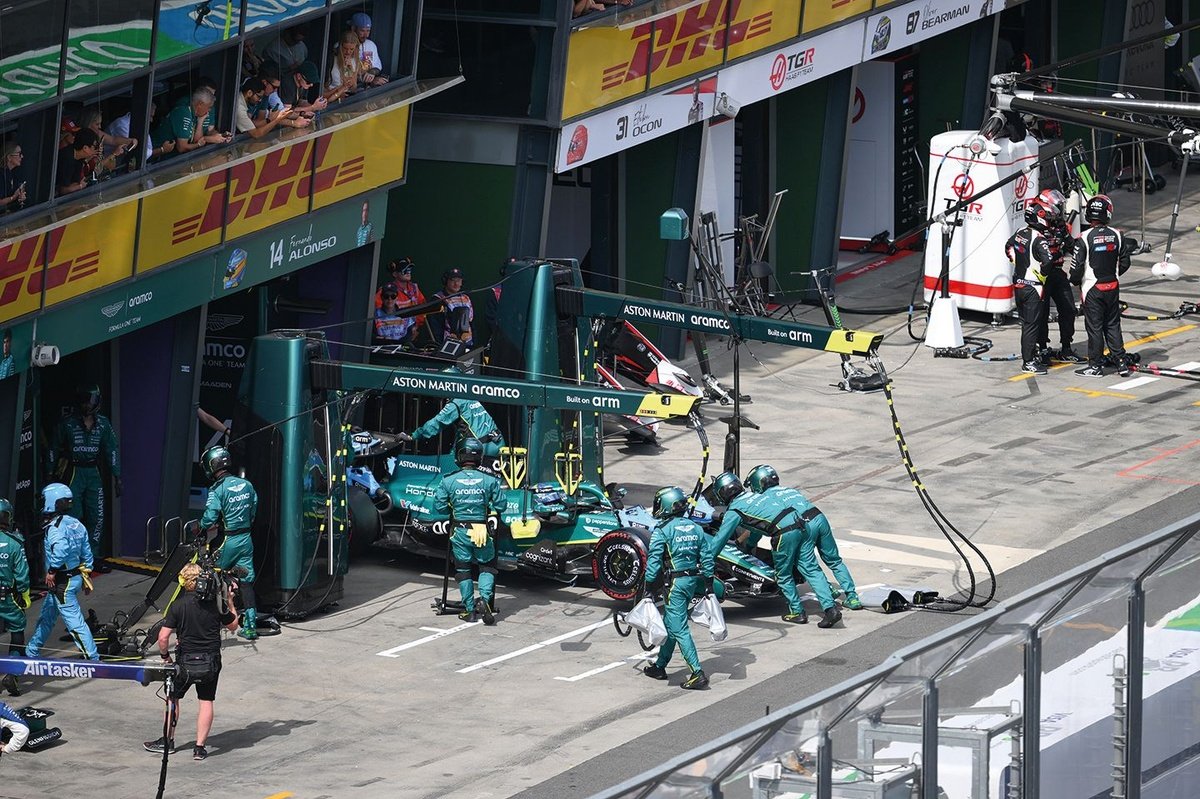
Before the start of the Formula 1 season, ambitions were high at Aston Martin and the goal was clear: to dare to dream. But even before hitting the track, those dreams had to face a harsh reality, marked by Honda’s shortcomings and, soon after, the need to intervene on the chassis side as well. The situation has been made even more complicated by the fact that the AMR26 has logged very little track time compared to its rivals.
The Japanese power unit manufacturer is working hard to remedy a situation that currently leaves it with the least competitive engine on the grid, both in terms of power and reliability, alongside a reorganisation of the working group following the success it previously achieved with Red Bull. Vibration issues have also affected the project since winter testing, significantly limiting mileage and slowing the entire development process.
From Bahrain testing through Suzuka, Honda continued development work together with Aston Martin, because there are issues with not just the power unit but the entire package.
Honda engineers have repeatedly explained that the engine vibrations are not caused solely by the PU itself, but are amplified by the chassis, which effectively behaves like a resonance chamber. It is therefore no surprise that Andy Cowell was moved from his team principal role to act as a bridge between Silverstone and Sakura.
The vibrations were so severe that they not only knocked out several batteries, but also made it difficult for the drivers to complete an entire race distance. In China, Fernando Alonso was even forced to retire due to severe discomfort. At Suzuka, the first corrective measures arrived and the Spaniard finally managed to finish a race in 2026. It was a step forward, but the road to solving the issue remains long.
Why the AMR26 stayed in Japan after Suzuka
After the home race, Honda took advantage of the enforced break and the proximity to organise a different kind of work programme. After the grand prix, one of the AMR26s did not immediately return to Aston Martin’s Silverstone base, but instead remained at the Sakura factory for more extensive dyno bench testing.
Lance Stroll, Aston Martin Racing
Photo by: Alastair Staley / LAT Images via Getty Images
Since the start of the season, Honda engineers had already kept a complete monocoque at Sakura for dyno testing, essential for reproducing what happens on track without physically running on a circuit, with support from Aston Martin engineers who had been sent there.
However, having the chance to work directly on one of the two AMR26s represents a valuable opportunity: it allows the team to study the vibration phenomenon under more realistic conditions and develop more targeted countermeasures to try to contain it.
“It has been a long but intense period between the races with lots of work happening in collaboration with Aston Martin F1 both in Japan and in the UK. The Japanese Grand Prix showed that the work is going in the right direction and helped us to find the motivation to keep pushing forward,” explained Shintaro Orihara, Honda F1 trackside general manager.
“After that race, we took the opportunity to keep one of the AMR26 cars on site for further static testing in Sakura for the first time, focusing our efforts on reducing the vibrations and thus increasing reliability.”
More fixes coming in Miami, work also focused on drivability
According to Honda, further improvements should already arrive in Miami, likely more related to the integration between engine and chassis than to the power unit itself. On that front, the physical interventions currently allowed are still very limited, and more significant modifications will have to wait for the ADUO.
“Realistically, this progress will not have a visible impact on the power unit performance on track,” Orihara added. “So, we shouldn’t be expecting big jumps forward here. Miami is the first circuit on the 2026 calendar with lots of slow speed corners. It is a unique track, having two long open-throttle sections, and several slow speed corners. This combination makes it interesting to find the car setting compromise.”

Honda Power Unit Launch
Regarding performance goals, aside from unlocking power – which will only be possible by intervening on the hardware with the arrival of the ADUO – there is still considerable room for improvement on the software side, where the parameters allow more freedom of action. However, it should be remembered that from a certain point in the season onward, software updates will also be limited, so each intervention will need to be planned more carefully.
On the drivability side, the drivers have criticised not only some characteristics of the AMR26 chassis, which lacks downforce in fast sections compared to the competition, but also the behaviour of the power unit.
“On the power unit side, it’s about improving driveability through the slow speed sector,” Orihara said. “Optimising energy management in this section is a key factor to maximise performance.”
With Bahrain and Saudi Arabia – despite being night races – being among the hottest events of the season, the Miami Grand Prix will be the first real test for the power units under scorching temperatures. During pre-season testing in Sakhir, when the car also ran during the day, the AMR26 featured numerous cooling openings for heat dissipation, something Orihara himself emphasised in his analysis.
“Miami is also the first warm race weekend of the season, so it’s paramount to keep the power unit temperatures under control under these new regulations,” he said. “The Miami Grand Prix is a sprint weekend which means we only have one practice session – albeit 90 minutes – to optimise all of the data settings under the new regulations and define the best cooling specifications ahead of Sprint qualifying, which makes FP1 here very important.”
We want to hear from you!
Let us know what you would like to see from us in the future.
– The Autosport.com Team
