
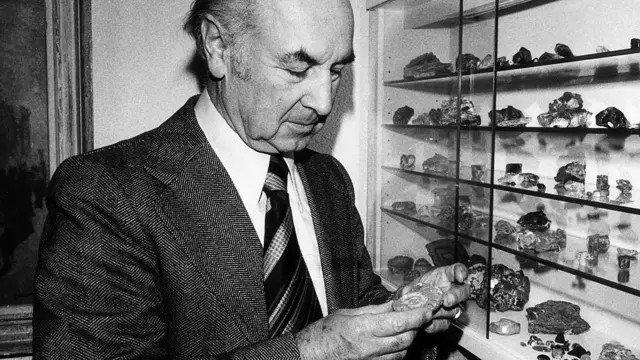
Albert Hofmann discovered the hallucinogenic effects of LSD by chance in April 1943 Getty Images Important: this report contains detailed descriptions of drug use. “At the end of the synthesis, I had a very strange psychic situation. A kind of dream world emerged, a feeling of oneness with the world.” Swiss chemist Albert Hofmann (1906-2008) was working on a routine experiment at a pharmaceutical company in Basel (Switzerland), when he made, by chance, a discovery that changed the world. He was the first to experiment, in a gentle and mysterious way, with the substance that would become known as LSD. And his decision to take the psychedelic drug three days later brought terrifying visions and one of the strangest bike rides in history. It all started on Friday, April 16, 1943. He was preparing a new batch of lysergic acid diethylamide, a compound that he himself had first synthesized five years earlier. The chemist was 37 years old at the time and studied medicinal plants. Hofmann was experimenting with ergot, a type of fungus that grows on corn. Their goal was to try to produce a medicine that could help pregnant women avoid postpartum bleeding. The substance’s name in German is Lysergsäurediethylamid, which led to its better-known name: LSD. The BBC interviewed Hofmann in 1986. He stated that his unexpected experience with the drug made him recall “mystical” childhood moments spent in woods and forests. The feeling of “observing the true aspects of nature, the beauty” filled the scientist with joy. Hofmann wondered if this pleasant dream state was somehow linked to the LSD crystals he was purifying. He had not deliberately ingested the compound, but he may have had a small amount of the substance on his fingers. This would indicate that it was something very potent and the chemist decided to find out by experimenting on himself when he returned to work on Monday. Cautious by nature, he started with what he thought was the smallest dose that would have any effect. “I started with 0.25 milligrams,” Hofmann recalled. He planned to increase the dose only if nothing happened. “But even this very small dose, the first planned dose of my experiments, was very, very strong,” he says. After taking the drug, Hofmann began to feel unwell and staggered home through the streets of Basel on his bicycle. Along the way, everything became strange. His vision became distorted, as if he was looking into a distorting mirror. And by the time he got home, his sense of reality had disintegrated. Albert Hofmann argued that LSD could be useful in psychiatry and only becomes “very, very dangerous” when taken recklessly Getty Images When he entered his living room, Hofmann was surprised to observe how completely it seemed to have changed. “The room itself and the objects inside it had a very different shape, different color, different meaning,” he told the BBC. Even an ordinary chair appeared to be a “living object”, as if it were moving. “It was so unusual that I really feared I had gone crazy,” Hofmann recalls. The bizarre hallucinations continued throughout the night. A neighbor was kind enough to bring him milk as an antidote, but she seemed to have turned into a witch. “At times, Hofmann felt as if he had died and gone to hell,” explains the BBC reporter. The chemist only felt like he was returning to the normal world about six hours after taking the drug. Undeterred by this alarming experience, Hofmann would take LSD several more times in the decades that followed, to observe its effects. His bicycle ride from the laboratory to home, on that Monday in 1943, is celebrated every year, on April 19th, by people inspired by LSD, whether scientifically or creatively. In 1985, professor Thomas B. Roberts, from Illinois, in the United States, coined the expression “Bicycle Day” to designate the anniversary. Hofmann told his discovery to his boss at the pharmaceutical company, Sandoz. Based on the effect of LSD on him, the chemist calculated that one teaspoon would be enough for 50,000 people. He and his colleagues “quickly realized that this was a very important agent that could be useful in psychiatry and research.” Sandoz began distributing LSD to psychiatric hospitals, in an experimental drug called Delysid. Some psychiatrists administered it to patients because of its effects on the subconscious mind, which allowed them to release suppressed memories and mental conflicts. LSD spreads around the world The effects of this powerful new substance caught the attention of the American Army, which began a highly secret research program, known as MK-Ultra. Ken Kesey (1935-2001) was one of the civilians exposed to LSD during this research. He would later write the book One Flew Over the Cuckoo’s Nest (Ed. Record, 1976), which gave rise to the film of the same name starring Jack Nicholson. “I decided it was too important to leave in the hands of the government,” he told the BBC. Impressed by the hallucinogenic power of the drug, which was still legal at the time, Kesey began distributing it to his friends. And in 1964, he brought together a group of like-minded people. They called themselves the Merry Pranksters (“Happy Pranksters”, in free translation) and traveled across the United States in a bus painted in bright colors. This is how LSD left the laboratories and reached the entire country, fueling the counterculture experience. At the time, it was already known that LSD users risked experiencing so-called bad trips — terrifying spirals of fear and panic that can cause permanent psychological damage. Still, many people taking the drug championed its potential to change the world for the better. One of the most active promoters of LSD was the former psychologist at Harvard University in the United States, Timothy Leary (1920-1996). His famous catchphrase “turn on, tune in, drop out” became a defining slogan of the psychedelic era. Leary wrote to the Swiss pharmaceutical company in 1963 with a request for 100 g of LSD, enough for two million people. The letter was addressed to Hofmann. Already alarmed by the abuse of his discovery outside the field of medicine, Hofmann recommended that Sandoz not fulfill Leary’s order. “I immediately realized it would be dangerous because a substance with such a profound effect must be used with care,” he told the BBC. Ken Kesey’s ‘Merry Pranksters’ set out across the United States in a brightly painted bus (pictured, parked on a New York street in 1964) Getty Images Hofmann noted that ancient cultures and indigenous communities had used hallucinogens for centuries, but only in religious settings and always “in the hands of the shaman, not in public.” He highlighted that, in modern society, the closest equivalent to the shaman, in this case, is the psychiatrist and that these drugs “should remain in the hands of the shaman.” That’s why he feared from the beginning that “bad things could happen” with reckless and uncontrolled use of LSD. And he felt that his fear was subsequently confirmed. It is estimated that more than a million Americans took LSD in 1969 without medical supervision. Many found the dark side of its effects on the mind unbearable. But Hofmann said he never felt guilty because “it’s not the LSD that’s bad.” He argued that, if consumed properly, LSD is not a harmful substance. It only becomes “very, very dangerous” when it is taken recklessly and without respect for its “profound influence on society and even on conscience.” But with so many people taking the drug carelessly, amid an ever-increasing number of press reports about its harmful effects, regulation soon became inevitable. The 1971 United Nations Convention on Psychotropic Substances imposed strict international control over LSD, which would be banned in many countries. LSD is currently illegal throughout most of the world and remains under strict control in countries that allow its use for medical research. The substance’s powerful effect on the mind and the risk of long-term flashbacks have led to it being classified alongside cocaine and heroin due to its high potential for abuse. Albert Hofmann died in 2008, aged 102. He told the BBC that the main insight gained from his experience with LSD is that “reality is not something fixed, but rather ambiguous.” “Before, I always thought that there was only one reality, one true reality. And then I realized that there are other dimensions,” he said. The title of his autobiography, LSD: My Problem Child (“LSD: my problem child”, in free translation) reflects his ambivalent stance towards the drug. But he maintained his faith in LSD’s therapeutic potential. “I believe that if people learned to use the vision-inducing ability of LSD more wisely, under appropriate conditions, during medical practice and in conjunction with meditation, this problem child could, in the future, become a child prodigy.”
Source link
The bizarre story of the world’s first LSD trip
22

previous post