
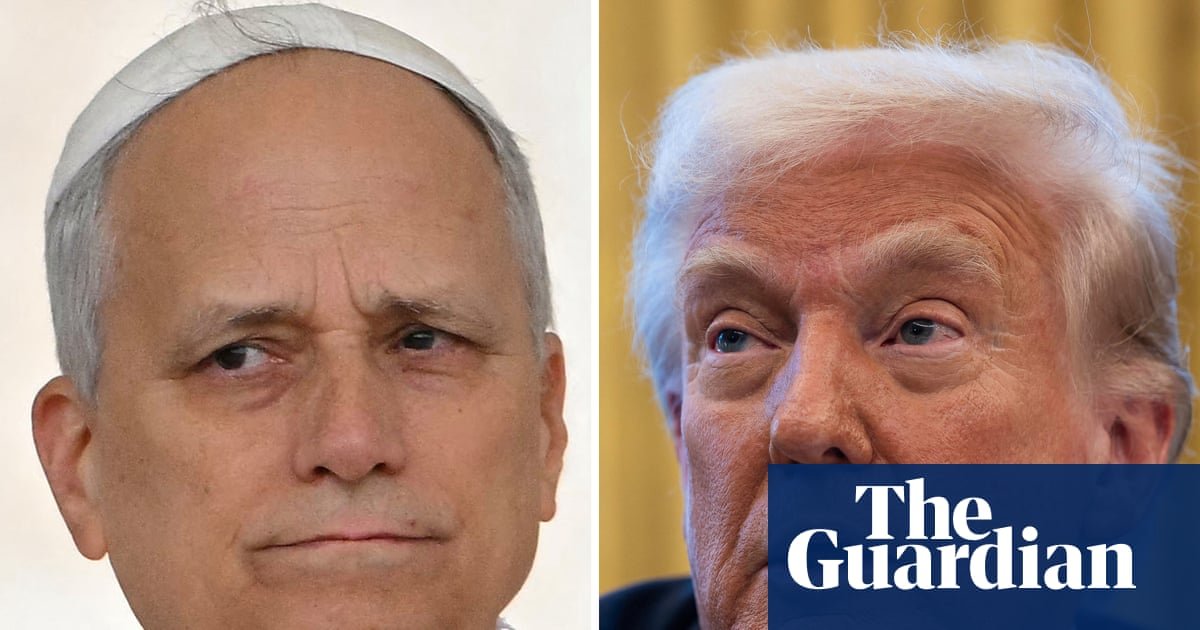
Alex Sullivan tended to his five children on the lawn after a traditional Latin mass at the Catholic Church of Saint Monica in Duluth, Georgia, and contemplated his faith in the light of God and the shadow of Donald Trump.
Sullivan, a self-described conservative who once staffed a libertarian state representative at the Georgia capitol, described his faith as almost medieval.
Trump got “over his skis a little bit” in his criticism of Pope Leo XIV, but Sullivan said he rejected the idea that the US president’s comments in response to pontifical criticism of the war in Iran might diminish his opinion about the leader of the Catholic church.
“No, I will not support the pope any less,” he said. “There have been times in the past when this pope or the prior pope have done things that I struggle with. Usually I have to pray about it, and sometimes I have to be OK with not being OK with what he said and just living in that tension.”
That tension between faith and politics typifies the American Catholic experience, perhaps never more so than in the past few weeks. Pope Leo has advocated for peace in the Iran conflict from the moment the US began bombing on 28 February, proclaiming on Palm Sunday: “Brothers and sisters, this is our God: Jesus, King of Peace, who rejects war, whom no one can use to justify war.”
“He does not listen to the prayers of those who wage war, but rejects them, saying: ‘Even though you make many prayers, I will not listen: your hands are full of blood,’” the pope added, quoting scripture.
On Easter Sunday, Trump threatened to bomb civilian infrastructure in Iran unless the regime opened the strait of Hormuz. Two days later, the US president again made extraordinary threats. “A whole civilization will die tonight,” he wrote on Truth Social. Leo XIV called this threat “unacceptable” and asked the public to “contact the authorities – political leaders, congressmen”. On 12 April, three American cardinals appeared on 60 Minutescalling into question the morality and ethics of US attacks on Iran. Trump exploded on social media later that night in a lengthy post on Truth Social, calling the pope “WEAK on Crime, and terrible for Foreign Policy” and claiming that Leo’s ascension as the first American-born pontiff should be considered a response by the church to Trump’s election.
The president subsequently posted an AI-generated image depicting himself as Christ. Trump subsequently removed the image and claimed he thought he was being depicted, in a flowing red and white robe before a heavenly host, “as a doctor”.
On Sunday, Catholics around Atlanta treated the president’s comments toward the pope with disdainful resignation.
“I think there’s been a long history of the Roman emperor – the large hegemony political figure – fighting with the Holy Father,” said Alex Aboutanos, a software engineer in Duluth. “There’s nothing new under the sun here. There can be legitimate political disagreement about what’s the right move.”
The tone of the president has been a problem, Aboutnas said. “I can disagree with my own personal father, but I don’t speak to him like that. I don’t name-call him. I have to listen to what he says and then disagree. That’s not proper. And as to the image … that move was wrong, and I think he recognized that, and it was a rare move where he actually removed it. Which tells me that … I’m not going to say that he recognized his fault, but his PR guy recognized the fault.”
The AI image also crossed a line for Nick Dicarlo, an operations manager in Duluth and a self-described conservative.
“In terms of his depiction of himself as our Lord, you know … that’s a pretty major problem. I don’t know what he’s thinking there,” Dicarlo said. “Really, what he needs to do is publicly recant it because that’s something that needs some reparation.”
The AI meme image was a bad idea, said Kate Stroth after mass at Atlanta’s Cathedral of Christ the King. She and her husband, Dave, self-identify as political conservatives and Trump voters.
“I didn’t like it, and it’s one of the first things that he’s ever done that I was just strongly opposed to,” she said. “And some of the harsh words may be a conflict, but that’s typical. Nobody’s going to be perfect. Not even the pope. Not even Donald J Trump. He’s not a Catholic, so it hasn’t changed my opinion of him. It actually just shows a lot of blind spots that he might have with regards to faith and his awareness of his own faith, but it doesn’t necessarily change my viewpoint of him as a president.”
Stroth spoke carefully about her views of the pope. “My first inclination has always been that the pope doesn’t really understand the full political landscape, that he has a certain lens that he’s choosing to see it through,” she said. “He’s certainly entitled to his opinion, and there’s nothing wrong with that … I do support what President Trump has done with the military and the action he’s taken, because I kind of see it through that lens, and I think it’s a protective measure.”
Dave Stroth described their voting behavior around issues, not individuals, and the dispute changes nothing about their underlying political interests, “peace through strength, limited crime on streets, proper immigration – all those things we’ve achieved”, he said. “We don’t vote for president for personal reasons. We vote for execution about the job.”
But, “to attack the pope as weak, he probably didn’t need to go there,”he said. “It’s classic Donald Trump, back to The Art of the Deal. If he’s a world leader, he’s fair game, but my pope I’ll protect, so that was probably unkind.”
Many expressed admiration for Leo’s uncompromising position against war as a fundamental expression of Catholic doctrine, and said they viewed attacks on the pope’s call for peace as absurd.
“The president was saying that the pope wanted Iran to have nuclear weapons, and I don’t think the pope said that. The president just says stuff that people haven’t said,” said James Echols after mass at St Patrick’s Catholic church in Norcross. Asked if he viewed the president’s comments as an attack on his religion, Echols replied: “I don’t think he really cares about religion. I think he just says things to try to get people on his side.”
Echols voted for Kamala Harris in 2024. His wife, Maribic Echols, voted for Trump. The president’s comments have caused her to reconsider her support, she said.
“I’ve changed, because this is not what I was expecting when I was voting for him – about the war, and about people being arrested who are not supposed to be arrested,” she said.
About 55% of American Catholics cast a vote for Trump in 2024. Polls suggest Catholic support for the president is eroding as the war, high gas prices, the revelations in the Epstein files and a litany of scandals within the administration take their toll.
“We’re Catholic first. The Republican party does not perfectly align with my views,” Dicarlo said. “They’re just closer than the Democratic party. And they almost always fail to live up to even the principles they say they have. But in some of the core issues affecting our culture … they will at least more slowly do damage than the alternative. So, it has nothing to do with an allegiance to Trump. The fact that I voted for him is not because I saw him as this savior. It was that there’s at least some good there that I think I can vote for and there’s less harm than the other.”
