
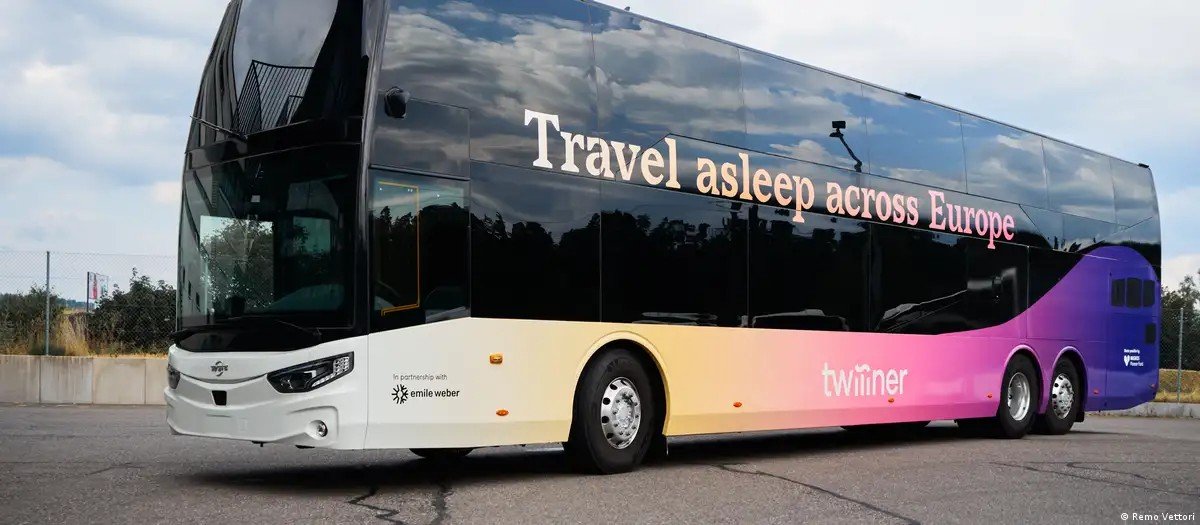
Twiliner sleeping bus Photo: Remo Vettori European passenger transport is undergoing a silent but significant transformation, with the launch of the first sleeping buses equipped with fully reclining beds, a transport model common among transport companies in Brazil, but which in Europe is still in its infancy. 📱Download the g1 app to see news in real time and for free Innovation in Europe is led by the Swiss startup Twiliner, which recently launched the first European sleeper bus service. The proposal appears as a direct alternative to short flights – considered expensive, uncomfortable and highly polluting – and also to traditional night trains, which face continuous price increases and high crowding. See the trending videos on g1 See the videos that are trending on g1 Twiliner has been advertising a seat inspired by aviation business class models, capable of reclining 180 degrees and automatically transforming into a completely horizontal bed at the touch of a button, redefining the standard of comfort in European road transport. Each bed is equipped with complete bedding, pillow, blanket, individual lighting, retractable table, free Wi-Fi and USB-C port for devices. The proposal contrasts with long-distance bus services common in Europe, which have often cramped seats and seats that recline at a maximum angle of 45 degrees, as well as offering few amenities. In the European press, the new sleeper buses have provoked curiosity, with several press outlets from the United Kingdom, Germany and Portugal publishing reports in which journalists tested the “business class” road service. Twiliner sleeper bus interior Photo: Remo Vettori Double-deck bus for 21 passengers The buses have two floors, and on the lower deck there are a bathroom, changing room and a small snack bar with unlimited water and coffee, something that does not exist on conventional European buses and is unusual even on many night railway routes. As the vehicle carries only 21 passengers – 18 on the upper floor and three on the lower floor – the journey takes place in silence, with little movement. Safety, a sensitive point when it comes to traveling lying down, was resolved with a specific system that has a kind of “sleeping bag” affixed to the bed structure, guaranteeing stability even in the case of braking or more pronounced curves. This technology has already been established in Asian and Latin American markets and has now been adapted to the European context. Up to 30 destinations by 2028 The routes currently operated connect some of the most relevant cities on the continent. Among the most popular routes are Zurich–Amsterdam, with stops in Basel, Luxembourg, Brussels and Rotterdam, and also Zurich–Barcelona and Bern–Barcelona, both with a strategic stop in Girona, Catalonia. All trips depart from central regions of cities, eliminating the need for passengers to travel to distant airports – one of the biggest inconveniences of short air travel. Twiliner plans to expand its network to 25 to 30 destinations by 2028, which should consolidate the company as a relevant new mode in European international mobility. The fleet is powered mainly by hydrotreated vegetable oil (HVO, also called renewable diesel). The company claims its buses produce less than 10% of the CO2 emissions of a comparable flight. Even when using regular diesel, which is sometimes necessary, a Twiliner bus is as sustainable as a night train per passenger kilometer, according to the company.
Source link
Europe finally discovers the sleeper bus, and a common model in Brazil grows on the continent
17
