
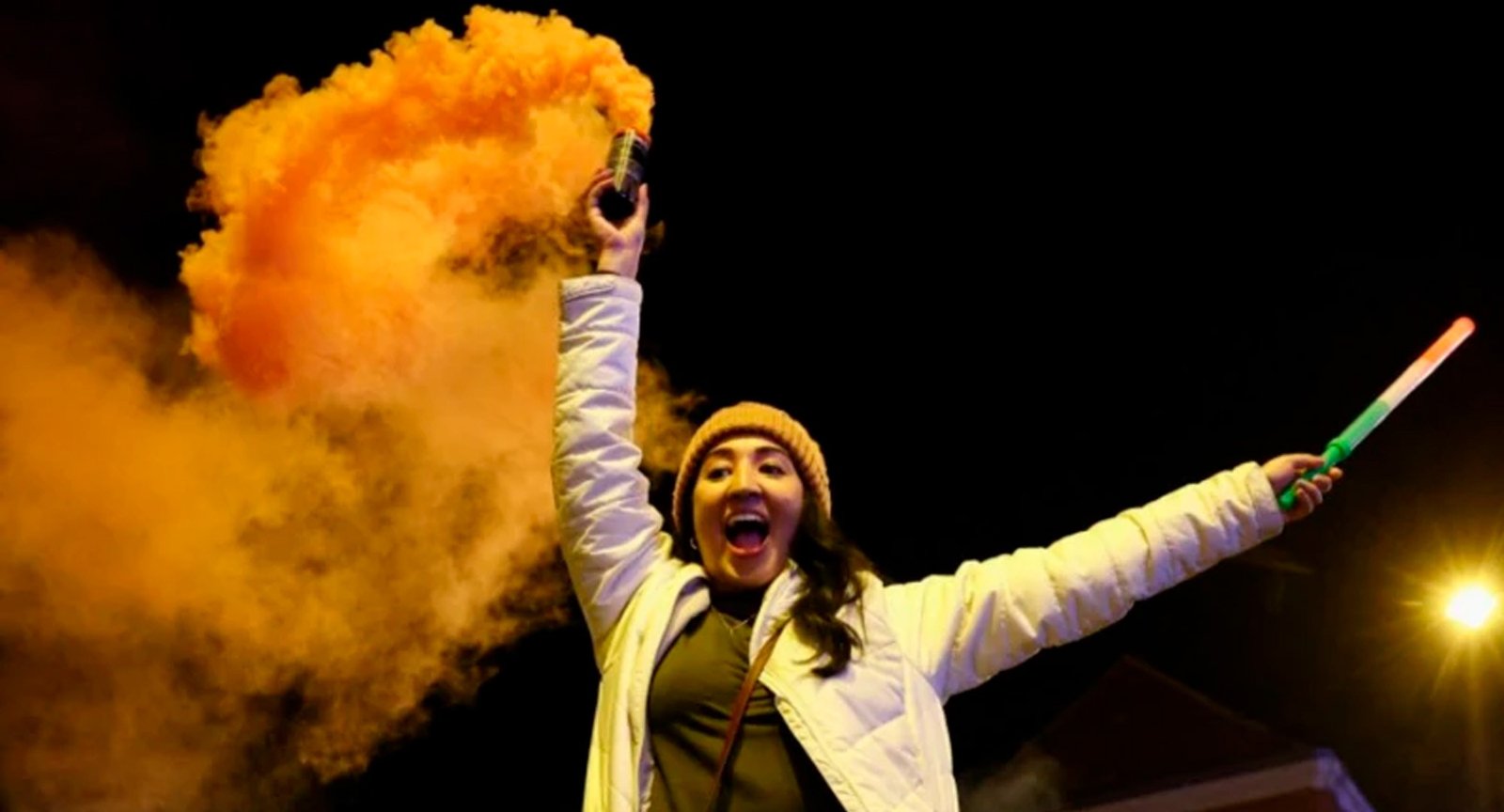
A woman celebrates the election results in Budapest REUTERS Budapest’s iconic Chain Bridge connects the two sides of the city — beautiful Buda to vibrant Pest — over the Danube River. At night, the lights that illuminate the bridge reflect like small moons in the water. The place is usually packed with tourists taking selfies. But last Sunday (12), the scenario was different. Following a historic election result that led to the defeat of Prime Minister Viktor Orbán after 16 years in power, the bridge was lit up in green, white and red, the colors of the Hungarian flag. Supporters of the victorious Péter Magyar and his Tisza party described their feeling as one of regaining their own country. A feeling that Magyar conveyed to them in his victory speech. “We did it,” he said. “We overthrew the Orbán regime; together we liberated Hungary. We reclaimed our homeland! Thank you! Thank you everyone!” Hungarian politician steals the show during celebration of Orbán’s defeat in the elections The atmosphere was historic. Voter turnout was record. Despite Orbán’s iron control over state media, the changes he introduced to the electoral system to favor his party, and the enormous influence his friends and family wield in positions of power in the “illiberal democracy” he claims to have created in Hungary, the Fidesz leader suffered a crushing defeat at the polls. I saw crowds of first-time voters dancing through the narrow streets of Budapest, drunk on a mixture of hope and disbelief in the early hours of Monday morning (13). “I cried when I marked the X on my ballot,” Zofia told me. “I still can’t believe it. But we did it!” As Zofia spoke, her group of friends shouted in chorus: “Russians, go home!” For Orbán, what happened represents an ironic twist in history. The radical right leader rose to fame in 1989 in then-communist Hungary by urging Russians to leave the country in an impassioned speech delivered during the final days of the Soviet Union (USSR). This message first echoed in Budapest during the failed Hungarian anti-communist uprising of 1956. Changing course But over the years, Orbán’s political trajectory changed. He moved further to the right, adopting an authoritarian stance. During this latest election campaign, his old rhetoric from the 1990s was used against him by critics outraged by his long and close relationship with Russian President Vladimir Putin. Orbán’s defeat represents a major blow to Putin, who benefited from an ally within the European Union. Orbán has delayed the implementation of sanctions following Russia’s invasion of Ukraine and has been blocking a major EU loan to Kiev, essential for Ukraine’s survival. But Russia’s loss is Ukraine’s gain. President Volodymyr Zelensky was quick to congratulate Hungary on Sunday night, writing in X that he looked forward to joint “constructive work.” The message is not exactly effusive, as one might expect. Zelensky is well aware that many Hungarians distrust their country. Fidesz spread posters of Magyar and Zelensky across the country, trying to associate the two leaders BBC Orbán used campaign posters and rallies to warn voters that only he could guarantee the safety of the population and prevent the war in Ukraine from spreading across the border, putting the lives of their loved ones at risk. Magyar is likely to tread carefully when in government. He is unlikely to reverse Orbán’s decision not to send military aid to Ukraine for fear of alienating the Hungarians, although he has promised Brussels that his country will stop obstructing the $105 billion loan to Kiev, which Orbán blocked. Farewell to the “Obstructor” Few European leaders will regret Orbán’s departure. In Brussels he was nicknamed “the Obstructor”. But more broadly, it was seen as the breach in a united European front against threats from Moscow, Beijing and, more recently, the United States. On Sunday night, UK Prime Minister Keir Starmer described the election result as historic for European democracy. European Commission President Ursula von der Leyen declared that Hungary chose Europe. In Washington, US President Donald Trump was probably much less euphoric. Hungarian voters ousted their closest ally in Europe. The Republican supported Orbán, and even sent his vice-president, JD Vance, to Budapest in the midst of the war against Iran to participate in a rally in favor of the prime minister. US Vice President JD Vance stands next to Orbán during an event in Budapest the week before the elections REUTERS Why? Both admire the Hungarian prime minister as a leading figure of the Christian nationalist and “anti-globalist” right. Steve Bannon, Trump’s former chief strategist and supporter of populist nationalist movements in Europe, described Orbán as a “hero.” Although some analysts point to Orbán’s defeat as a sign that populist nationalism in Europe has reached a plateau, I prefer to adopt a more cautious stance before endorsing this reading. Family and traditional gender roles It’s true that Marine Le Pen’s National Rally party underperformed in last month’s French local elections and that Italian Prime Minister Giorgia Meloni was recently punished by voters in a referendum on judicial reforms that became a judgment on her tenure — but all of these examples are permeated by national peculiarities. Orbán had long alienated sectors of Hungarian society: the left, the LGBTQ+ community, many women who felt their rights were being eroded by Orbán’s “pro-family, pro-traditional gender roles” agenda. But the final nail in Orbán’s political coffin was driven home when even his most loyal supporters abandoned him en masse. The BBC visited Felcsút, Orbán’s hometown, on the eve of the elections BBC The day before the vote, we visited Felcsút, Orbán’s hometown. Once from humble beginnings, he invested a lot of money in the local community, building his own stadium and football academy. His son-in-law is linked to a luxurious golf course in the region, while his father is rebuilding a nearby private property, which is estimated to cost around US$30 million (R$150 million). Orbán has always denied accusations of corruption, and when Hungary’s economy was healthier, many were willing to virtually ignore the problem. But in recent years, inflation has soared and living standards have fallen, while Orbán’s inner circle appears to be getting richer. “He let us down. He let the country down. He fooled us,” Gyárfás Láh, a former Orbán enthusiast and former local mayor, told me wearily. Who is Peter Magyar? Who is Péter Magyar, the opponent who won parliamentary elections in Hungary Among Magyar’s voters, there is a significant number of Hungarians who voted against Orbán, and not in favor of Magyar himself. He has yet to prove his worth in government. So who is he? What kind of prime minister will he be at home, or as an interlocutor for Hungary’s allies abroad? Well, he is an energetic (during the campaign, he participated in four to six rallies a day), intelligent and photogenic man, 45 years old, former member of Orbán’s Fidesz party. This means that, like Orbán, he is a conservative nationalist. He loves to take a Hungarian flag with him to every political event. It could be argued that Hungarian voters needed a center-right candidate to rally behind before they would consider abandoning Orbán. Hungary is a socially conservative country. It is to be expected that Orbán’s anti-immigration attitudes will continue under the new government, for example. Magyar, however, promised sweeping reforms “to topple the Orbán regime”, including weakening ties with Russia and rebuilding bridges with Europe. For now, most Hungarians say their priorities are internal: improving the country’s economy and public services, which are in decline, reducing inflation and the cost of living. There is much to be done. With a beaming smile late Sunday night, surrounded by jubilant supporters, Magyar told the crowd: “Tonight we celebrate. Tomorrow, get to work!” Magyar will only officially become prime minister when Hungary’s president asks him to form a government. This is expected to happen in about a month.
Source link
What Viktor Orbán’s defeat in Hungary means for Putin, Ukraine and the rest of Europe
12

previous post