
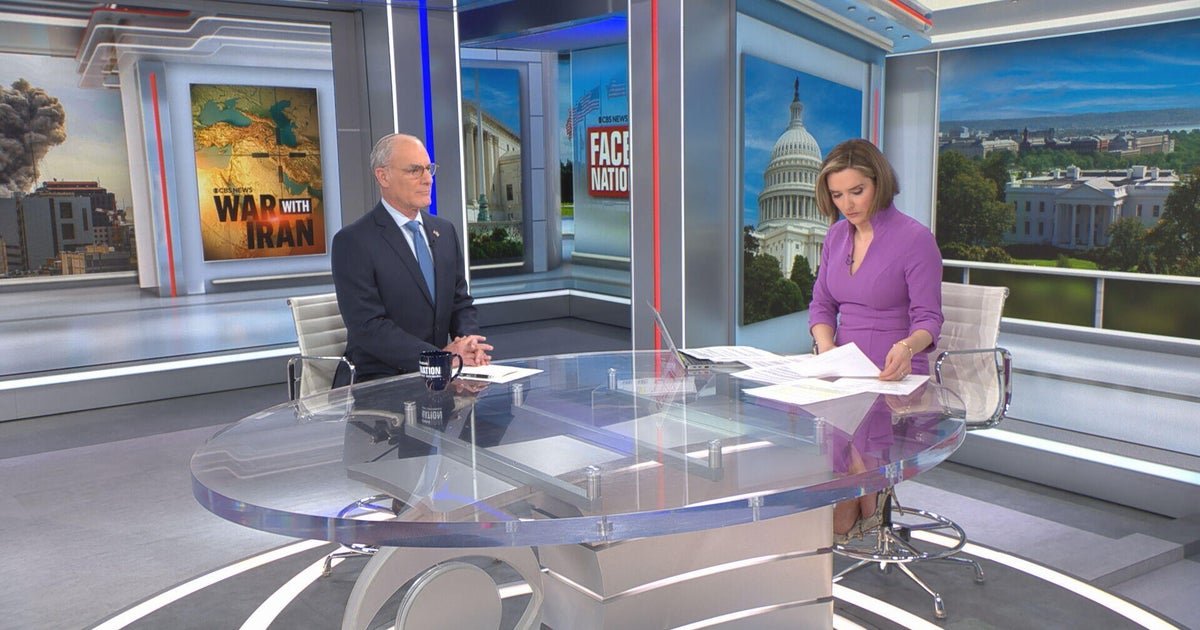
On this “Face the Nation with Margaret Brennan” broadcast, moderated by Margaret Brennan:
- Israeli Ambassador to the U.S. Michael Leiter
- Democratic Sen. Mark Warner of Virginia
- GOP Rep. Mike Turner of Ohio
- Kristalina Georgieva, managing director of the International Monetary Fund
Click here to browse full transcripts from 2026 of “Face the Nation with Margaret Brennan.”
MARGARET BRENNAN: I’m Margaret Brennan in Washington.
And this week on Face the Nation: Vice President Vance returns to the U.S. empty-handed following talks with Iranian leaders. But President Trump now says he’s ordered the Navy to blockade the Strait of Hormuz.
The 21 hours of negotiations ended early this morning in Pakistan.
(Begin VT)
J.D. VANCE (Vice President of the United States): The bad news is that we have not reached the agreement. And I think that’s bad news for Iran much more than it’s bad news for the United States of America.
(End VT)
MARGARET BRENNAN: President Trump and Secretary of State Rubio got the news while they were out for a Saturday night at the UFC fights.
Earlier, Mr. Trump downplayed the significance of the talks.
(Begin VT)
DONALD TRUMP (President of the United States): Whether we make a deal or not makes no difference to me. And the reason is because we have won.
(End VT)
MARGARET BRENNAN: What’s next in the now 44-day war that has sent gas prices soaring around the world? Will the fragile two-week cease-fire hold? And what exactly is President Trump’s goal in the conflict?
We will hear from the Israeli ambassador to the U.S., Michael Leiter, the top Democrat on the Senate Intelligence Committee, Mark Warner, and Republican Congressman Mike Turner.
We will also take a closer look at the war’s impact on the global economy with the head of the International Monetary Fund, Kristalina Georgieva.
And, finally, a bleak week winds up with a very happy ending.
It’s all just ahead on Face the Nation.
Good morning, and welcome to Face the Nation.
As we come on the air, President Trump is weighing in on the outcome of those talks in Pakistan, saying that – quote – “Most points were agreed to, but the only point that really mattered, nuclear, was not.”
He also says the U.S. Navy will begin a blockade of the Strait of Hormuz and that any Iranian who fires at us or peaceful vessels will be – quote – – “blown to hell.”
There’s no word on what Mr. Trump is suggesting was agreed to at this point.
According to our new CBS poll, there is increasing concern about the president’s handling of the war and its impact among Americans. Those factors and more add up to a new low in President Trump’s overall job approval rating for his second term.
The inflation report out late last week did not help. It was the worst of Mr. Trump’s second term, showing a monthly jump we hadn’t seen in nearly four years.
We have got more on our poll later in the broadcast, but we begin with Saturday and Sunday’s dramatic negotiations in Pakistan between the U.S. and Iran.
Our Imtiaz Tyab reports from Islamabad.
(Begin VT)
IMTIAZ TYAB (voice-over): There was a real sense of optimism as Vice President J.D. Vance arrived in Islamabad, along with special envoy Steve Witkoff and the president’s son-in-law, Jared Kushner.
Just hours earlier, the Iranian delegation had also arrived in the capital city led by the speaker of Parliament, Mohammad Bagher Ghalibaf, and Foreign Minister Abbas Araghchi. It was hosted by the Pakistanis, who helped broker the cease-fire so the talks could happen, the first high- level face-to-face meetings between top American and Iranian political leaders since the 1979 revolution.
And after 21 hours of marathon talks, including multiple calls to President Trump, Vice President Vance emerged at 6:00 a.m. local time.
J.D. VANCE (Vice President of the United States): We have made very clear what our red lines are, what things we’re willing to accommodate them on and what things we’re not willing to accommodate them on. And we have made that as clear as we possibly could, and they have chosen not to accept our terms.
IMTIAZ TYAB: According to Vance, the key sticking point was Iran’s refusal to agree to never develop a nuclear weapon. Iran’s Foreign Ministry spokesman, Esmail Baghaei, said the U.S. made – quote – “excessive demands,” but downplayed the apparent breakdown.
(ESMAIL BAGHAEI SPEAKING IN FOREIGN LANGUAGE)
IMTIAZ TYAB: “One should not have expected that we could reach an agreement in a single session,” he said.
And while that may not have been the Iranian delegation’s expectation to end the punishing six-week war, the U.S. delegation left the talks more definitively.
VICE PRESIDENT J.D. VANCE: We leave here with a very simple proposal, a method of understanding that is our final and best offer. We will see if the Iranians accept it.
IMTIAZ TYAB: Throwing into question whether the shaky cease-fire would hold, if further talks would be held, and whether U.S. forces would return to direct combat.
Mushahid Hussain Syed is a member of the Pakistani Senate.
Are the talks dead, and will we see the war restart?
MUSHAHID HUSSAIN SYED (Pakistani Senator): No, talks are not dead. There’s a stalemate. But the fact is that top leadership met face to face. That’s almost a miracle.
And Pakistan pulled it off. So, I think that says a lot. That shows that both sides are ready, able and willing to seek a deal.
(End VT)
IMTIAZ TYAB: And the Pakistani government has said it was – quote – “imperative” the U.S. and Iran uphold the cease-fire and that it would also try to host further talks in the coming days, Margaret, talks which could determine the fate of the Strait of Hormuz and a conflict which has seen global energy prices soar and thousands of people killed.
MARGARET BRENNAN: That’s Imtiaz Tyab in Pakistan.
For more on the peace negotiations, we are joined now by Israel’s ambassador to the United States, Dr. Michael Leiter.
Good morning. Welcome back to the program.
MICHAEL LEITER (Israeli Ambassador to the United States): Good morning, Margaret. Good to be with you.
MARGARET BRENNAN: Israel and the U.S. have been lockstep in this war to date. You heard the vice president sort of leave the door open to diplomacy, but President Trump also said this morning “The U.S. is locked and loaded for an appropriate moment.”
Is it your understanding that Israel and the U.S. will hold fire until the end of this two-week cease-fire?
AMBASSADOR MICHAEL LEITER: We have to remember that the president has been relentless in pursuing an end to this crisis through talks. That’s – the talks preceded the June war. Talks preceded Epic Fury. The talks are going on now.
And I think that, if we can conclude this crisis with Iran, with this regime, this tyrannical regime that’s pursuing nuclear weapons without going back into kinetic activity, it would probably be best for everyone.
The president continues to pursue that. But, right now, they saw face to face – the vice president sat opposite this fellow Ghalibaf, who’s directly responsible for the murder of his own people just in January, this past January, and just saw how obdurate and obstinate they are in pursuit of nuclear weapons.
MARGARET BRENNAN: When you said the talks are still going on, are there – is there any level of U.S.-Iran contact at this point?
AMBASSADOR MICHAEL LEITER: Well, you know, the president gave the issue two weeks.
MARGARET BRENNAN: Yes.
AMBASSADOR MICHAEL LEITER: And we’re just into the end of the first week, so there is another week left for the potential for continued talks.
MARGARET BRENNAN: OK.
AMBASSADOR MICHAEL LEITER: We – we know the Iranians. We know this regime. We don’t think they’re going anywhere, but it’s important to give it a chance.
MARGARET BRENNAN: Vance said “We need to see Iran give affirmative commitment to not seek a nuclear weapon or the tools that would enable them to quickly achieve a nuclear weapon.”
Is your understanding that the U.S. position is zero enrichment? Or are they still leaving the door open that Iran could have a civil – civilian nuclear program for medical purposes?
AMBASSADOR MICHAEL LEITER: Civilian nuclear program doesn’t entail enrichment. There are 57 countries with a civilian nuclear program that don’t have enrichment. They bring the material in.
MARGARET BRENNAN: But they want a little bit. You know that.
AMBASSADOR MICHAEL LEITER: No. No, if they have a little bit, then they can have a lot.
To move from 60 percent, which they had, to 90 percent, look, you don’t build these production plants deep underground if you’re doing it for medical purposes. You have nothing to hide. These people lie. We shouldn’t be surprised when people who murder their own also lie.
This has been their pursuit. They’ve been chanting for 47 years, “Death to America,” “Death to Israel.” That’s their goal.
MARGARET BRENNAN: Right.
AMBASSADOR MICHAEL LEITER: Let’s not be paternalistic about it.
MARGARET BRENNAN: But we’re negotiating with that same regime right now.
AMBASSADOR MICHAEL LEITER: We’re trying at the same time to – we’re negotiating them…
MARGARET BRENNAN: The very same people.
AMBASSADOR MICHAEL LEITER: We’re negotiating them after eliminating their navy, after eliminating their air force, after degrading their leadership. Hopefully, they’ll come to their knees and say, we’re surrendering.
MARGARET BRENNAN: Well, the president has said the war is won. Your prime minister said the work is not yet complete.
Specifically, what part of Iran still poses a military threat to Israel? Do you still consider it an existential threat?
AMBASSADOR MICHAEL LEITER: Well, there are three things that we have to be concerned with from the beginning, number one, the pursuit of a nuclear weapon. If they go back to that pursuit that concerns us.
MARGARET BRENNAN: They say they aren’t…
AMBASSADOR MICHAEL LEITER: Number two, ballistic missiles. OK, these ballistic missiles – they promised, by the way, that they don’t have a ballistic missile that could reach Europe. They lied. We saw that they do.
They will turn…
(CROSSTALK)
MARGARET BRENNAN: You’re talking about the firing on Diego Garcia.
AMBASSADOR MICHAEL LEITER: The firing on Diego Garcia. They said it was limited to 2,000 kilometers. We see now they’ve got 4,000 kilometers. It’s just a sprint to 8,000 kilometers and to hit Chicago or Tenafly, New Jersey.
So, that has to be dealt with…
MARGARET BRENNAN: U.S. intel says nine years.
AMBASSADOR MICHAEL LEITER: … and proxy. Well, our intel says less than nine years, OK?
MARGARET BRENNAN: Yes.
AMBASSADOR MICHAEL LEITER: And our intel has been accurate on this from the very beginning, OK?
Now, it was clear. We said that they’re in a sprint to achieve nuclear weapons. And Mr. Witkoff came back from the talks beforehand and said they came in, they walked into negotiations, said, we’ve got 60 percent ready for 11 bombs.
MARGARET BRENNAN: Yes.
AMBASSADOR MICHAEL LEITER: Eleven bombs at 60 percent means that you got a week or two until you got 90 percent and weapon-grade.
And the last thing, Margaret, are the proxies, OK? We – this isn’t over until there is a complete de-linkage between Iran and its proxies, which have spread death, mayhem and destruction around the Middle East.
MARGARET BRENNAN: I want to come back to that in regard to Hezbollah.
But just to finish what you’re talking about with intelligence, there was this highly detailed “New York Times” report this past week. I know you read it, extraordinary journalism that detailed this February 11 meeting, where your prime minister pitched President Trump on bombing Iran.
It said the Israeli plan was to kill the Ayatollah. Done. Cripple Iran’s ability to threaten its neighbors, spur a popular uprising in Iran, and then conduct regime change, leaving in place a secular leader.
Obviously, all those goals were not achieved. Can you declare an end to the war without achieving that checklist?
AMBASSADOR MICHAEL LEITER: First of all, all of those goals have not been achieved yet. This is a process. This isn’t instant soup, number one.
Number two, I was in the room at that meeting. The journalists who wrote that article were not. And, apparently, they received the information second- third-hand. There’s an awful lot in that article which simply isn’t true, which is a narrative that’s being created, interesting narrative, but not accurate.
So I would be very careful about quoting from that particular article.
MARGARET BRENNAN: Well, specifically, what – what did they get wrong? Because they say your intelligence services, the Mossad, argued the Iranian regime would be so weak it could not choke off the Strait of Hormuz. That was wrong. Iran would have minimal…
AMBASSADOR MICHAEL LEITER: No, no, we didn’t argue that. We argued the potential, that we’ve got to work towards that.
No – nothing was presented as a fact, that, if we do this, this will be the outcome. It’s not science. Politics is not science. Military operations are not science. We presented the case that this is what we think should be done.
The president makes a decision. This whole thing about the prime minister coming in…
MARGARET BRENNAN: Yes.
AMBASSADOR MICHAEL LEITER: … and dragging the president into this, it’s all, you know, for publicity purposes.
MARGARET BRENNAN: Did Mossad believe that there would be protests that would overthrow the regime and that Kurdish fighters would enter through the north?
AMBASSADOR MICHAEL LEITER: The Mossad thought that, as we saw in January, hundreds of thousands and millions of people rise up, the potential for that happening again is even greater now.
And we still think it’s very great. We still think we could – that could materialize over the next couple of months. But there’s no guarantee.
MARGARET BRENNAN: Then why negotiate with the same regime that is suppressing those people?
AMBASSADOR MICHAEL LEITER: Well, you can negotiate…
MARGARET BRENNAN: Is Israel really supportive of this diplomacy?
AMBASSADOR MICHAEL LEITER: You can negotiate. We’re supportive of the president and his efforts, OK?
We’ve been in lockstep from the beginning in the planning, in the implementation, and we’re going to end this thing together as well. So we’re completely supportive of the president’s efforts, both diplomatically and militarily.
MARGARET BRENNAN: On the proxies, “The Jerusalem Post” today is writing that Israel’s war in Lebanon is the price to pay for Iran reopening Hormuz.
The Israeli offensive against Hezbollah – and, for our viewers, they are a political party in Lebanon and they also are Iran’s strongest militia and proxy force. They’ve complicated things here. The Trump administration is holding talks Tuesday in Washington. You’ll be at the table with the ambassador from Lebanon. Hezbollah is not part of these talks.
In that lead-up, is Israel going to pause, reduce the strikes on Lebanon?
AMBASSADOR MICHAEL LEITER: If I can, a point of correction. Hezbollah is a terrorist organization…
MARGARET BRENNAN: It is.
AMBASSADOR MICHAEL LEITER: … which is also a political party. It’s not a political party which also has a terrorist wing. They are a terrorist organization. They’re a proxy of Iran…
MARGARET BRENNAN: Yes.
AMBASSADOR MICHAEL LEITER: … which has an agenda of destroying the state of Israel.
MARGARET BRENNAN: Yes.
AMBASSADOR MICHAEL LEITER: And they fire missiles into our towns and villages.
MARGARET BRENNAN: Yes.
AMBASSADOR MICHAEL LEITER: And we have to respond.
Now, we want to negotiate with Lebanon. Lebanon and Israel can live in peace tomorrow. I believe – you know, we had this initial phone call on Friday. It was a conference call between myself…
MARGARET BRENNAN: You and the Lebanese ambassador.
AMBASSADOR MICHAEL LEITER: … Lebanese ambassador, the U.S. ambassador to Beirut, all moderated by the State Department official Mike Needham.
It was a great conversation. And the thing we all agreed upon, that, if there was – if we just put Hezbollah on the side, and just Israel and Lebanon negotiate peace…
MARGARET BRENNAN: Right.
AMBASSADOR MICHAEL LEITER: … two months, three months, we’ve got a complete peace agreement.
MARGARET BRENNAN: But let me just follow up. You said Israel has to respond. That’s different when it comes to responding to a strike from Hezbollah versus the kind of bombing that we saw this past week, particularly on Wednesday.
The airstrikes killed more than 350 people that day, a third of them women and children and the elderly, according to the Lebanese Health Ministry. The vice president said Israel had agreed to check itself with these strikes. And the president said he spoke with Bibi, your prime minister, and he said he’s going to low-key it.
Can you explain what low-key bombing means? Is this a reduced cadence and volume of strikes from Wednesday? What exactly did the U.S. and Israel agree to?
AMBASSADOR MICHAEL LEITER: Reduce cadence, upped cadence, operational issues aren’t discussed on Sunday morning on television.
MARGARET BRENNAN: Well, the president…
(LAUGHTER)
AMBASSADOR MICHAEL LEITER: Well, what we – we discussed is that we’re going to be in tandem with the president’s efforts in the Gulf, and we support the president’s efforts.
Right now, we are pursuing those who are shooting missiles against our civilians, and the operation Wednesday was targeted against operation centers of Hezbollah. Now, what they do…
MARGARET BRENNAN: You dispute those Lebanese government figures of civilian deaths?
AMBASSADOR MICHAEL LEITER: No, abs – oh, of course. It’s like Hamas releasing figures from Gaza, their Health Ministry.
MARGARET BRENNAN: But you’re – you’re negotiating with the Lebanese government.
AMBASSADOR MICHAEL LEITER: We – we – absolutely. Absolutely.
But the – sometimes, there’s this attempt to paint us as, you know, going after civilians. We’re going after, in a targeted fashion, the terrorist infrastructure. That’s what we focus on.
Now, what they do Margaret, is they put their operation centers, their terrorist centers among civilians. Now, we tell them to get out. They don’t always get out, but we do what we can. Hamas does this in Gaza by building their bases within civilian centers. Hezbollah does it.
And we saw the other day where Tehran sent their civilians out to the bridges and the – energy plants…
MARGARET BRENNAN: Yes.
AMBASSADOR MICHAEL LEITER: … so they wouldn’t be – this is a crime against humanity.
MARGARET BRENNAN: Well, you have your own diplomacy on Tuesday, we will be watching for that and what happens. Thank you for your time this morning.
AMBASSADOR MICHAEL LEITER: Thank you.
MARGARET BRENNAN: We will be right back.
(ANNOUNCEMENTS)
MARGARET BRENNAN: We turn now to Senator Mark Warner. He’s the top Democrat on the Intelligence Committee. And he joins us from Charlottesville, Virginia.
Good morning to you, Senator.
SENATOR MARK WARNER (D-Virginia): Good morning, Margaret.
MARGARET BRENNAN: I want to pick up where we just left off with the ambassador when he was talking about his country’s intelligence estimates versus ours.
He said he was in that room that day when Prime Minister Netanyahu pitched President Trump on this war that the U.S. is now in. He said these press accounts were wrong. In your understanding of U.S. intelligence, is it true the CIA disputed the Mossad’s assessment as farcical?
SENATOR MARK WARNER: Well, Margaret, I was not in that meeting.
I know two things. One, having seen all the intelligence, there was no imminent threat from Iran against the United States. And, two, I take my former colleague and now Secretary of State Marco Rubio at his word when he publicly said, well, we knew the Israelis were going to strike Iran, so we felt we needed to go ahead and strike first, since Iran would attack us.
So, we are where we are, but let’s – no American should forget this is a war of choice chosen by the president. And if we just quickly look at the goals, regime change, frankly, the new leadership is more radical.
Getting the enriched uranium out would require 10,000 troops minimum guarding a perimeter around a bunker where our troops would have to go in and get this very volatile uranium out. The Ukrainian – I’m sorry – the Iranians could bomb that.
We – we’ve taken down a lot of their ballistic missiles. But, as we’ve seen, they still have many left shooting down our planes. Thank God our military is world-class and got those pilots out. But they literally have thousands of drones left.
And this question about what the president is going to do with closing the Strait of Hormuz…
MARGARET BRENNAN: Yes.
SENATOR MARK WARNER: … the Iranians have hundreds of speedboats where they can still mine the strait or put – put bombs against tankers.
And closing the strait, how is that going to ever bring down gas prices?
MARGARET BRENNAN: Well, two things on that just to follow up. That 10,000- troop requirement, is that an official government estimate, and is that in the midst of combat, or is that with Iranian government permission to have boots on the ground?
SENATOR MARK WARNER: This has been – this has been known for – there is a reason – the Iranian regime is awful. I agree with the ambassador on that. They’ve been awful for 47 years.
But there was a reason why previous presidents, including President Trump in his first term, didn’t choose to go to war.
MARGARET BRENNAN: Yes.
SENATOR MARK WARNER: Because this is extraordinarily complicated.
The fact that the president acts like he’s surprised the Iranians closed the strait or would attack our Gulf allies, anybody who would have read the intelligence would’ve known that was first.
The ability to protect our soldiers would require, every estimate I have seen, at least 10,000 troops guarding a perimeter, sending troops into these bunkers for days on end, very vulnerable. The Iranians still have ability to bomb their own bunkers. That is again a reason why I think action like this has not been taken before.
MARGARET BRENNAN: So, CNN is reporting that – and “The New York Times” – that China is set to deliver new air defense systems to Iran within the next few weeks. The Israeli ambassador previously has acknowledged that China was considering helping – helping Iran.
How significant would you describe Beijing’s support at this point?
SENATOR MARK WARNER: I would describe it as significant.
But they try to hide themselves. China says, well, this is their private sector. We all know there is no such thing as a true private sector in China. Every company in China has to have its first loyalty to the Communist Party.
But what we have done – let me also point out, Margaret, by the Trump administration releasing sanctions on Russian oil, that’s $10 billion to Putin. More crazy is, by releasing sanctions on Iranian oil at sea, we have literally funded the Iranian government $14 billion that they’re using to buy from China and elsewhere weapons to attack our troops.
That is insanity, in my mind.
MARGARET BRENNAN: But you’re talking there about President Trump’s efforts to try to, you know, lower oil prices through those measures.
I want to ask you, though, on the broader point, in our polling, we see broad dissatisfaction with how the administration is handling the war. But, as for, you know, the aspirations, Americans broadly support them; 87 percent say strait of Hormuz needs to be reopened; 81 percent want to ensure freedom for the Iranian people; 76 percent want to permanently stop Iran’s nuclear program; 55 percent want the current leaders ousted before we end the war.
Do you sort of want to see us finish what America has started here? Can you really just hit the brakes?
SENATOR MARK WARNER: Margaret, I agree with all of the goals of the American people.
But when you take – ask the next question, are you willing to put your sons and daughters in a ground war in the Middle East to get that enriched uranium out, I have not found any volunteers on that.
The Strait of Hormuz was open before this war started.
MARGARET BRENNAN: Well…
SENATOR MARK WARNER: Gas in Virginia was $2.81 40 days ago. It is over $4 now.
Even if the president declares victory tomorrow, those high gas prices will be with us for months.
MARGARET BRENNAN: Yes.
SENATOR MARK WARNER: And it’s natural gas, not just gasoline. Asian countries are shutting down their economies one day a week because the price of oil has skyrocketed so much.
We buy a lot of stuff from Taiwan…
MARGARET BRENNAN: Yes.
SENATOR MARK WARNER: … South Korea and countries around Asia. All those prices are going up.
MARGARET BRENNAN: And we will – we’re going to talk about that with the IMF director later on.
But just to put a fine point on it, does this mean you would not vote for a supplemental funding request if the president needs more money to finish what he started?
SENATOR MARK WARNER: I will take a look at anything. I want to make sure our troops, who’ve done magnificently – but this president should have come to the American people and Congress first and say, I’m going to choose to go to war. Here’s what I want to try to accomplish.
Those four goals of regime change, uranium, missiles…
MARGARET BRENNAN: Yes.
SENATOR MARK WARNER: … and the Strait of Hormuz, we only got those goals about 10 days into the war. And on any honest assessment, I don’t think we’ve accomplished any of them so far.
MARGARET BRENNAN: I want to ask you, on another topic, and that is basically congressional inaction.
We’re on day 58 of the shutdown of Homeland Security, in terms of this standoff in regard to funding. Republicans are preparing a plan to fund ICE and to fund a CBP on a party-line vote through a process known as reconciliation.
Democrats had the standoff to demand policy changes that never happened here. What did Democrats actually get out of this?
SENATOR MARK WARNER: Well, Margaret, what we got out of it, at least in the Senate, is we got 100-0 vote saying, let’s fund all of the rest of DHS except for ICE.
That should have, we assume – you had every Republican senator vote for that. And then the speaker of the House, who can’t seem to decide what he wants, rejected it.
MARGARET BRENNAN: Yes.
SENATOR MARK WARNER: I am glad that the president has gone ahead and paying the salaries.
MARGARET BRENNAN: Yes.
SENATOR MARK WARNER: But I think if you ask your same poll questions, do the American people want ICE running around cities…
MARGARET BRENNAN: Yes.
SENATOR MARK WARNER: … frankly, arresting not only undocumented, but Americans…
MARGARET BRENNAN: OK.
SENATOR MARK WARNER: … and putting Americans’ lives in jeopardy, as we saw in Minneapolis, I don’t think they want that going on as well.
MARGARET BRENNAN: Senator – OK, Senator, I have a hard break I got to take here. Thank you very much for joining us.
We’ll be right back.
(ANNOUNCEMENTS)
MARGARET BRENNAN: We will be right back. Stay with us.
(ANNOUNCEMENTS)
MARGARET BRENNAN: Welcome back to “FACE THE NATION.”
Americans are growing increasingly concerned about the war with Iran and its impact. Our latest CBS News poll finds, as the approval of Donald Trump’s handling of the conflict has dropped to 36 percent, back home the president’s ratings on handling of inflation are at the lowest level of his second term with only 31 percent approving.
For more we’re joined by our executive director of elections and surveys, Anthony Salvanto.
Good to have you here, Anthony.
ANTHONY SALVANTO: Good morning, Margaret.
MARGARET BRENNAN: So, what exactly are Americans telling you?
ANTHONY SALVANTO: Well, when I just asked how this war is making you feel, the top answers people give are “worried” and “stressed.” Let’s unpack that. Why?
When they look overseas, they see a lot of important goals for the U.S. Big, bipartisan majorities think it is important too. You can go down the list. Stop Iran’s nuclear program. Make sure the Iranian people are safe and free. Change the regime. Change the leadership in Iran. And, most important, open the Strait of Hormuz.
And what you see is interesting is when you juxtapose that and ask them, well, have those things been done, you see a dramatically different answer because very few people think that they have. What that collectively tells you is, this looks to people like unfinished business. There are goals. OK, the war began. Not everybody liked it. But now they’re saying, make sure it pays off in ways that come back to the U.S.
And let me pick up on that word “pays off” for a second because when they talk about opening the Strait, so really talking about gas prices.
MARGARET BRENNAN: Right.
ANTHONY SALVANTO: And what we’ve seen is people here telling us those higher gas prices are a financial hardship, difficult to pay. And so that is having an impact, both on their views of the economy more generally, as well as their pocketbooks. And you mentioned those ratings at the top. Look, sort of like first rule of politics, gas prices and prices go up and approval ratings start to go down.
MARGARET BRENNAN: Well, the president always uses social media to make, you know, big statements of intent. A few days ago he posted a particularly incendiary one. It said, quote, “a whole civilization will die tonight, never to be brought back again. I don’t want that to happen.” That statement drew rebukes from even some of the president’s closest supporters as well as the pope.
You gauged reaction to that rhetoric. What did the American public think?
ANTHONY SALVANTO: So, by the time we got to talking to the people that had heard and seen that post, and when we showed it to them, the general view was, they disliked it. There were some who said, OK, a little bit more like, and those were folks in the MAGA base, not all, but relatively more.
But it’s also a window into how people process some of these statements. And we’ve been looking at this for ten years, that are, if you will, shattering norms or changing the way things have been done in the past. And that is they thought it was at least as much a negotiating tactic as it was an intention.
MARGARET BRENNAN: So, how does all of that impact how the public views the president’s leadership?
ANTHONY SALVANTO: So, one consistent thing through this war is that most people have said they don’t feel the administration has clearly explained the goals. I followed up on that this week and most folks who feel that way think it’s that the goals have kept changing that they’ve heard. Not that they haven’t articulated anything.
So, there’s that wide array and they’re not clear which one exactly. That relates to most people saying they don’t feel Donald Trump has a clear plan for this conflict. Those two things together speak to that collective uncertainty about it, if you will. And when there’s uncertainty, you inevitably start to see ratings overall and the feeling that the war isn’t going well yet going down.
MARGARET BRENNAN: Anthony Salvanto, interesting stuff. Thank you.
ANTHONY SALVANTO: Thanks.
MARGARET BRENNAN: And we’ll be right back with a lot more “FACE THE NATION.” Stay with us.
(ANNOUNCEMENTS)
MARGARET BRENNAN: We’re back now with Republican Congressman Mike Turner.
Thank you for coming back to town early to talk to us in person.
REPRESENTATIVE MIKE TURNER (R-OH): Thank you.
MARGARET BRENNAN: Let’s start on our polling because you, like many people right now, are running for re-election, right? You look at these – this poll. Sixty-four percent of the American people disapprove of the war, 62 percent say that the president has no clear plan. There are these negative perceptions of the president’s handling of the economy and inflation. Dayton isn’t immune. Gas prices up $1 from where they were same time last year. How are you explaining to people in your district that this war is worth it?
Well, first off, no conflict ever polls well. And when there was a conflict occurring, no one says it’s being handled well, because you – you have to – to go through the conflict. The president has articulated, I think very well, that this is about ensuring that Iran does not become a nuclear state. And no one is willing to trade lower gas prices for Iran becoming a nuclear state.
And when Vice President Vance stood at the podium and said that the negotiations had broken off because Iran was not willing to declare that they would not become a nuclear state, that should have sent a chill both through Europe and around the world. And I think, you know, for everyone because that truly is what this is about. That puts away what, you know, what Senator Warner was trying to dismissively say, that this was not an imminent threat and what everyone else has been saying in Europe and around the world of – of the –
MARGARET BRENNAN: Well, the president says it’s an ambition.
REPRESENTATIVE MIKE TURNER: But that this is an immediate – the IAEA, Grossi, the director, had said they were weeks away from being – having enough material to have a nuclear bomb.
MARGARET BRENNAN: He said there was no evidence that they were pursuing a nuclear weapon. He couldn’t rule it out.
REPRESENTATIVE MIKE TURNER: He said they were – they were weeks – they were weeks away. And now you have it. No longer can people say that they did not – they did not have the ambition. Here they are, all the way at the table, they have been in this – this massive conflict.
MARGARET BRENNAN: Yes.
REPRESENTATIVE MIKE TURNER: And they’re unwilling to say they’re not going to pursue –
MARGARET BRENNAN: Yes, and the American people, in our polling –
REPRESENTATIVE MIKE TURNER: They’re unwilling to pursue a nuclear weapon.
MARGARET BRENNAN: Are for preventing that. However, the negotiation itself is proof of the fact that militarily you cannot achieve destruction of a nuclear ambition, is it not?
REPRESENTATIVE MIKE TURNER: And the – and the president has said that this
MARGARET BRENNAN: What’s ongoing?
REPRESENTATIVE MIKE TURNER: This conflict, this act, the negotiations. This is not –
MARGARET BRENNAN: But the president said the war is won.
REPRESENTATIVE MIKE TURNER: This is not – this is – this is not over. And as it’s not over, Iran is going to have to come to the realization, as – as are – you remember, the JCPOA, the original enrichment deal –
MARGARET BRENNAN: Yes.
REPRESENTATIVE MIKE TURNER: That Obama negotiated –
MARGARET BRENNAN: Yes.
REPRESENTATIVE MIKE TURNER: Where he said, we’re not going to allow them to have a nuclear weapon but we’re just going to watch –
MARGARET BRENNAN: And they didn’t have a nuclear weapon.
REPRESENTATIVE MIKE TURNER: And where we’re going to watch them –
MARGARET BRENNAN: And they don’t have a nuclear weapon now.
REPRESENTATIVE MIKE TURNER: And we’re going to watch them enrich until they get close enough and then we’ll take military action.
MARGARET BRENNAN: Yes.
REPRESENTATIVE MIKE TURNER: Every – Europe, everyone was a party to the deal.
MARGARET BRENNAN: Right.
REPRESENTATIVE MIKE TURNER: This is not just the United States –
MARGARET BRENNAN: But the president’s saying they still won’t agree to not get a nuclear weapon and we can’t stop them.
REPRESENTATIVE MIKE TURNER: This is not just a United States issue. As we saw during this conflict, where Iran, in their missile technologies, sent a missile all the way to Diego Garcia. This was a wake-up call for Europe. They now have missile technology that can reach Europe.
MARGARET BRENNAN: Right.
REPRESENTATIVE MIKE TURNER: This is a regime, a terrorist regime, that we cannot allow to have a nuclear weapon.
MARGARET BRENNAN: So, you said the president has been very clear here in his goals and intent. Our polling showing the American people aren’t persuaded in the same way you are. Let me run through some of the things he said on the Hormuz Strait.
At the outset of the war March 3rd he said the Navy would begin escorting tankers. “No matter what, the U.S. will ensure the free flow of energy to the world.” March 9th he said he was stilling thinking about taking it over. March 15th he said it was someone else’s problem. Our allies would take care of it. Maybe we shouldn’t even be there. We don’t need it. We have a lot of oil. Six days later he threatened online the U.S. would attack Iran’s power plants if it didn’t open the Strait within 48 hours. March 26th he went back to blaming allies, saying he’s disappointed in NATO.
REPRESENTATIVE MIKE TURNER: Margaret, in any conflict there’s going to be – – a conflict is going to be fluid.
MARGARET BRENNAN: And then he announced a two-week ceasefire, saying Iran had agreed to open the Strait.
REPRESENTATIVE MIKE TURNER: A conflict is –
MARGARET BRENNAN: I’m not done. Because yesterday he said –
REPRESENTATIVE MIKE TURNER: A conflict is going to be fluid.
MARGARET BRENNAN: That CENTCOM announced they’re sending two ships to set the conditions for clearing mines. This morning he said the Navy is going to start blockading the Strait and interdict ships.
Is that the final answer? I mean can you see here why the public doesn’t think that the president has a clear strategy?
REPRESENTATIVE MIKE TURNER: Margaret, your adversary – your adversary has – your adversary has a vote in this too, and they have a position in it too, which there were just negotiations just yesterday.
MARGARET BRENNAN: Pick a position. They change with the days.
REPRESENTATIVE MIKE TURNER: Just yesterday there were negotiations. And literally, Iran had an opportunity just yesterday to say to the world, we are not going to pursue a nuclear weapon. Can you imagine, the largest exporter of terrorist –
MARGARET BRENNAN: But on the Strait of Hormuz, which is the thing that’s causing your gas prices in Dayton to go up is what I’m asking you.
REPRESENTATIVE MIKE TURNER: A terrorist regime having a nuclear weapon. They have been enriching – they have been enriching uranium. They have been enriching to the point where the IAEA, the head of the IAEA said they were weeks away from having enough to have a nuclear weapon.
MARGARET BRENNAN: There has not been a single congressional hearing on this issue. No one’s disagreeing it’s an important one. Since this war began, you have been in session for 11 days, Congressman.
REPRESENTATIVE MIKE TURNER: There have been – there have been hearings on – there have been hearings on Iran’s nuclear ambitions for decades.
MARGARET BRENNAN: Do you think this is adequate oversight of this war?
REPRESENTATIVE MIKE TURNER: There have been decades of – well, actually, we have had classified briefings on this issue. Now, this is – this is an ongoing conflict. There are going to be continued briefings. I think the administration certainly could and certainly – the chairman of the Armed Services Committee has chastised the department on needing to provide Congress with more information. But we’ve had classified briefings. But the issue that’s the crux of this, that Iran cannot be permitted to have a nuclear weapon, which is what the vice president stood before the world –
MARGARET BRENNAN: Yes.
REPRESENTATIVE MIKE TURNER: And said that Iran is unwilling to declare, just yesterday –
MARGARET BRENNAN: Right.
REPRESENTATIVE MIKE TURNER: Which was the breaking point of the negotiations, has been the subject of hearings for decades.
MARGARET BRENNAN: Do you know what the president means when he says that the United States Navy is now going to be blockading the Strait of Hormuz that we are trying to open? Has that been briefed to Congress?
REPRESENTATIVE MIKE TURNER: I think – I think – I think – well, of course not, because it was just – it was just announced, as you were discussing, this morning.
MARGARET BRENNAN: Well, if it was a clear strategy all along, and this was part of the plan, you would think it had been.
REPRESENTATIVE MIKE TURNER: What is – what is clear in the strategy is the president has said is the Straits are not just a United States’ issue. It is also a Europe issue. It is a worldwide issue. And Iran should not be permitted –
MARGARET BRENNAN: And the president said today we have to re-examine NATO because of that.
REPRESENTATIVE MIKE TURNER: Iran should not be permitted to control the Strait. And it’s not just a United States issue.
MARGARET BRENNAN: Did they mine it?
REPRESENTATIVE MIKE TURNER: And the – and Iran shouldn’t be permed to just decide who gets through. And Europe, our NATO allies, others who have certainly an interest in the Straits, should be coming to the table and they should not just be a U.S. issue. And the president, by saying we’re not just going to let them decide who gets through, is certainly calling all of our allies and everyone to the table of, this needs to be addressed.
MARGARET BRENNAN: Did they mine the Strait of Hormuz? Because in the tweet today the president also said they might not have.
REPRESENTATIVE MIKE TURNER: Well, I think –
MARGARET BRENNAN: Because he said no ship –
REPRESENTATIVE MIKE TURNER: I think you’ll have to ask the president. It’s his tweet.
MARGARET BRENNAN: But that’s the point, that Congress has not been briefed on that.
REPRESENTATIVE MIKE TURNER: It’s his tweet. You know, I think – I think you’ll have to ask the president.
MARGARET BRENNAN: As a member on Oversight and Armed Services, do you feel like this has actually been adequately explained to you, because the American public does not.
REPRESENTATIVE MIKE TURNER: The president just tweeted this, this morning. So, you’ll have to ask the president.
MARGARET BRENNAN: We would love to ask the president.
REPRESENTATIVE MIKE TURNER: I bet you would.
MARGARET BRENNAN: Or the secretary of state, or the secretary of defense. But members of Congress from his party are the only ones sitting here today. And we do appreciate you answering questions on it.
REPRESENTATIVE MIKE TURNER: Thank you, Margaret.
MARGARET BRENNAN: All right. We’ll be right back.
(ANNOUNCEMENTS)
MARGARET BRENNAN: On Friday we spoke with the managing director of the IMF, Kristalina Georgieva, here in Washington. And we began by asking her about the war’s impact on the global economy.
(BEGIN VT)
MARGARET BRENNAN: How do you calculate the economic shock from this Mideast war?
KRISTALINA GEORGIEVA (Managing Director, International Monetary Fund): We look at the size of the impact and the duration of impact. And what I can tell you is that this shock is large, 13 percent of oil, 20 percent of gas that would have flown in the world is now stuck for five weeks and counting. It is global. Everybody uses energy. Everybody feels the pinch of prices going up. And it is asymmetric. It affects different countries differently. If you are in the vicinities of the conflict, it’s a big hit on you. If you are an oil importer, it is a big hit on you. If you have no reserves to protect yourself, you are in a very tough situation.
MARGARET BRENNAN: It appears like Asia bore a lot of the economic impact here. South Korea, they’ve got a big computer chip industry. They have called on their citizens to conserve energy. India, they’re rationing energy. The Philippines had a national energy emergency.
KRISTALINA GEORGIEVA: Yes.
MARGARET BRENNAN: The Australian gas stations are running out of fuel. It seems like there’s a large part of the planet that’s really in pain.
KRISTALINA GEORGIEVA: Oh yes. People are hurting. They’re hurting because of sheer lack of quantities. If you are in the Philippines, you are queuing the same way people were queuing here in the ’70s to fill your tank. They are hurting because they may be in need of helium for semiconductors or for MRIs. And now –
MARGARET BRENNAN: And that comes out of Qatar, out of the Middle East.
KRISTALINA GEORGIEVA: That comes out of Qatar. And now it is cut to size. They may be hurting because of fertilizers. Now is the planting season. If you are not getting fertilizers or not getting them at a reasonable price, we may see spike in food prices coming. They’re hurting because of remittances. Just think how many people live in the gulf, work in the gulf, send money home to places like India and Bangladesh.
MARGARET BRENNAN: Right.
KRISTALINA GEORGIEVA: And this money is not coming. They’re hurting because of transportation.
I’ll tell you, my heart goes for Sri Lanka. A country that is coming out of a big shock. They were now affected because a third of flights to Sri Lanka go through the gulf. Now tourism is going to be – to be hammered.
So, for many, many reasons countries are affected. And when you look at the size of the impact, it depends on how much your reliance on imports is. But it also depends on what is your fiscal position. Do you have capacity to absorb the shocks?
MARGARET BRENNAN: Right.
KRISTALINA GEORGIEVA: Guess (ph) who has this capacity? Poor, vulnerable countries. Whether they are in Asia or in sub-Saharan Africa, they’re being hammered dramatically. And when we discuss our response, we will zero in on this highly vulnerable countries.
MARGARET BRENNAN: Here, Americans, they’re still spending, they’re still driving, but they have seen inflation go up.
KRISTALINA GEORGIEVA: Uh-huh.
MARGARET BRENNAN: Prices at the gas pump.
KRISTALINA GEORGIEVA: Right. I mean, the U.S. is in the category of countries that are somewhat less impacted because U.S. is energy exporter. But, as I said, everybody feels the pinch of prices going up. Why? This is a negative supply shocks. You have less energy, but the demand is still the same. What happens? Prices go up. And here in the United States, people have not quite yet seen inflation going down to target. We were projecting this to happen by early ’27. Now that may be somewhat delayed. And what does it mean? It means that people experience attacks on their income. Who is most affected? Of course low-income part of the population.
MARGARET BRENNAN: Well, at one point oil prices surged nearly 50 percent because of this war in Iran.
KRISTALINA GEORGIEVA: Uh-huh.
MARGARET BRENNAN: And you called it the largest disruption to global energy markets in modern history. Increases, as you said, to fertilizer, to other prices that are going to push up food. Do you see this impact stretching through 2026, even if we get a ceasefire that sticks?
KRISTALINA GEORGIEVA: So, the impact is baked in. Because already the tankers that should have arrived in Asia have not arrived, right? So, we already have that impact. But then on top of it we have the infrastructure impact. Seventy-two energy facilities have been hit. One-third of them severe damage. You take the gas field in Qatar –
MARGARET BRENNAN: Yes.
KRISTALINA GEORGIEVA: It would take three to five years to reach its full capacity. That has significance. And then we have other infrastructure impacts, like refineries. If they don’t receive oil on the regular schedule, they have to shut down. When they shut down to restart, that is with delays. So, yes, we are going to see some drag of this crisis over the year.
But if we have peace, of course conditions are likely to improve faster. Above all, because confidence is going to benefit from the knowledge that there is a resolution of the fighting.
Before – something that is very, very important to recognize, the world economy has been incredibly resilient.
MARGARET BRENNAN: It has.
KRISTALINA GEORGIEVA: We have been hit by one shock and another and another. We were actually projecting a small upgrade for growth in 2026 had it not been for this war. Now we are going to have a downgrade. And the size of this downgrade will depend on these two things, duration and speed with which everything can come back to the same level of production that we had before.
MARGARET BRENNAN: Do you think that global economists really overestimated the negative impact of the Trump tariffs?
KRISTALINA GEORGIEVA: Oh, very good question. So, the Funds (ph), when the tariffs came, was among the very few institutions that were not projecting recession. We did project some slowdown in growth. We did see some slowdown in growth.
MARGARET BRENNAN: Said it would be somewhat disruptive.
KRISTALINA GEORGIEVA: We thought it would be somewhat disruptive. It was somewhat disruptive. But then what happened was an adjustment. Adjustment in the United States with agreements that have reduced the pressure that tariffs would put here and on the rest of the world. And we saw the rest of the world saying, OK, let’s see how we can trade more with each other. Massive increase in trade agreements. More attention to regional trade. If you look at a place like –
MARGARET BRENNAN: You’re saying turning away from the U.S.?
KRISTALINA GEORGIEVA: Well, the U.S. is saying we want to have an economy that is mostly based on investing at home. I think manufacturing at home. That’s a choice that the country is making. Other countries are looking into their economic future. Small, open economies, they have no choice. They have to find ways to trade with each other. Because otherwise it would be very costly for their people.
So, the developments are relatively calming in a sense that we see trade like water. You put an obstacle, it goes around it.
(END VT)
MARGARET BRENNAN: Our full conversation can be seen on our YouTube channel, website and our podcast.
We’ll be right back.
(ANNOUNCEMENTS)
MARGARET BRENNAN: Now to some good news. The Artemis II mission has ended and it was a perfect splashdown for NASA and its crew, with the capsule Integrity landing into in Pacific Ocean just off the coast of San Diego Friday evening. NASA astronauts Reid Wiseman, Victor Glover, Christina Koch and Canadian Jeremy Hansen reflected on their extraordinary mission Saturday after being reunited with their families.
(BEGIN VC)
REID WISEMAN, NASA ASTRONAUT: I would suggest to you that when you look up here, you’re not looking at us. We are a mirror reflecting you. And if you like what you see, then just look a little deeper. This is you.
(END VC)
MARGARET BRENNAN: The four spent just over nine days traveling to the far side of the moon. Farther than any human had been.
(BEGIN VC)
VICTOR GLOVER, NASA ASTRONAUT: The gratitude of seeing what we saw, doing what we did and being with who I was with, it’s too big to just be in one body.
CHRISTINA KOCH, NASA ASTRONAUT: I know I haven’t learned everything that this journey has yet to teach me. But there’s one new thing I know, and that is, planet earth, you are a crew.
JEREMY HANSEN, NASA ASTRONAUT: It’s a special thing to be a human and it’s a special thing to be on planet earth.
(END VC)
MARGARET BRENNAN: That’s it for us today. Thank you all for watching. Until next week. For “FACE THE NATION,” I’m Margaret Brennan.
