
On Friday morning, David Gladman was looking at tables in the back of Jimmy’s Corner, the Times Square dive bar that has served up beers for more than 50 years.
The table tops are covered with photographs, some dating back to the 70s, with yellowing laminate over the top. Gladman used the torch on his phone to scour the pictures.
“There it is,” he said, triumphantly. He pointed at a photo of himself in the early 1980s, next to his wife. In the image, Gladman, now 73, is smoking a cigarette and his wife is smiling at the camera. He took a photo of the photo, an image which remembers one of many, many Jimmy’s Corner nights over the years: Gladman, a former executive chef, said he drank at the bar “every day from 1988 to 2012”.
“My job was very stressful,” he said. “So I would come here, spend three or four hours here, and go home feeling good.”
It’s easy to see why he is so attached to the bar, which was opened by Jimmy Glenn, a former boxer, in 1971. Amid the present-day bright lights and tourist cacophony of Times Square, Jimmy’s Corner remains as a last vestige of an older New York: when things were grittier and, in truth, a bit dirtier. The walls are covered with ageing photos of boxers, the restrooms decorated with stickers representing long broken-up bands and long-shuttered bars. An dust-covered Happy Birthday sign hangs behind the long, narrow bar, where those lucky enough to get a seat are treated to rickety stools; those forced to stand constantly have to tuck in their pints to allow people to pass by.
It’s not a swanky bar, but it’s authentic, and it’s clear why the regulars are horrified that, after 55 years, Jimmy’s Corner is facing closure. The building’s landlord, the Durst Organization, has told Adam Glenn – Jimmy’s son, who took over the bar in 2015 – that he is being evicted, and has put the building up for sale.
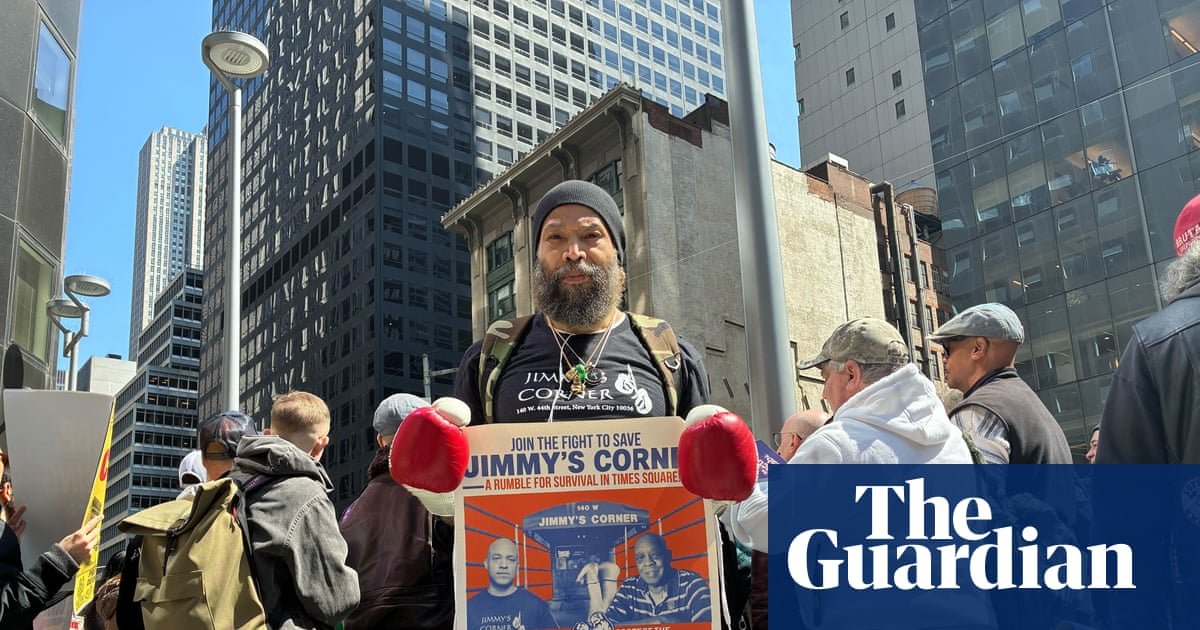
It has prompted last ditch efforts to keep the bar open. Adam filed a long-shot lawsuit against Durst last year, and on Friday scores of bar patrons, and several local politicians, held a rally in an attempt to save the bar.
“It’s a testament to our community,” Adam said ahead of the event, as he cast his eye across the bustling bar. He had opened early, and at 10.30am dozens of people were readying themselves for protest, some fortifying themselves with the help of the bar’s famously cheap beer.
“They’re clamoring to do this,” Adam said. “I think through adversity a lot of communities get stronger and this threat has made us stronger: people think even more about what they love about this place. It’s been humbling, and I appreciate it, and that’s a huge part of why I’m doing this.”
When Jimmy opened the bar, Times Square was known as a hub for prostitution, peep shows and general vice. Jimmy and his bar served as a safe haven – he would often stand outside the bar to keep an eye on the street and it attracted a fiercely loyal clientele. Adam said his father was close to the Durst family for decades, but he believes he was “tricked” into agreeing to a lease provision which enabled Durst to shut down the bar after Jimmy died, in 2020.
“I think my dad would be incredibly hurt and disappointed, because he would have expected better from them,” Adam said.
He would surely have been impressed by the scene on Friday, though, when local TV news flocked to capture the rally outside the Durst headquarters. The bar’s patrons headed out to a gathering point on the corner, carrying pre-printed signs and blinking in the sunlight.
“I’m 68, I’ve been coming here since I was 14 with my parents,” Thomas P Walsh said as he walked to the protest. He was not happy about the prospect of his local bar closing down. “The landlord is greedy. It’s a small business. And everyone who comes here, it’s like family. It’s like Cheers. Everybody knows everybody.”
The bar’s quest to evade eviction has been picked up by local politicians, and, at the rally they paired the fight against Jimmy’s closing with promoting legislation which would protect other small businesses from being booted out by landlords.
“This is just one example of thousands of businesses being forced to close all over the city due to just unsustainable rent increases,” said Julia Salazar, a New York state senator. “Small businesses are the beating heart of the city. They represent culture. They also employ more than half of the workers in New York state, and it really has a profound ripple effect when a small business is forced to close due to unsustainable costs.”
Salazar’s speech was met by chants of “Save Jimmy’s Corner!” Some cars honked their horns as they drove by, although it was unclear if they knew what they were honking for.
“I love Jimmy’s Corner,” Emily Gallagher, a New York state assembly member, told a cheering crowd. She recalled her first visit to the bar: “I met people from all around the world, and then that became a place that I love to go, that I love to bring people, where I knew that we would meet new people.”
Gallagher added: “So often now, New York just feels like a strip mall in Iowa. And there’s nothing wrong with Iowa, but it is not New York. Jimmy’s is a beloved family-owned bar. Durst Organization is an enormous real estate company, and they are attempting to evict them.”
For its part, Durst thinks it has done nothing wrong. In a statement, it said: “The building is for sale and is the ideal location for a new housing development. For 50 years, the Durst family maintained a special personal relationship with the bar’s original owner, Jimmy Glenn. That’s why Durst helped keep the bar’s doors open for decades, including through below-market rent. In fact, Durst has not raised the bar’s rent in nearly 20 years. Unfortunately, no good deed goes unpunished.”
Durst said it had offered Adam money to vacate.
“We have done our best to be good neighbors, and we regret it has come to this,” the company said.
That argument held no water on Friday, when Jimmy’s regulars spent an hour of metaphorically sticking it to big business. It was tiring work, and after the protest it was time to head back to the bar, where an upbeat atmosphere – aided, no doubt, by $3 beers – belied the sadness at Jimmy’s potential closure.
Among them was Gladman, who was drinking a beer and reminiscing about old times.
“Jimmy was like a dad to me,” he said. “He was a fantastic counsel. He knew all about my life and everything about me, and they would give me some really great advice.”
Gladman doesn’t come to the bar to look at the old photo. It didn’t work out between him and his wife. She moved to California, he remarried. He has been with his second wife for 35 years. He comes to Jimmy’s Corner because, he said, it feels like home.
“I don’t want this place to go,” he said. “It holds a lot of memories for me. For everyone.”
