
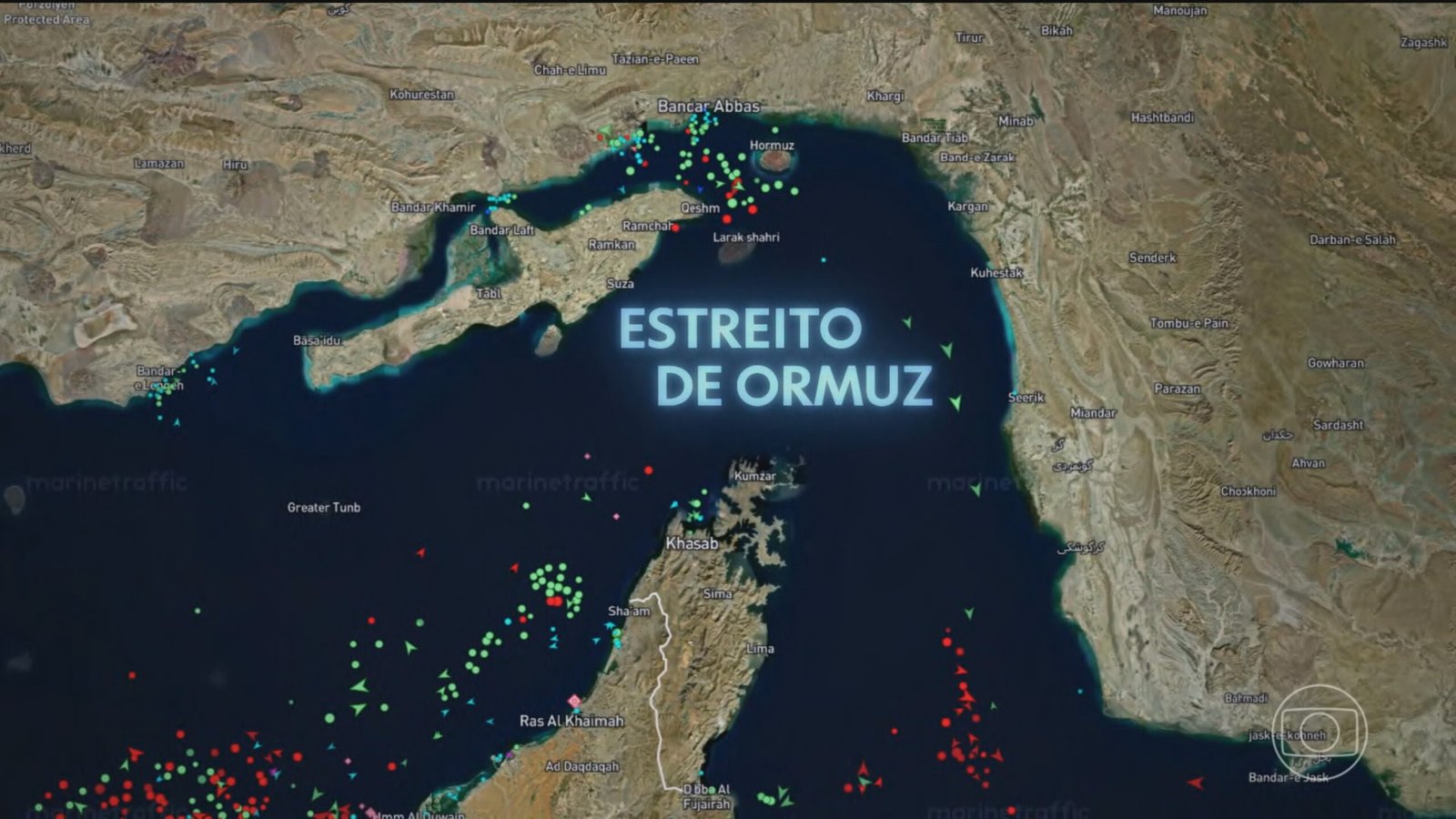
Iran accuses Israel of violating the ceasefire agreement and decides to block the Strait of Hormuz again National Newspaper/ Reproduction The Iranian Revolutionary Guard (IRGC) warned ships that, when crossing the Strait of Hormuz, in the Persian Gulf, they should maintain a route that passes through their territorial waters, while traffic on Thursday (9) remained well below 10% of normal volume. Mitsui OSK Lines, one of Japan’s three biggest shipping companies, is among those affected by the confusion, as companies try to understand the impact of the two-week ceasefire between the US and Iran. “It is necessary to confirm that the security risks are sufficiently low,” President and CEO Jotaro Tamura told Reuters in an interview on Thursday. The company recently managed to remove three tankers from the strait – one loaded with liquefied natural gas and two with liquefied petroleum gas (LPG). Tamura said the company was awaiting guidance from the Japanese government on how to proceed during the two-week ceasefire. Larak route The Revolutionary Guard wants vessels to sail through Iranian waters around Larak Island to avoid the risk of naval mines on the usual routes through the strait, Iran’s semi-official Tasnim news agency reported on Thursday. The vessels must enter the strait north of Larak Island and exit south of it until further notice, in coordination with the IRGC Navy, according to Tasnim, which cited the IRGC. “There is a real possibility of continued risk to unauthorized transits through the Strait of Hormuz, as well as to Israeli- and US-linked vessels attempting to transit,” British maritime security firm Ambrey said in a statement. “Even vessels with apparent authorization have been prevented from passing in recent weeks during transit,” he added. Little traffic Just six ships passed through the strait in the past 24 hours, compared with about 140 normally, ship tracking data showed on Thursday. Among them were an oil tanker and five bulk carriers, according to data from Kpler, Lloyd’s List Intelligence and Signal Ocean. A chemical tanker was about to cross the Gulf to India, according to ship tracking data on the MarineTraffic and Pole Star Global platforms released on Thursday. “Most shipping companies are likely to remain cautious, and two weeks will not be enough to clear the ship backlog even if there is a significant increase in traffic,” said Torbjorn Soltvedt of risk intelligence firm Verisk Maplecroft. More than 180 tankers, carrying approximately 172 million barrels of oil and oil products, remain stuck in the Gulf, according to ship tracking firm Kpler.
Source link
Strait of Hormuz is practically paralyzed; Iran warns of risk of naval mines
18
