
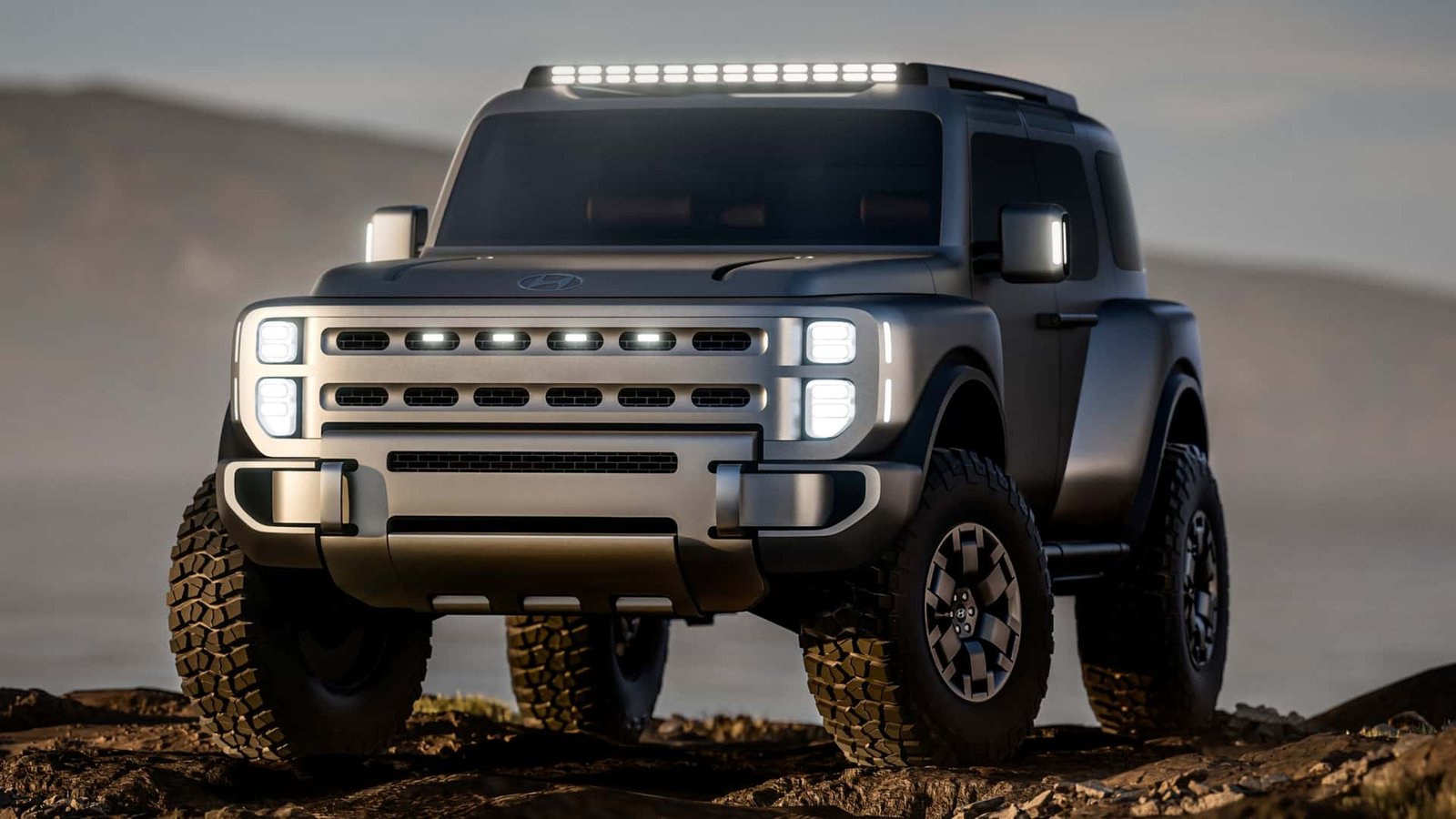
Hyundai has been pushing the envelope of automotive design for the better part of a decade. What’s more, it doesn’t simply copy and paste one set of styling cues across a variety of vehicle shapes and sizes.
The automaker’s “chess piece” strategy means that its different designs are tailored to segment needs, while remaining recognizable across a broad set of design principles. A Santa Fe SUV and an Ioniq 5 electric crossover, for example, look different because they serve different purposes and appeal to different customers.
At the 2026 New York International Auto Show, Hyundai surprised everyone by unveiling its body-on-frame Boulder concept and the latest iteration of its design language, called ‘Art of Steel.’ We spoke to Brad Arnold, Head of Hyundai Design North America, about the concept and Hyundai’s unique design philosophy.
(The following conversation has been lightly edited for clarity and length.)
Photo by: Hyundai
Brad Arnold: We’ve been focusing on XRT a lot the last five-ish years. But it all started with the Santa Cruz. We developed that vehicle for the US, and it was our first entry into vehicles more focused on outdoor activities. Obviously, that’s grown a lot to the point where we’re at now, where we’re getting into body-on-frame.
But yeah, the area of emphasis when we were starting to design this was that term stronger, not louder, and designing something that lets the honesty of the product come through to the surface and be reflected in the final design. A bumper is a bumper, a tow hook is a tow hook. Let’s embrace that as the unique design features.
And also, as SangYup [Lee, head of Hyundai Global Design] mentioned in his presentation, the ‘Art of Steel,’ embracing the materials that we’re building this out of, and trying not to torture those interiors or those materials into a shape that they don’t want to go into, you know?
I think production processes of the past limited what designers could do with the surface. So that’s why they ended up being quite iconic and simple. And I think people yearn for a lot of that simplicity and honesty in today’s design world. So that was something that we focused a lot on, letting it speak for itself, letting it be honest and authentic to what you’re using it for.

Photo by: Hyundai
I think the great thing about Hyundai is it’s a fast-moving, lean company, and almost everything we do is being used in some way, right? There’s no room for doing a design exercise just for the design exercise’s sake and letting it go in the trash. So everything that you see from us, typically, is a version of something that’s coming down the road. No pun intended.
But for this specifically, we’re working on a lot of different derivatives and versions of adventure vehicles, US-focused vehicles, so definitely, it’s something that’s ruminating throughout the company. It’s an exciting adventure for us, especially being the US Design Studio.
So I mentioned the ‘Art of Steel’ being the inspiration that formed the body, formed the fenders, letting the honesty and integrity of the material come through to the design. But another really fun part of that is when we have a really honest rolling section like this [points to rear tailgate and taillight]it gives a lot of depth to the lamp that, at first glance, is like big, soft pixels.
So, from far away, across the intersection, it has a bold, memorable look to it. But upon further inspection, there are a lot of beautiful technical details. And also the ambient light that it casts onto the surface draws your attention to where you’re supposed to grab so making sure that even in the design and the cascading light that we’re drawing attention to the areas that need to be functional, you can put your hand in here and feel the section of that on either either side, like a dual-hinged tailgate, but letting that just like, what’s the most comfortable grab that you can imagine? Right? It’s like rock climbing, like some of those handholds.
I don’t rock climb, but we have some of that stuff in our studio for inspiration, and that drove a lot of [conversation]. What’s the most comfortable section we can build that isn’t a separate handle? Just grab the surface and open it.
Photo by: Hyundai
No, I think [it is practical]. But also, you can make it a single unit, and it can be inserted from the back. But no, it can definitely look like this.
Potentially, but for us, it was less about wanting to create a boxy shape and creating something in architecture that is the most useful for the customer. Typically, the shape is shaped for a reason, right?
What we want is to give to the customers the most amount of visibility to the outside experience that they’re driving through, also the most amount of interior space, so it doesn’t feel like we’re claustrophobic, and boxes are pretty efficient at doing that, right?
Anytime the tumblehome and the windscreen are more upright, the interior space feels a lot bigger, and then it allows you to open the window graphics up a lot to make sure that the light from the environment you’re driving through is flooding in. So already that drives a pretty functional-looking aesthetic, but it’s driven by wanting to give them the best experience while they’re driving the vehicle. Not like, ‘Okay, we want to make the thing boxy.’
I think it’ll shape-shift depending on what we’re trying to design for it. In this case, it was the most functional to make it this shape. It also allows for a lot of versatility. When the thing is a little bit more linear, it’s easier for you to mount things on it, right? Yeah, everything’s got huge amounts of plane view, crown, section, and elevation change. It’s very difficult to make a ladder or a box or an accessory kit because it’s like, well, it’s only going to fit this one car in this one location. So I think that also speaks to the freedom of expression, like giving the customer the biggest amount of flexibility that we can to make sure that your Boulder looks different than mine.
I think that’s a unique way for customers to put their stamp on a vehicle like this. It’s like, ‘well, I go kayaking, I go hiking,’ and they want to wear that badge of honor on the vehicle, right? Even if it’s not something they do all the time, they want to sort of represent, I’m the hiking person. I’m the canoeing person. I’m the cycling person.
Photo by: Hyundai
Especially for doing outdoor, adventure-focused vehicles, it frees you up quite a bit, right? It gives you a platform that is inherently more capable than unibody.
You can obviously develop a unibody vehicle to be very capable, but this platform allows us a starting point that’s inherently more capable. So you can be simpler, because you don’t need to embellish upon something deficient in terms of capabilities, you can let the real proportions of a short wheelbase, short overhangs, high-ground-clearance car, just that’s already cool, right?
And I think this is the type of vehicle that, if most kids are handed a marker and say, draw an SUV or draw a truck, this is what they draw, right? And it’s in all of our subconscious, that’s what a truck should look like. I don’t want to say it’s easier, because it’s still a big challenge, but it is. It is something that we let the inherent capability of the vehicle be represented in the final design. And not try to get in the way with styling. You’ve got to show a lot of restraint on a vehicle like this.
I think very much so. We still talk about the chess pieces internally and externally. It’s a good way for us to remind ourselves that the customer just wants the best possible product; they’re not as impressed with, ‘But this is the grille that we have on all the other cars,’ right?
It allows the design team and the product development team to focus on building the best possible product for each need. And we keep using the chess piece analogy, because it’s a good way for us to see that the overall image of the vehicle can be different every single time, but the bases are all the same. So it keeps some level of consistency.
And for me, internally, when we speak of the designers, the consistency is that this brand, from its inception, has been the company and the customer shaking hands, right? That’s the form of the [Hyundai logo] H. And if we remind ourselves throughout each project that that’s what we’re doing here, that we’re trying to keep the focus on the customer and their experiences. It allows us greater freedom to sketch the shape. I don’t want to say it doesn’t matter, but it comes secondary to the experience we’re trying to deliver.
Photo by: Hyundai
We talked a lot about ‘Art of Steel’ when we were designing this vehicle, and when we got to details like the wheels or the tow hooks, what’s the simplest way to illustrate the functionality that we’re delivering on that component?
So the tow hook, what does it need to do? It has to attach in these two areas, and it has to loop to give you volume, to put the shackle or rope behind. Same thing with the wheels. How do we give you a feeling of connection and strength, but keep it as simple as possible? So you’ll see really nice drill bit details on the side for light-weighting, but when you glance at it, it is, say, familiar, right?
It’s a six-spoke wheel. I think every kid, given a marker, can sort of represent what a tough-looking wheel is. This might be something that they would draw, but we add something special to it as we refine.
We really wanted to celebrate the gaps between surfaces. I think when anything becomes really flush, your brain automatically starts to think, ‘Well, that’s not a real bumper. That’s not a real tow hook.’
With vehicles like this, celebrating the gaps and celebrating the negative space is really quite powerful, right? And showing the physical connection to things conveys connection. Also, it just draws your eye to the tow hook. You don’t have to search for it, right? So I think that motif became something that we played with a lot.
