
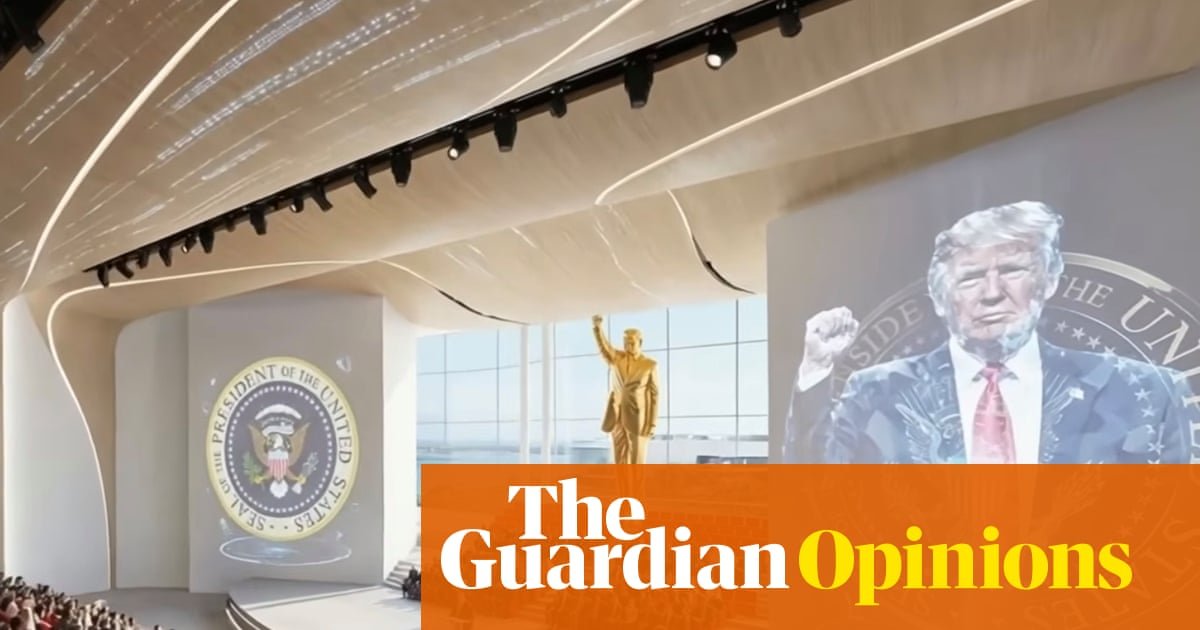
Last week, the Trump administration proudly published two pieces of news which, at first sight, could not be more different: one a dry 52-page legal opinion from the justice department declaring the 1978 Presidential Records Act unconstitutional; the other an AI-generated clip of Trump’s planned “presidential library”, a waterfront skyscraper in Miami. Both sent the same message, though: the legal opinion – authored by a jurist heavily involved in attempts to overturn the 2020 election – leaves Trump free to destroy evidence of wrongdoing; the building envisaged for Biscayne Bay appears to be less of a library than a hotel complex. As the president reassured anyone suspecting that he might fill a glitzy edifice with boring papers and books: “I don’t believe in building libraries or museums.” These are clear signals about wanting to avoid accountability; it is not too early to devise strategies to counter politically motivated amnesia.
In what jurists widely saw as an opinion of breathtakingly bad faith, T Elliot Gaiser, the Ohio-based election denier and a former clerk of Samuel Alito, asserted that Congress had no right to ask the president to preserve records; the imperative to create and keep documents served “no legislative purpose” and could “impede” the day-to-day “performance” of the head of the executive. The act had been crafted in the wake of the misdeeds of Richard Nixon, who had wanted discretion over which of his tapes and papers to destroy; in response, Congress first passed the Presidential Recordings and Materials Preservation Act in 1974, making the government take custody of Nixon’s materials. Nixon sued; the supreme court rejected the view that the separation of powers had been violated; the justices also took the occasion to affirm the importance of “the American people’s ability to reconstruct and come to terms with their history”. Congress then passed the more general Presidential Records Act, which no one up until Trump appeared to have experienced as remotely burdensome.
Trump’s indifference – to put it mildly – when it comes to archiving is of course not a revelation at this point; after the end of his first administration, he just took documents from the White House to Florida. Ironically, Jack Smith’s report, which had led to 40 felony counts for mishandling classified documents, will never be released, thanks to the infamous Trumpist judge Aileen Cannon. Trump fired the archivist of the United States last year, replacing the first woman to have held that role permanently with Marco Rubio (who has nothing else to do), while also drawing on the services of – one could not make this up – the president of the Richard Nixon Foundation. Worries about disappearing documents are not the preserve of pedantic historians: what is at stake here is nothing less than the public’s right to various forms of accountability.
Meanwhile, Trump’s sycophants boast about the “most transparent administration in history”; what has indeed been transparent from day one of his second term in office is that Trump promises impunity and the erasure of history, especially to those willing to engage in illegal activity on his behalf. Even the most violent January 6 insurrectionists were pardoned; those who had been involved in establishing the facts about them were removed from the FBI and the Department of Justice. A database with the charges as well as videos also disappeared from the justice department’s website.
Prioritizing such moves underlined that Trump actually had no real ambitions for his second term other than retribution (it is another story that plenty of powerful people saw his return as an opening to pursue their own agenda, from extractive industries and crypto boosters to assorted white supremacists). There is a perverse logic to not wanting a presidential library and a proper exhibition, but instead a golden statue of himself and a 747 jet in the atrium: what accomplishments would there be to show?
Whether Trump will follow through with trying to erase history through issuing pardons for all his lackeys is unclear. According to reports, Corey Lewandowski at the Department of Homeland Security boasted that he could do whatever he wanted because Trump would pardon him (Lewandowski has denied this). Whether Kristi Noem and Bondi secured pardons before their firings is an open question, though – if the president wants to keep them under control (and prevent them from dropping some files on the way out, for instance), he will certainly not have made any promises – and he may eventually forget about some former underlings needing to avoid a reckoning.
How to counter amnesia and the conscious prevention of accountability, and preserve what the court called the American people’s ability to come to terms with their history? Certainly, Democrats can explicitly push for keeping records and try to shame those scrubbing websites and taking down historical explanations (though that is not likely to have much effect on what is without doubt the most shameless administration in US history). They can also start designing something like a truth commission (which may or may not hold out a promise of reconciliation); while often seen as a failure, Congress’s January 6 commission did a convincing job of questioning witnesses and even producing videos that clearly showed the violence which GOP members today wish to forget.
And the pardon power? The founders adopted the idea from the British monarch, on the understanding that a president prone to abusing that power would just get impeached and, that, as Hamilton put it: “The dread of being accused of weakness or connivance, would beget … circumspection.” Jurists sometimes gestured at the possibility of suing over corrupt pardonsbut the supreme court’s granting of virtually total immunity to the president in its 2024 decision – also amply exploited by Gaiser in his impunity-on-demand opinion – would seem to make this a non-starter. A constitutional amendment is unlikely – but, like much else with a post-Trump era of Reconstruction of the political system, it should at least be on the agenda.
