
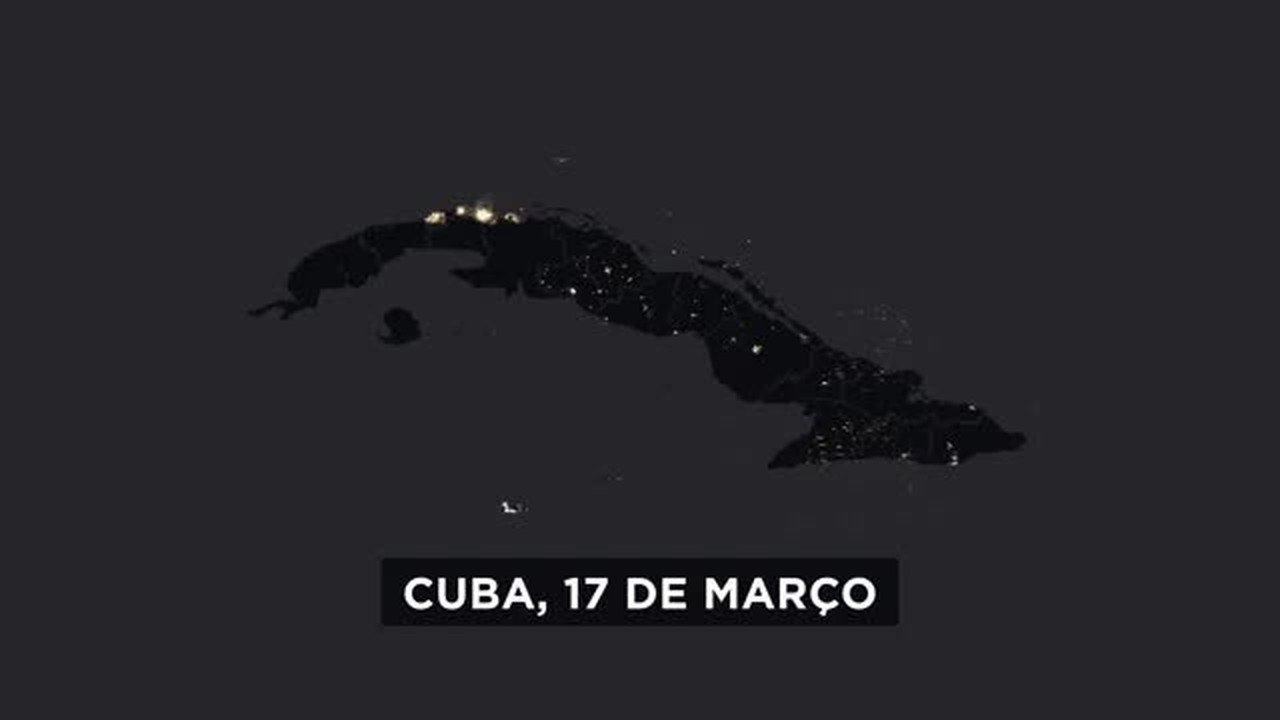
Satellite images show blackout in Cuba after power supply collapse; PHOTO Since the government of American President Donald Trump imposed an almost total blockade on Cuba three months ago, Mauren Echevarría Peña has been housed in a specialized maternity wing in the country’s capital, Havana. At 26 years old, she is expecting her first child and had a complicated pregnancy. “I was diagnosed with gestational diabetes and chronic hypertension,” she explains. Sitting on a bed in the Ramón González Coro maternity ward and with her birth scheduled for near the end of the month, Echevarría is nervous. ✅ Follow the g1 international news channel on WhatsApp Not only did she have to remain at rest for weeks, under constant supervision, but she also had to give birth in a nation that suffers prolonged general blackouts, which can last an entire day. On the weekend of March 21, Cuba faced yet another collapse of the national electrical system. Still, Echevarría is grateful for the attention she received from the medical team, who worked around the clock under truly challenging conditions. The BBC had access to the public hospital when an international coalition of solidarity movements arrived in Havana with boxes full of donations for the maternity hospital. “They did everything possible for me at the hospital,” she explains, with doctors present in the room. “They gave me the medicine and insulin I needed for the health of my baby and placenta.” Echevarría believes that her country will always “find a way to move forward” in the midst of the crisis, but she cannot hide her fear of the possibility of having to give birth in the middle of a blackout. Mauren Echevarría Peña hopes there will not be a blackout at the time of birth BBC Generalized crisis It is estimated that there are currently around 32,800 pregnant women in Cuba, according to local government statistics. And many of them did not have the same state support received by Echevarría. At her home in a suburb of Havana, Indira Martínez, seven months pregnant, has not been able to cook breakfast for days — not even make a latte. Your house has had no electricity since the afternoon of the previous day. The refrigerator is empty, the electric oven doesn’t work and the only way to cook is using a small, improvised wood-burning oven built by her husband. “You have to get up at dawn, when the power comes back on, to cook whatever you have,” she says. “And it often doesn’t have the vitamins and proteins I need, and it certainly doesn’t satisfy my pregnancy-related hunger,” he explains. Martínez maintains her smile and good humor, but the difficult circumstances amid her pregnancy are clearly undermining her resilience. She is a hairdresser, but she stopped her work so as not to expose her baby to the chemicals used in the beauty salon. Therefore, the family has been supporting itself with the modest earnings of her husband, who works as a blacksmith. Martínez’s mother is a retired nurse. She worries about the lack of food and the levels of stress faced by her daughter in these last months of pregnancy. Martínez contracted chikungunya, a viral disease transmitted by mosquitoes, during an epidemic faced by Cuba when she was in the first trimester of pregnancy. She is very weak and can barely walk to the bathroom. But doctors say her baby is in excellent health. MORE Elite American troops removed from power a former ally of Cuba, the now former president of Venezuela, Nicolás Maduro. Since then, the United States government has stopped basically all oil shipments to Cuba. US President Donald Trump warned the island’s main energy partners, particularly Mexico, that he would impose import tariffs if they sent new tankers of fuel to the island. And instead, Mexico dispatched hundreds of tons of humanitarian aid, including powdered milk for pregnant women. But Martínez highlights that he did not receive this help, much less support from the State. “I haven’t seen any of the humanitarian aid sent to Cuba,” she says. “My husband and I knew very well what we were doing when we decided to have a baby in this situation. We knew we couldn’t count on government help. It’s us against the world!” The only thing they can do is pray that, in the end, everything turns out well, highlights Martínez. Just like Echevarría, who is in the hospital just days away from giving birth, Martínez feels increasingly afraid and cannot imagine laboring in a dark room at the medical center, with the girl being born illuminated by the flashlight of a cell phone. Hospitals have generators, but face difficulties in obtaining the necessary fuel. Furthermore, your fear goes beyond pregnancy. She fears for the life that awaits her daughter Ainoa, as she will be called, in Cuba. “How am I going to tell her that there is no future? Because she won’t have one…”, explains the mother, resigned. In recent weeks, Cuba has suffered at least two national blackouts that have made health care precarious. REUTERS For a long time, education was one of the pillars of the Cuban revolution. But, like so many other things on the island, Martínez says that this sector has also deteriorated, with a lack of investment and qualified teachers. She also says that the island’s serious economic situation forces young people to look for work to earn a little more than the meager state salaries. Martínez was a computer technician before becoming a hairdresser and her husband was an accountant, until he needed to learn the blacksmith trade. “As a mother, I want to offer my daughter a full life. But I have no reason to say that she has a promising future ahead of her or that she can develop her intellectual potential to the fullest”, she laments. “If I said that, I’d be lying. She won’t have any opportunities for growth here, none.” This prognosis is bleak for an era that is often described as one of expectations, even enthusiasm and hope. Cuba has an aging population, a very low birth rate and huge emigration rates. And, despite the current crisis, the island needs more young people to have children. But, even before the paralyzing fuel blockade, many young Cubans were already thinking twice before deciding to start a family in the country. Which is not surprising, since Mauren Echevarría’s baby and, probably, Indira Martínez’s daughter (who will arrive in two months) will simply be born in one of the most difficult moments in the island’s modern history. VIDEOS: most watched on g1
Source link
‘What we have doesn’t satisfy my hunger’: pregnant Cuban women who suffer with a country on the brink of collapse
26

previous post