
-
The story is co-published with Public Domainan investigative newsroom that covers public lands, wildlife and government
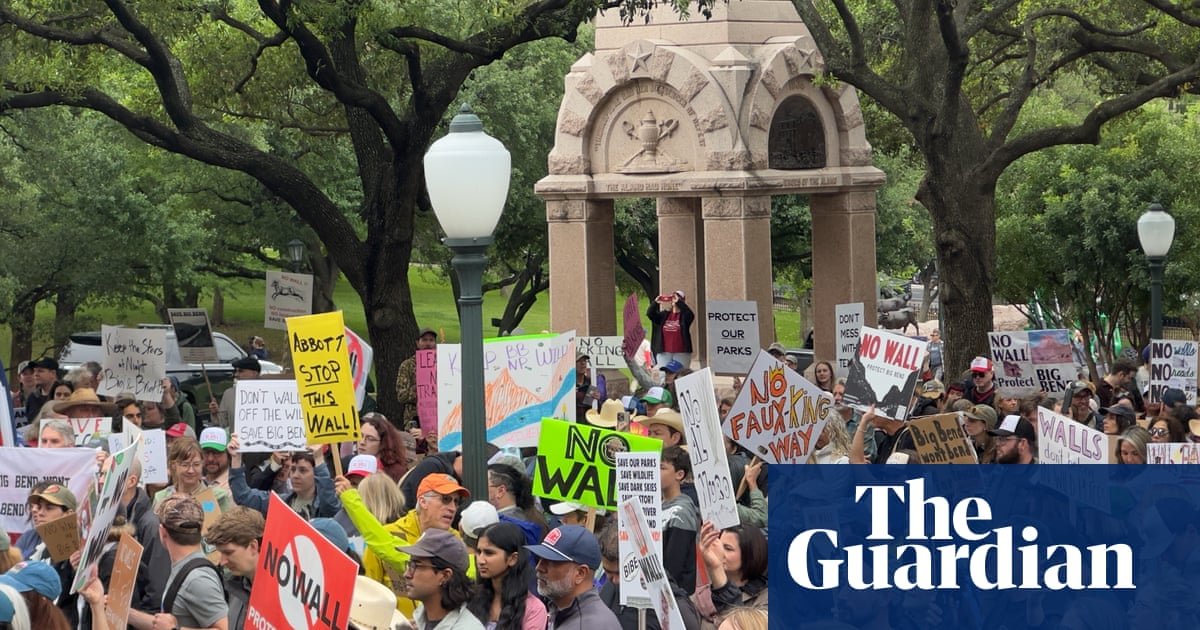
Thousands of people gathered at the steps of the Texas capitol on Saturday to protest against the construction of a border wall through Big Bend, in a show of bipartisan opposition to the White House’s plans.
More than 2,000 people attended the rally, according to Texas Public Radioholding signs with slogans such as “No Big Bend NP Wall,” “Big Love for Big Bend” and “No al Muro” – Spanish for “No to the Wall.” Organizers gathered postcards from protesters to deliver to Greg Abbott, the Texas governor who has yet to weigh in publicly on the border wall expansion plans at Big Bend.
César Blanco, a Democratic state senator, said his office had been flooded with messages from constituents sharing stories of their love for Big Bend and their opposition to marring it with a border wall.
“There’s nothing like that region anywhere in the world,” Blanco said. “It’s a place where families make memories together.”
“We all agree that border security matters,” he added. “But we don’t have to harm our communities in the process. We don’t have to destroy the ecosystem to achieve it. We can do it the right way. We can do it thoughtfully with the people that live in those communities.”
Brandon Herrera, a rightwing gun YouTuber running for the congressional seat that includes Big Bend, described opposition to building the wall there as “something we can actually agree on”.
“Democrats don’t want this wall in Big Bend,” Herrera said. “Republicans don’t want this wall in Big Bend. Independents don’t want this wall in Big Bend. Sheriffs don’t want this wall in Big Bend. The tourists don’t want this wall in Big Bend. Nobody wants this wall in Big Bend.”
Jerry Patterson, a Republican and former Texas land commissioner, led the crowd in a chant of “no damn wall.”
“I have found no one, Republican or Democrat, who wants a wall in the Big Bend,” Patterson said. “I almost wanna find somebody so I can talk to ‘em. But I can’t.”
Other speakers raised concerns about a border wall’s impact on the bighorn sheep and black bears that need access to the river. Several described wall construction as a form of federal overreach. Anthropologist Carolyn Boyd said current plans threaten to wall off or destroy dozens of rock art murals.
“These are not just archeological sites,” Boyd said. “They are sacred landscapes. They are libraries of human knowledge. They are the voices of 175 generations preserved on canyon walls. And many of these places remain sacred to Native American communities today.”
Big Bend national park is the largest single chunk of public land in Texas and widely loved in the region for its desert landscapes, dark skies, river rafting and hikes through the Chisos Mountains. Many of the protesters had deep personal connections to the region.
Brenner Burgess said he proposed to his wife, Sara Reid, three years ago atop a mountain in Terlingua, just outside Big Bend national park. They married at Sotol Vista Overlook in Big Bend last year in a small ceremony with close family.
“It was perfect,” Reid said. “And it was $60. It’s the best wedding venue in Texas.”
The One Big Beautiful Bill Act that Donald Trump pushed the GOP-controlled Congress to ram through last year includes a staggering $46.5bn for border wall construction. (The total National Park Service budget, for comparison, stands at $3.3bn – which the White House says is too much.)
In February, Customs and Border Protection (CBP) updated an online map of the border wall to show new plans that appeared to include steel bollard wall through portions of both Big Bend national park and neighboring Big Bend Ranch state park. That month, Kristi Noem, then homeland security secretary, waived a slew of environmental and historic protection laws to speed the construction of a physical wall through parts of CBP’s Big Bend Sector, a 500-mile (805km) stretch of the US-Mexico border in west Texas.
In the face of widespread condemnation from the public, as well as local law enforcement and political leaders, CBP has since repeatedly updated the map on its website – first indicating that the planned barrier through the national park would rely on technology only, and later making a similar adjustment for Big Bend Ranch state park. CBP has said little on the subject, other than it is working with local partners to determine the wall strategy.
The unannounced changes have caused a perpetual state of confusion. Opponents have largely cheered the redrawing of the border wall map as a sign that public pressure is making an impact. But many also continue to view CBP skeptically.
The agency has yet to state definitively that it will spare the parks. Even if it did, there would be no way for opponents to hold the agency to its word – leading some wall opponents to press Congress to write into legislation a prohibition on building a physical wall through the parks. And no one knows for sure what the “detection technology” CBP envisions will look like.
CBP started discussions with the Texas parks and wildlife department back in February to obtain easement rights at three parks, including Big Bend Ranch state park, according to records obtained by Inside Climate News. The agency told TPWD the next month that the plans had been put on hold, the report says.
Lloyd Easterling, the Big Bend sector chief, retired last week, according to CBP. The retirement was pre-planned, the agency said. But some conservationists are concerned about losing a border patrol official who had sought to assure locals in a recent closed-door meeting that the Trump administration’s border wall expansion plans would not include steel bollard walls in Big Bend Ranch state park.
