
The Japanese Grand Prix highlighted how the 2026 Formula 1 regulations can create exciting races, but with critical issues which need addressing – starting at next week’s meeting between F1, the FIA, and the teams.
Precisely because of this dynamic of overtakes and counter-overtakes, Suzuka offered a chance to observe how certain behaviours of the complex new power units can affect how drivers must handle their cars – almost unnaturally – forcing them to adapt more to energy management logic than to instinct.
This is something that also affects qualifying, and it’s one of the reasons many drivers have pointed out that it’s now more advantageous to stay below the limit rather than take unnecessary risks.
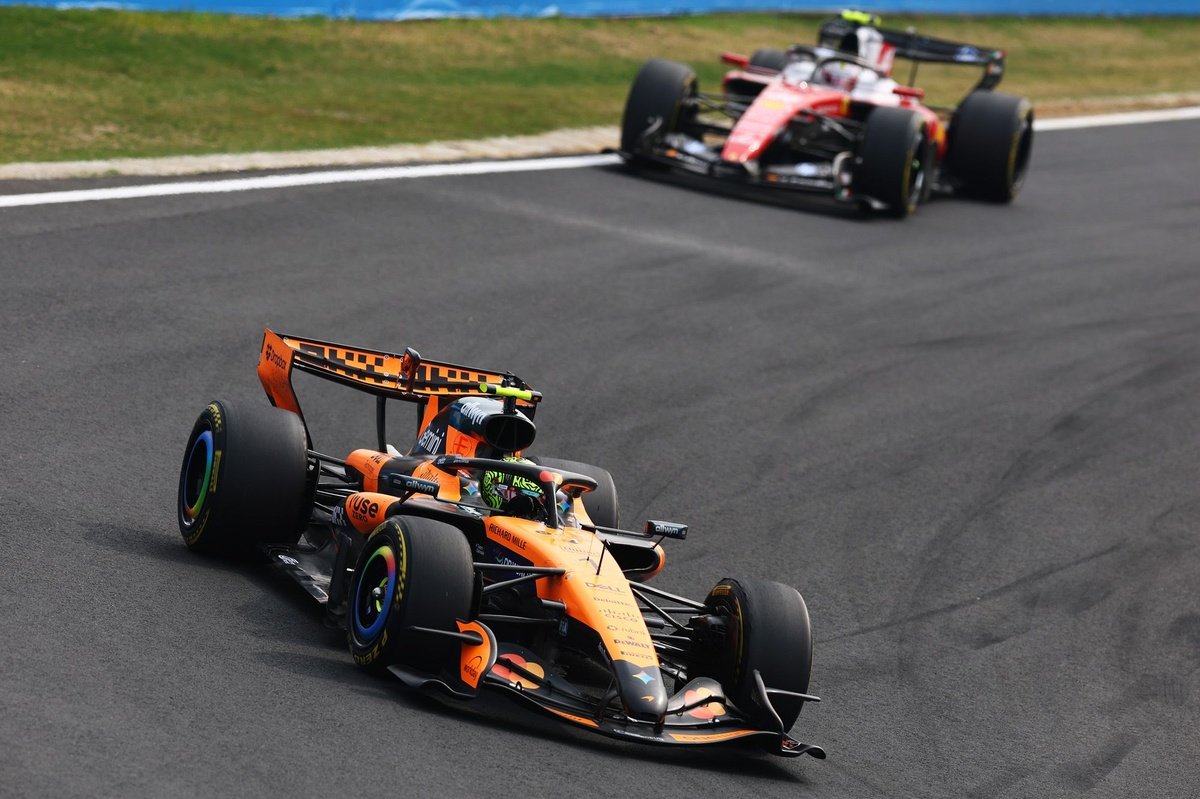
The issue doesn’t only concern single-lap pace, however, it also impacts on-track battles. One of the clearest examples seen in Japan was the fight between Lando Norris and Lewis Hamilton across the final laps.
For the attacking driver, the most effective choice was generally to use energy between Spoon and the final chicane. In that section, significantly higher speeds were reached, while the driver ahead tended to suffer a sharper drop when the MGU-K stopped providing support, then entering a recharge phase with super clipping.
This dynamic appeared on lap 50, when Norris, using electric boost out of Spoon, managed to close the gap significantly before 130R. He got so close to Hamilton that he had to lift off at nearly 330 km/h.
Lewis Hamilton, Ferrari
Photo by: Ferrari
Up to this point, there would be nothing unusual. The problem arises from what happened next. Between 130R and the final chicane, there is still some distance, and to avoid losing too much ground, the pursuing driver has to get back on the throttle. In these situations – also due to the large speed difference – the chasing driver would prefer the power unit to reduce electric motor support.
This would still allow an attack, or even completing an overtake, especially when the driver ahead, like Hamilton in this case, is in a recharge phase with super clipping. It would also bring another advantage: helping save energy for the following straight, the main straight, where many counter-overtakes were seen during the race.
Here’s where the problem emerges. If 130R is taken flat-out, it means the full-throttle section from Spoon onwards is longer and there’s continuity in throttle application. Therefore, the control unit governing the engine follows a specific curve for reducing MGU-K support. But if the driver is in overtaking mode or using boost, the moment they lift off the throttle, that energy reduction curve is reset due to the regulations.
In essence, when getting back on the throttle after lifting – as in Norris’ case – the power unit is forced by regulation to restore electric motor support, delivering at least 200 kW for at least one second before resuming the MGU-K reduction curve. This means the driver ends up with surplus MGU-K power even when it’s not desired, consuming more energy than intended. This rule was introduced for safety and to prevent simulating traction control on corner exit, but clearly the situation changes at the end of a straight.
This is something drivers have no control over. The only way to avoid it is to keep the throttle fully open, preventing the power unit control system from resetting this ‘counter’ and allowing it to continue the natural reduction of electric motor power.
This is what happened, for example, to Isack Hadjar in the early laps, when his engineer told him over the radio that, using boost out of Spoon, he could not afford to lift at 130R. This action reset the MGU-K power reduction process and cost him energy when he went back to full throttle for the final section before the chicane.

Isack Hadjar, Red Bull Racing
Photo by: Lars Baron / LAT Images via Getty Images
The problem is that this logic becomes much harder to manage in a battle. In his duel with Hamilton on lap 50, Norris was also forced to lift off to avoid running into the Ferrari driver, who no longer had electric support because he hadn’t activated boost. At that point, such a large speed difference – and the fact that energy would be wasted when getting back on the throttle – pushes the driver toward attempting a forced overtake.
Norris tried to handle the situation differently, partially applying the throttle instead of going immediately back to full power. This helps mitigate the effect, but it’s clear how unnatural it is, in a duel, to see a driver almost forced into attempting an overtake due to energy management dynamics. The result was that he found himself without battery to defend on the following straight.
“The problem is, it deploys into 130R,” Norris explained after the race on Sunday. “I have to lift, otherwise I’ll drive into him, and I’m not allowed to go back on throttle. If I go on throttle, my battery deploys, and I don’t want it to deploy because it should have cut. But because you lift and you have to go back on, it redeploys. There’s nothing I can do about it.”
The remedy in these cases would be simple: don’t lift off the throttle. But it’s one thing to do that when driving alone, and another to manage it in the middle of a fight, where situations are unpredictable and it becomes unnatural for drivers to adjust their behaviour based on optimal energy deployment.
This isn’t an entirely new issue, but with a 350 kW MGU-K capable of delivering so much power, these situations carry far more weight than they might seem.
We want to hear from you!
Let us know what you would like to see from us in the future.
– The Autosport.com Team
