
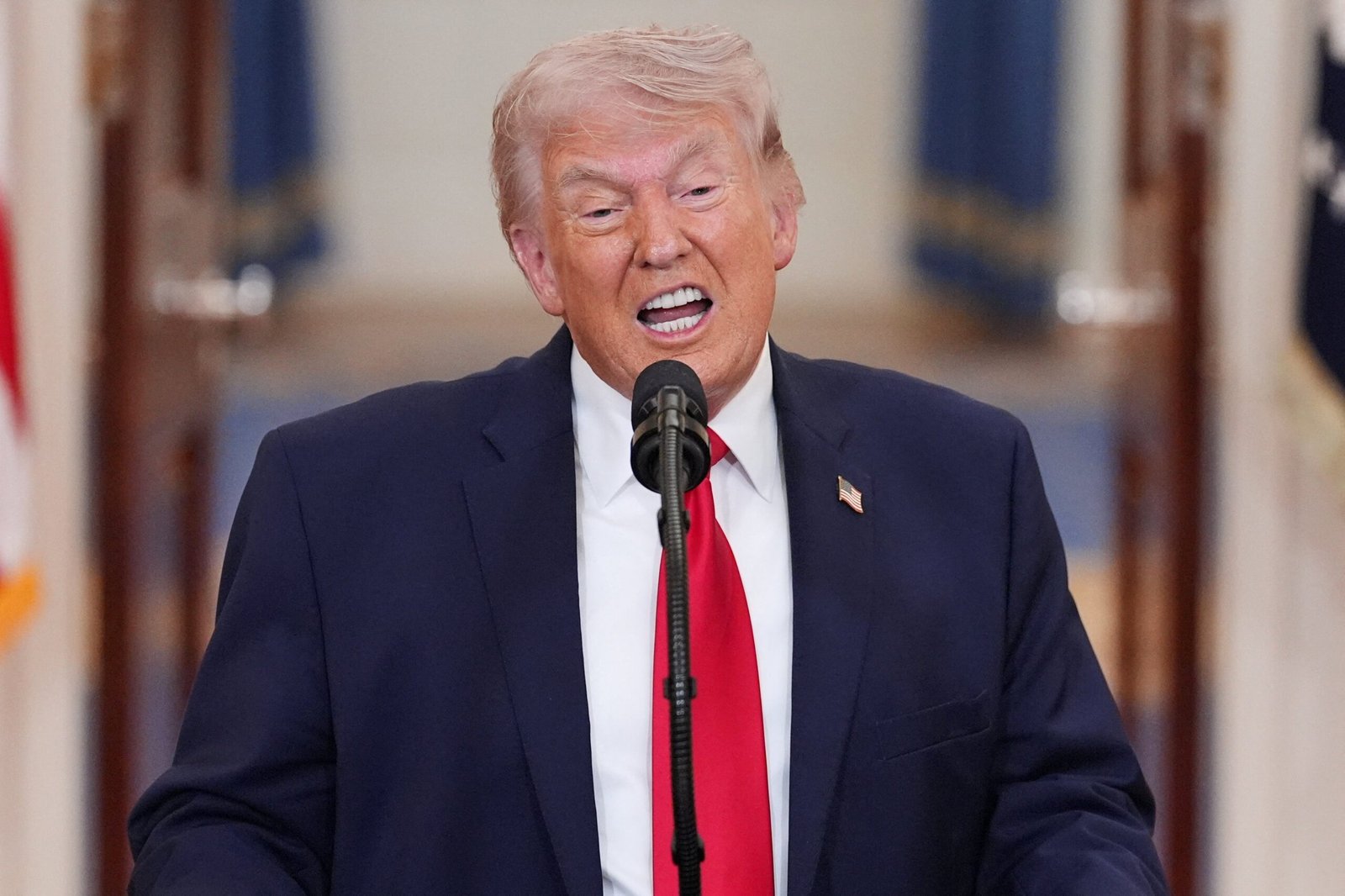
Trump says objectives in Iran are almost complete The spokesman for the Iranian Armed Forces Command, Ebrahim Zolfaqari, said this Thursday (2) that the war will continue until the ‘surrender and permanent repentance of the enemy’, according to local Iranian media Tasmin. The speech came after threats from US President Donald Trump that Washington would attack Iran “with extreme force” within weeks, even though Iran was “essentially decimated” and the United States was on track to achieve its military objectives. In the speech, Trump once again threatened Iran, including attacks on electricity plants if the country does not reach an agreement. The spokesman responded that US and Israeli assessments of Iran’s military capabilities were “incomplete.” It also threatened Israel and the US with ‘more overwhelming, widespread and destructive actions’. President of Iran sends letter to Americans In a letter addressed “to the American people” before Trump’s speech, the president of Iran, Masoud Pezeshkian, stated that his country does not “nurture enmity with the common people of the United States”, said he was not a threat and accused Donald Trump’s government of deceiving its own citizens. In the letter, released by the Iranian state press, Pezeshkian also asks Americans to question “whether Washington is truly putting the interests of the United States first or whether it is merely acting as a representative of Israel” and states that Trump is willing to fight “to the last American soldier.” The president of Iran, Masoud Pezeshkian, answers questions from the press during a press conference in New York, this Friday (26) Angelina Katsanis/AP Photo The letter was the first direct communication from the Iranian government aimed at the US population since the beginning of the conflict in the Middle East. In the document, the Iranian president makes a separation between the country of the United States and the American people: “The Iranian people do not harbor any enmity against other nations, including the people of America, Europe or neighboring countries”, says the letter. “What Iran has done – and continues to do – is a considered response, based on self-defense, and in no way an initiation of war or aggression,” she asserts. The letter states that hostilities between Iran and the West began in 1953, with the coup d’état that deposed Prime Minister Mohammad Mossadegh, engineered by the CIA and MI6, the British secret service. Pezeshkian classified the episode as “an illegal intervention by the United States” that “interrupted Iran’s democratic process, reinstated the dictatorship and sowed deep distrust among Iranians regarding US policies.” See the videos that are trending on g1 Trump threatens Iran again US President Donald Trump made a statement on TV this Wednesday (1st) about the War in Iran, saying that the country’s military objectives are close to being achieved. “I’m pleased to report that these fundamental strategic objectives are nearly complete. We’re going to get the job done, and we’re going to get it done soon,” he declared, standing in front of a lectern at the White House. See the main points of Trump’s speech: According to the US president, the objectives were to destroy Tehran’s ability to carry out an attack against the US and make it impossible for the regime to exercise its military power outside its territory. He explicitly stated that regime change was not the objective of the military operation and that he never said that was the plan. The president stated, however, that the regime change actually occurred with the death of the old leaders, and that the new leadership is “less radical and much more reasonable”. Trump also threatened to attack Iranian energy infrastructure targets if there is no deal with Tehran: “We are going to hit them with extreme force in the next two or three weeks. We are going to take them back to the Stone Age where they came from.” When commenting on the Strait of Hormuz, an important corridor that transports oil from the Persian Gulf and closed by Iran, Trump suggested that the reopening is of more interest to European countries than to Washington. Trump speaks at the White House Alex Brandon/Pool via REUTERS Washed his hands of Hormuz Trump addressed the closure of the Strait of Hormuz during his speech. According to him, the US no longer depends on oil from the Middle East that passes through the maritime channel. The North American president stated that his country has become the largest producer of oil and gas in the world, especially with the help of production in Venezuela, and therefore “does not need” the production that comes from the Middle East. “The United States practically does not import oil through the Strait of Hormuz, and we will not import anything in the future. We do not need this. The countries of the world that receive wealth through the Strait of Hormuz must take care of this passage,” said the American president. Trump also again urged other countries to take action to reopen the strait. “I have a suggestion. First, buy oil from the United States. We have plenty. We have a lot. And second, gather some courage, however late. […] Go to the strait and simply take care of it, protect it and use it for yourselves.” Context: Trump has been criticizing European leaders for refusing to send military ships to reopen the Strait of Hormuz. In the opinion of Europeans, however, this problem was created by the US and Israel, and it is not up to them to place their soldiers inside the theater of operations. Unpopular war Trump faces an American voter wary of war and falling approval ratings. In a Reuters/Ipsos poll held from Friday (27) to Sunday (29), 60% of voters said they disapproved of the war, while 35% approved of it. About 66% of those surveyed said the US should work to quickly end its involvement in the war, even if it means not achieving the goals set by the government. Public opinion polls show that the war is widely unpopular, especially among independent voters, and Trump’s allies have been calling on the government to present voters with a clearer and more consistent justification for the conflict. Trump and his aides have offered varying explanations and timelines for the conflict, now in its fifth week. If he convinces voters that the war is time-limited and nearing an end, it could help ease growing concerns among Americans, most of whom oppose the conflict and many of whom are frustrated by rising gasoline prices due to disruptions in global oil supplies. alliance support for U.S. goals in Iran. A transatlantic rift during Trump’s second term deepened after European allies rejected his request to help maintain the safe passage of oil traffic through the Strait of Hormuz. He said he was “absolutely” considering withdrawing the U.S. from NATO, an organization whose treaty was ratified by the U.S. Senate in 1949. Trump added that while the U.S. would pull out of Iran “very quickly,” the military could return for “attacks.” punctual” as necessary.
Source link
Iran says war will continue until ‘enemy’s surrender and permanent repentance’ in response to Trump’s threats
24

previous post