
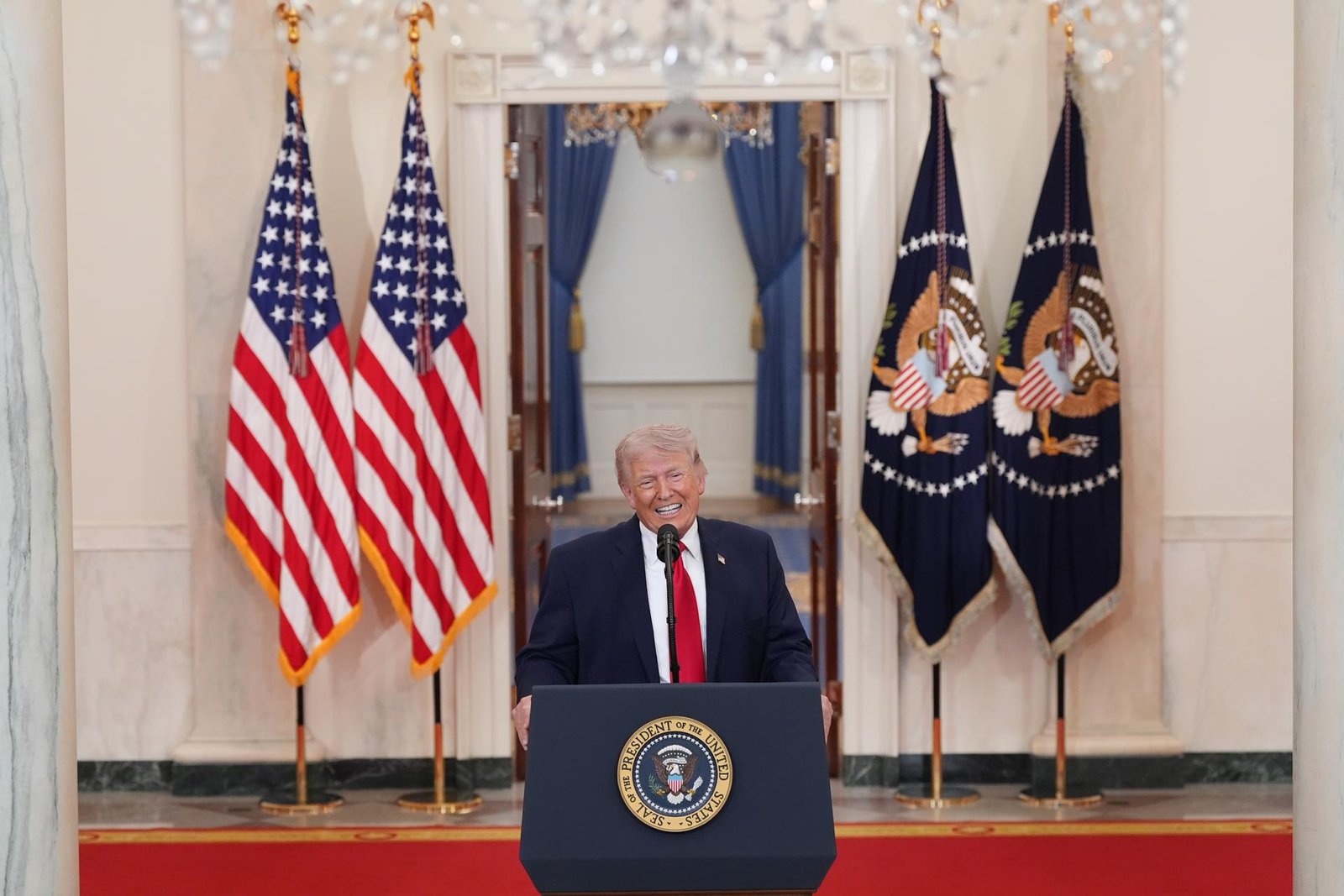
The President of the United States, Donald Trump, made a statement to the nation at the White House on Wednesday night (1st), where he stated that the war against Iran is close to an end and that American strategic objectives “are almost completed”, after a month of military offensive in the Middle East.
According to Trump, the military operation launched jointly with Israel on February 28 – called “Epic Fury” – has already drastically reduced Iranian military capacity. At another point, he stated that US forces destroyed the Navy, Air Force and a large part of the country’s missile arsenal, adding that the Iranian regime had been “annihilated” in its military capacity.
According to the president, the ongoing offensive was necessary to prevent the Iranian regime from advancing its nuclear program. He again criticized the nuclear agreement signed in 2015 and said that he initially tried to resolve the impasse through diplomatic channels. Trump recalled that he always defended the idea that the Islamic regime would never have a nuclear weapon.
“My first preference has always been diplomacy. Yet the regime continued its relentless pursuit of nuclear weapons and rejected all attempts at compromise,” he said.
In his speech, Trump recalled his government’s previous actions against Iran, such as the elimination of General Qasem Soleimani in 2020, and said he took decisions that other American presidents avoided. “Essentially, I did what no other president was willing to do – they [os presidentes anteriores] They made mistakes, and I’m correcting them,” he declared.
The president said that the current conflict against Iran is the result of decades of hostility by the Iranian regime against the United States and its allies. According to him, allowing Iran to obtain a nuclear weapon would pose an “intolerable” threat to global security.
“These terrorists with nuclear weapons would be an unacceptable threat,” he said.
Trump said the ongoing war has already compromised Iran’s ability to support terrorist groups operating in the Middle East. According to him, the ongoing military operation should “crush the regime’s ability to sustain its proxies terrorists and prevent the construction of a nuclear bomb.”
The president projected that the conflict could be ended within two or three weeks, although he did not detail what criteria will be used to declare the operation complete. He also stated that there are ongoing negotiations with the Islamic regime, but did not rule out new, stronger attacks against the country, including against Iranian energy infrastructure, if there is no diplomatic progress.
When commenting on the economic impacts of the conflict, Trump blamed Iran for the rise in oil prices. According to him, the regime is promoting attacks on oil tankers and energy installations and, therefore, is intensifying the crisis.
“This short-term increase is a direct result of the Iranian regime’s actions,” he said.
The president highlighted the United States’ energy capacity to survive the crisis and mentioned cooperation with Venezuela in the sector, stating that the US is prepared to face the effects of the conflict.
Without directly mentioning European countries, Trump suggested that oil-dependent nations in the Middle East, which are suffering from the crisis in the sector due to Iran’s blockade of the Strait of Hormuz, should look for alternatives, including American suppliers. He also said that these countries should have a “little courage” and go “for their oil” by carrying out operations to reopen the blocked strait.
Still in the speech, Trump paid tribute to the American soldiers killed in the operation, mentioning 13 soldiers. “We must honor them by completing the mission for which they gave their lives,” he said.
He concluded by saying that Americans will soon be able to live without the threat posed by Iran and that, after the conflict, the United States will emerge stronger.
