
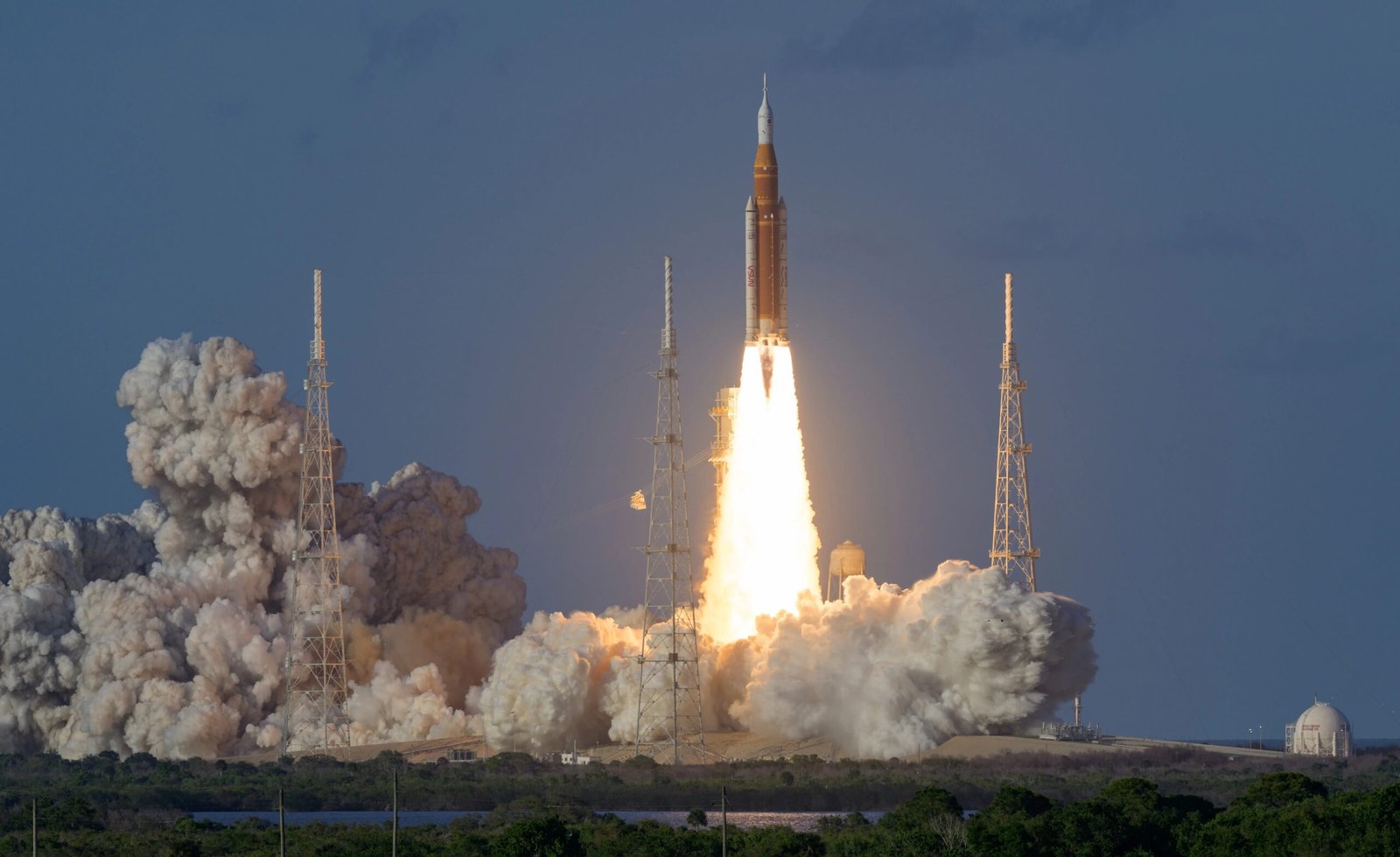
The Artemis II mission was launched at around 7:30 pm this Wednesday (1st), a space journey with a crew of four astronauts that will culminate in man’s return to the Moon for the first time in more than 50 years. The launch took place from the Kennedy Space Center in Cape Canaveral, Florida.
Houston, Texas-based flight controllers confirmed that all four wings opened as planned, locking into position and generating power as predicted. According to NASA, this wing of solar panels extends outside the European Service Module, giving Integrity a wingspan of approximately 19 meters when fully unfolded.
SEE ALSO:
- Artemis II: everything you need to know
- Who are the astronauts of the Artemis II mission
Each wing has 15,000 solar cells to convert sunlight into electricity. The panels can rotate on two axes, allowing them to rotate and follow the Sun, maximizing energy generation as the spacecraft changes attitude during its stay in Earth’s orbit and on its journey out to the Moon.
The next important steps will be the Perigee Raising Maneuver (PRM) and the Apogee Raising Maneuver (ARB), which will raise the lowest and highest points of the Orion spacecraft’s orbit and prepare it for deep space operations.
NASA broadcast the broadcast on its YouTube channel (click here to see). The American agency’s social networks, including X and the Facebookalso showed the mission launch in real time.
After the maneuvers, NASA will hold a press conference. After the press conference, the Artemis II crew will begin preparations for the Orion proximity operations demonstration.
What is the mission
Artemis II is the first manned rocket flight Space Launch System (SLS) and capsule Orionnamed by the crew of Integrity – “integrity”, in Portuguese. The mission launched this Wednesday does not foresee landing on the lunar surface, as occurred the last time man went to Earth’s natural satellite.
This time, the astronauts will fly over the Moon and return to Earth on a journey lasting approximately ten days, covering around 1.1 million kilometers.
The main objective of this mission is to test the life support systems of the Orion with crew on board for the first time, paving the way for a manned lunar landing expected to take place in 2028.
