
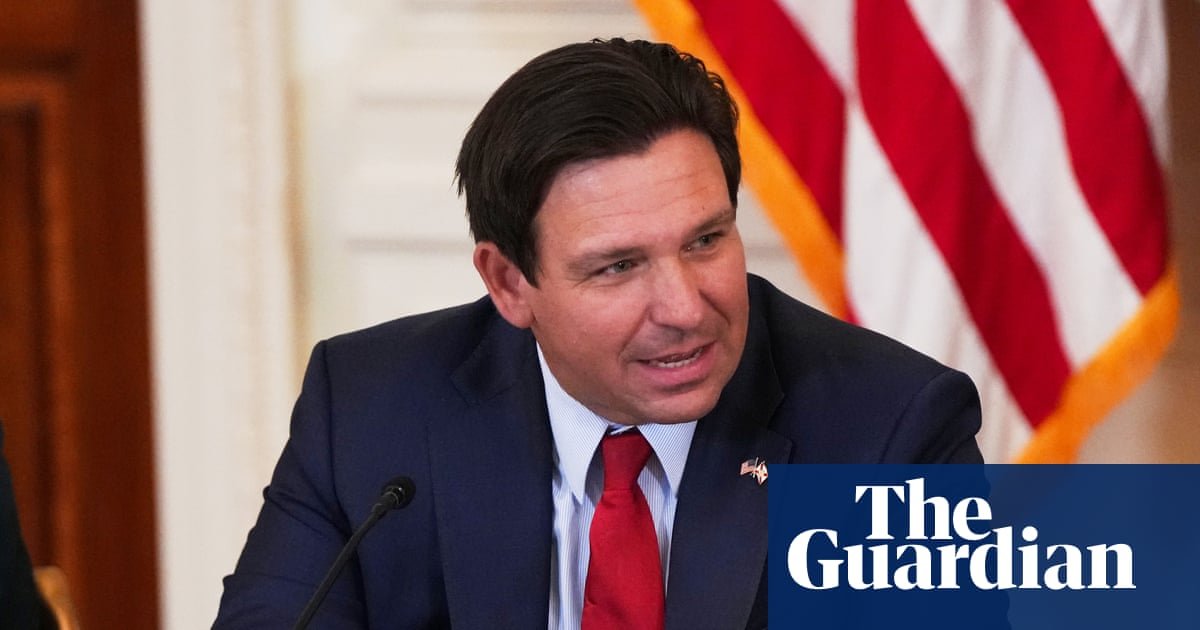
Governor Ron DeSantis of Florida signed legislation on Wednesday to require documented proof of citizenship to register to vote and to begin a process that will eventually unenroll voters who have not provided citizenship documentation.
Florida is now the third state to pass proof-of-citizenship laws for voting this year, after South Dakota and Utah’s governors each signed proof of citizenship bills into law in March.
The changes come as Donald Trump’s signature restrictive voting bill, the Save America Act, languishes in the US Senate with little chance of passage. The president is left weighing his options about how to move forward with its provisions, which include documented proof of citizenship requirements to register and strict photo ID requirements to vote.
The most likely path forward will be to continue to encourage conservative states to enact the same voting restrictions.
The Florida law requires the Florida department of state to identify registered voters who may not be citizens and therefore ineligible, checking their registration against state and federal records to determine citizenship. A potentially ineligible voter will be contacted by the registrar and asked to provide documentation, and unenrolled if they do not do so.
The law also adds US passport cards to the list of the types of ID acceptable as voter ID, while removing retirement center IDs, public assistance IDs, neighborhood association IDs, and debit and credit cards as acceptable ID. The changes will take effect on 1 January 2027.
But some state laws will take effect sooner. South Dakota’s proof-of-citizenship legislation has been fast-tracked to take effect before the November midterms.
Last week, as Republican senators debated voting legislation in vain in Washington DC, Mississippi legislators sent the Shield Act to Governor Tate Reeves, a Republican, to sign . The legislation requires voter registration applications be compared with the department of public safety driver’s license and identification information, and then with the United States Citizenship and Immigration Service’s Systematic Alien Verification for Entitlements database to determine if the applicant is a noncitizen.
Use of the USCIS database is a below-the-headlines provision of the Save America Act.
Louisiana’s legislation requiring proof of citizenship to register to vote took effect in 2025, but faces an ongoing court challenge. New Hampshire removed a provision in its voter registration law that allowed a registrant to affirm their citizenship, requiring documentation instead. That law, passed last year, is also under court challenge; a two-week trial concluded last month.
Oklahoma is the latest state to introduce a measure enhancing voter ID requirements, with lawmakers proposing an amendment to the Oklahoma constitution to require proof of identity for all methods of voting. It has passed out of committee. Bills that would require the Kansas secretary of state’s office to use the federal Save database twice a year to check for noncitizen voters have passed both chambers and are in a legislative conference committee.
Aside from state legislation, voting rights activists anticipate executive orders from the president that would attempt to dictate how states administer elections. The terms of a draft of the order are purportedly circulating among rightwing elections activists, but have not been released publicly yet.
Trump issued an executive order on Tuesday evening to create lists of US citizens who are eligible to vote in each state, and to require the US Postal Service to refrain from sending mailed ballots to anyone not on that list. The order drew immediate condemnation for its apparent unconstitutionality and swift threats of legal action.
Other Trump orders might hew closely to the terms of the Save America Act, which would also meet an immediate challenge in federal court. The US constitution allocates the power to administer elections to states and allows Congress to create some regulations, but gives no role to the executive branch over election practices.
A number of activists have circulated proposals that go much further to constrain state control over voting and impose requirements, though there is scant evidence that suggestions like a complete ban on mail-in voting or requiring every voter to re-register this year would be heeded by the White House.
The FBI and Tulsi Gabbard, the US director of national intelligence, have been running parallel investigations into foreign interference in US elections, according to public testimony and court documents. Trump may use the results of these investigations as the basis for a new executive order that relies on different legal powers that would require new arguments from opponents to overcome it in court.
However, Gabbard’s office delivered its annual threat assessment to Congress earlier this month, and for the first time in a decade it contained no reference to foreign interference in elections. “The intelligence community has been and continues to remain focused on any collection and intelligence that show a potential foreign threat,” Gabbard said in response to questions before the Senate last week.
