
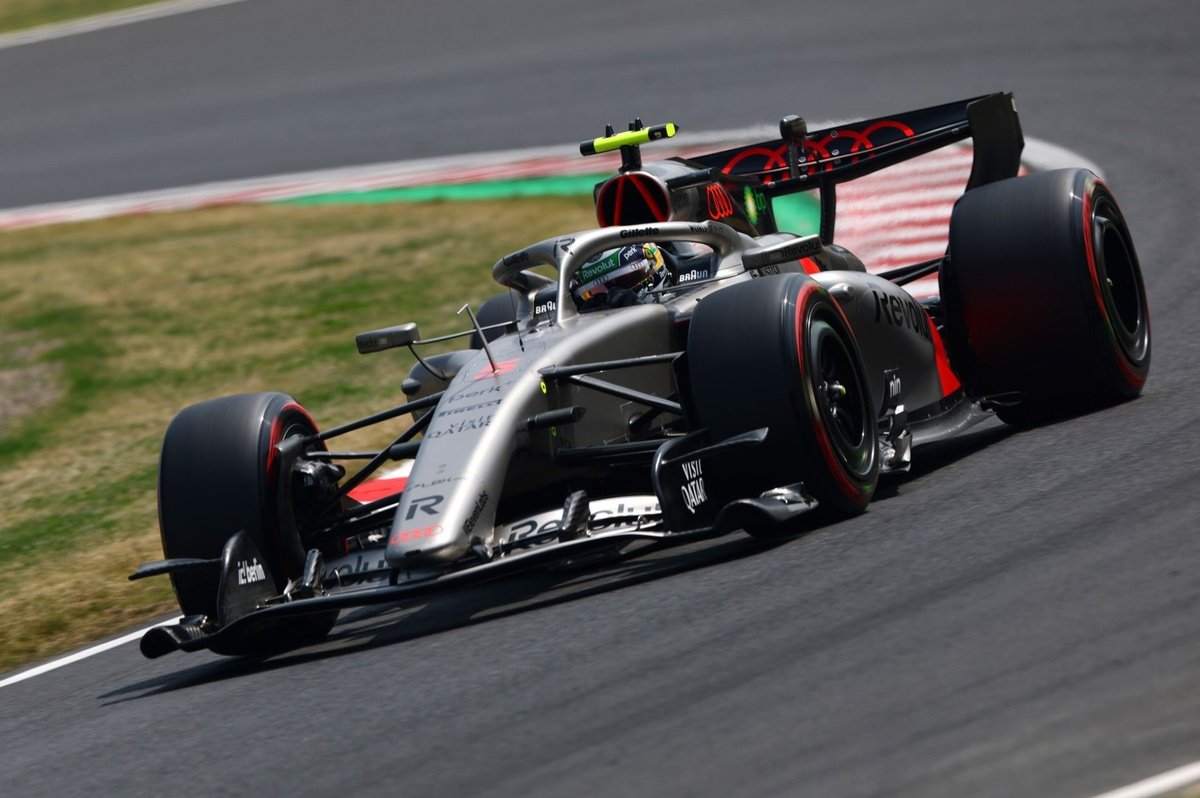
Formula 1 race starts in 2026 come freighted with many uncertainties, but one thing is virtually guaranteed: the sight of both Audis, having qualified well, falling off faster than John Lithgow at the end of the movie Cliffhanger.
Poor starts are just one symptom of an issue that affects all aspects of the Audi power unit’s performance, and the team has acknowledged there is no short-term ‘fix’ – despite the new regulations including a catch-up framework for manufacturers who have fallen behind. The first threshold for assessment under the ADUO (Additional Development and Upgrade Opportunities) regime may not come until Monaco in early June.
In Japan, to take just one example, Gabriel Bortoleto and Nico Hulkenberg qualified eighth and 13th, but by the end of the opening lap they were lying 13th and 19th. It’s understood that Audi’s power unit has a relatively large turbo compressor, where the trade-off for higher boost pressure is greater inertia – so the boost is longer in arriving.
Beyond being a contributor to slow launches, this also has an impact throughout the lap because it places more demands on the electrical part of the powertrain to deliver the required torque while the turbo is spooling up. Given the limitations on how much power can be harvested and deployed per lap, this means the Audi PU is, in effect, forced to ‘spend’ part of that amount covering shortfalls in the internal combustion engine’s output, which puts it at a disadvantage compared with rivals.
“It [Japan] has been a poor start,” said Mattia Binotto, who added team principal duties to his portfolio last weekend following the departure of Jonathan Wheatley.
“And it’s not the first time, so it’s certainly not our strength. At the moment, the reason it has not been addressed so far is because it’s not an obvious thing to be fixed.
“But on the other side, we know it’s a top priority for us. Because, again, we had a good quali and not it’s worthwhile having starting good positions if we are losing all the positions at the start.”
Bortoleto lost five places at the start in Japan
Photo by: Simon Galloway / LAT Images via Getty Images
The challenge for Audi is that the opportunities for change are limited, and not just because design choices such as compressor size aren’t easily unpicked mid-season, given the tight integration of chassis and engine. The FIA’s ADUO framework does provide some latitude for change, but in limited quantities and within a restricted time frame.
Internal combustion engines found to be between 2% and 4% off the benchmark engine according to the FIA’s performance metric are allowed one specific change immediately. Those over 4% are granted more concessions including increased dyno time and more flexibility under the cost cap.
But ADUO isn’t an opportunity for a quick fix, and nor was it intended to be. Engine development is a longer process than progressing a car design, so ADUO is structured to provide a gentle pivot, preventing competitive advantages and disadvantages from becoming ‘baked in’ from season to season.
For this reason, the evaluation points were set quarterly through the season – originally every six races when 24 grands prix were on the schedule. Now, given the cancellation of the Bahrain and Saudi Arabian GPs, the exact timing of the first ‘checkpoint’ is under discussion – it could be the Miami GP, now the fourth rather than the sixth round, or it could be Monaco.
Reports this week that Ferrari has already been given an ADUO break are, therefore, fallacious.

Mattia Binotto is also Audi’s team principal for now
Photo by: Jakub Porzycki / NurPhoto via Getty Images
Even when concessions are granted under ADUO, they cannot necessarily be implemented immediately.
“The lead times on engine development are very long,” explained Binotto.
“We have assessed, I believe, that most of the gap we got to the top teams is from the power unit, which is not unexpected. We knew that would have been the biggest challenge.
“And we have got a plan to recover. But engine development, especially when it comes to some concepts, can take longer. It’s not by chance that we have set 2030 as our objective [for challenging for the world championship].
“Because we know that it will take long. And I think what we need now is to be patient as well.
“We are very ambitious and we would like to see things solved in a couple of races. But sometimes that’s not the case.
“So I think we need to understand exactly where we are as a team, what are the plans. And as well, stick to the plans. Because miracles are not possible.
“We are not here to create miracles. It’s not us. We cannot do that. But we are here to have proper plans to address and to improve in the future.
“And I think that’s also possible.”
We want to hear from you!
Let us know what you would like to see from us in the future.
– The Autosport.com Team
