
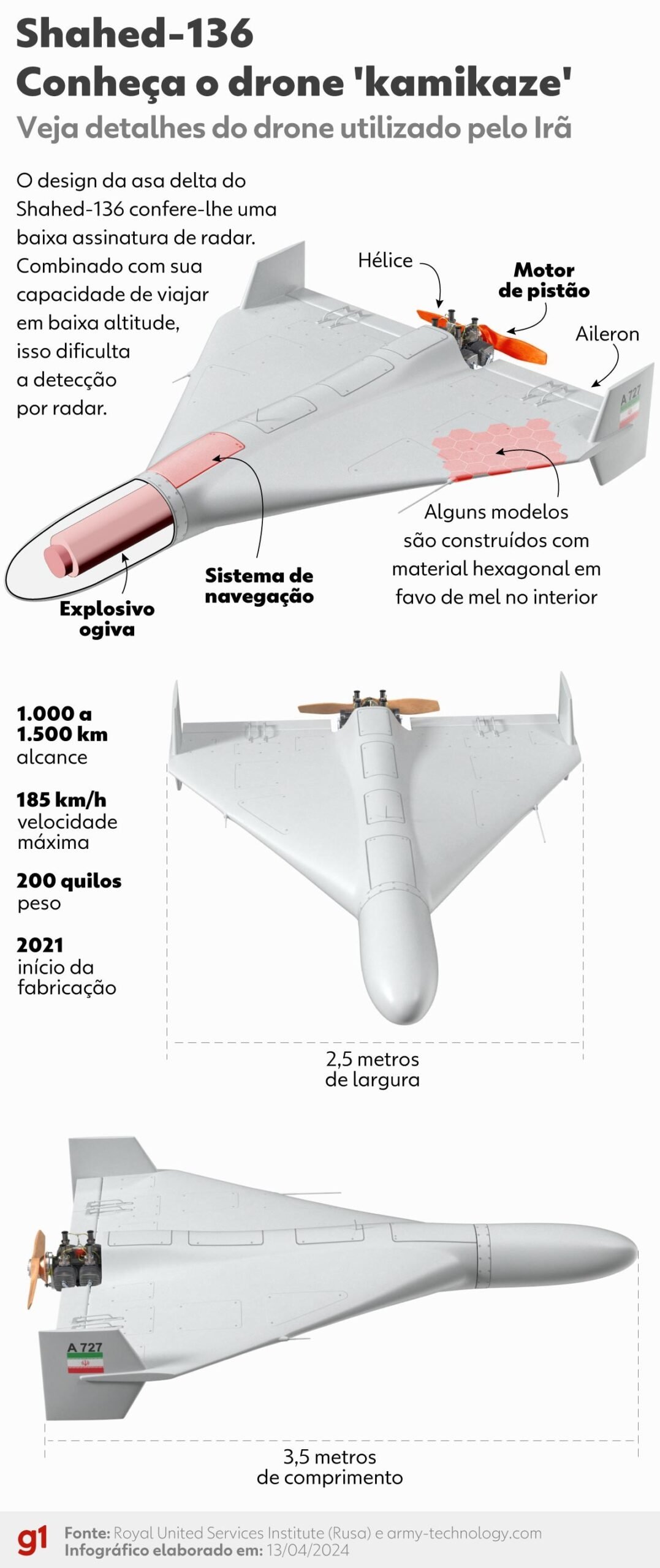
Iran carries out drone attack on oil tanker in Dubai A few hours after the first American and Israeli missiles hit Tehran, on February 28, Iran’s Revolutionary Guard launched its first retaliatory batteries, using a device developed years ago by the country and which, in a few days, managed to penetrate the air defense systems of Israel and Gulf states. ✅ Follow the g1 international news channel on WhatsApp Cheap and easy to produce, the Iranian Shahed‑136 drones have established themselves as one of the country’s main assets in the conflict, quickly reaching targets such as data centers, energy infrastructure, airports and even naval bases. In two weeks of exchanges of attacks, more than a thousand aircraft of this type had already been launched by Iran. The strategy relies on volume, not precision: large swarms are fired simultaneously to saturate air defenses. Just 3.5 meters long, they can be launched from simple structures, assembled in a few hours. The strategy is the same as that used by Russia in its invasion of Ukraine, which uses the same Shahed-136 drones against civilian installations in the neighboring country. 👉 The price justifies the quantity: A Shahed drone costs between US$20,000 and US$50,000 (R$100,000 to R$261,000), according to the Center for Strategic International Studies. Firing a single air defense missile used by the US and allies to shoot down drones could cost between US$1.3 million and US$4 million (R$6.7 million to R$20.9 million). Calculations by Reuters show that the cost of just one Patriot defense missile would be enough to finance at least 115 Iranian attack drones. Furthermore, unlike larger ballistic missiles, the Shahed‑136 flies slowly and on irregular trajectories, making it more difficult to detect. Each intercept usually requires two or three missiles, and when they escape, the impact can be significant. The explosive load and simplicity of the system led international press outlets to describe it as an “AK-47 from heaven”, in reference to the Soviet rifle known for its high firepower compared to its low production complexity. Experts estimate that this causes the US to spend at least US$1 billion (R$5.3 billion) per day to maintain the war. Tehran, even with its leadership shaken and part of its military structure destroyed, has managed to sustain its position in the conflict. Discover the Shahed-136 drone, used by Iran to attack Israel. Art/g1 Simple production, expanded reach The use of drones also puts pressure on Gulf countries. The Shahed has an estimated range of up to two thousand kilometers, says the manufacturer. But even a smaller real limit of a thousand kilometers would be enough to reach any point on the south coast. They force these states to turn to systems like NASAMS, Coyote and Avenger, whose single shots also cost hundreds of thousands of dollars. The Shahed-136 is built quite simply, using parts produced by 3D printers. Many are manufactured in dual-use facilities, which can be quickly adapted to expand industrial capacity. Analysis centers estimate that Tehran maintains a daily production of up to 400 units. Unlike American-made Switchblade kamikaze drones, a target must be inserted into the Shahed-136 in advance. The drone flies towards the target on its own and it cannot be changed retroactively. From then on, it operates completely autonomously. The simplicity of the system also makes electronic interference difficult, and the capabilities of countries in the region to block its signals are still considered low. READ ALSO United States flies nuclear bombers over Iran for the first time since the start of the war US journalist is kidnapped in Iraq Israeli minister wears hangman brooch and bursts champagne after approval of law on death penalty for Palestinians Use in Ukraine redefines war Shahed-136 drone, created by Iran and perfected by Russia, is displayed in front of St. Michael’s Cathedral in Kiev, Ukraine Valentyn Ogirenko/Reuters If drones don’t “winning” the war for Iran, they have been buying time for the Ayatollahs’ regime and redefining the conflict. Its use sustains a “war of attrition”, experts point out, aimed at depleting the enemy’s resources. In practice, Shahed contradicted the American expectation of ending the conflict quickly, dragged the Gulf countries into the dispute, and is even used as a threat to keep the Strait of Hormuz blocked. This imbalance became a strategic problem: attacking became cheap, while defending became extremely expensive. The modus operandi repeats that observed in the war in Ukraine, where technology changed the fate of the conflict. The Shahed are widely used by Iran’s ally Moscow under the name Geran-2 to target residential areas and civil infrastructure. But outmatched in armor and conventional aircraft, Kiev has also turned to cheap unmanned systems for reconnaissance and attack. It is estimated that drones account for around 70% of Russian casualties, allowing remote offensives and reducing the risk for pilots and crews, according to Reuters. Demand for technology at the front has even led Ukraine to swap its expensive air defense missiles for cheaper interceptors. Kiev claims that its anti-drone system, which also includes defensive drones, has allowed it to achieve an interception rate of over 80%. The Ukrainian experience led to an accelerated defense agreement between Kiev, Qatar, Saudi Arabia and the United Arab Emirates, signed last week. The terms were not disclosed, but Ukrainian President Volodymyr Zelensky said they included sharing information to shoot down drones. A team was sent to the Gulf for just this purpose. USA starts manufacturing drones similar to the Lucas attack drone, produced by the United States Army, which is inspired by the Iranian Shahed model. Disclosure/US Army At the start of the European conflict, the Pentagon’s chief weapons officer, Bill LaPlante, warned the Senate appropriations subcommittee that the war could become unsustainable if the US continued “shooting down a $50,000 drone with a $3 million missile.” Now, the US seeks to equate its strategy with Iran’s. One of the programs involved is the Low-cost Uncrewed Combat Attack System (Lucas), a US-made unidirectional attack drone “modeled after the Iranian Shahed”, says the Pentagon. The device, first used in the Iranian conflict, is also a cheap, long-range attack drone that is visually very similar to the Shahed-136 that inspired it. The commander of US Central Command (CENTCOM), Admiral Brad Cooper, described the system as “indispensable” in the conflict with Iran. “We captured the Iranian drone, dismantled it, sent it to the US, put a ‘Made in America’ on it and now we are shooting at the Iranians,” Cooper said. VIDEOS: most watched on g1
Source link
Cheap and deadly: Shahed-136, the Iranian drone that has revolutionized warfare
27
