
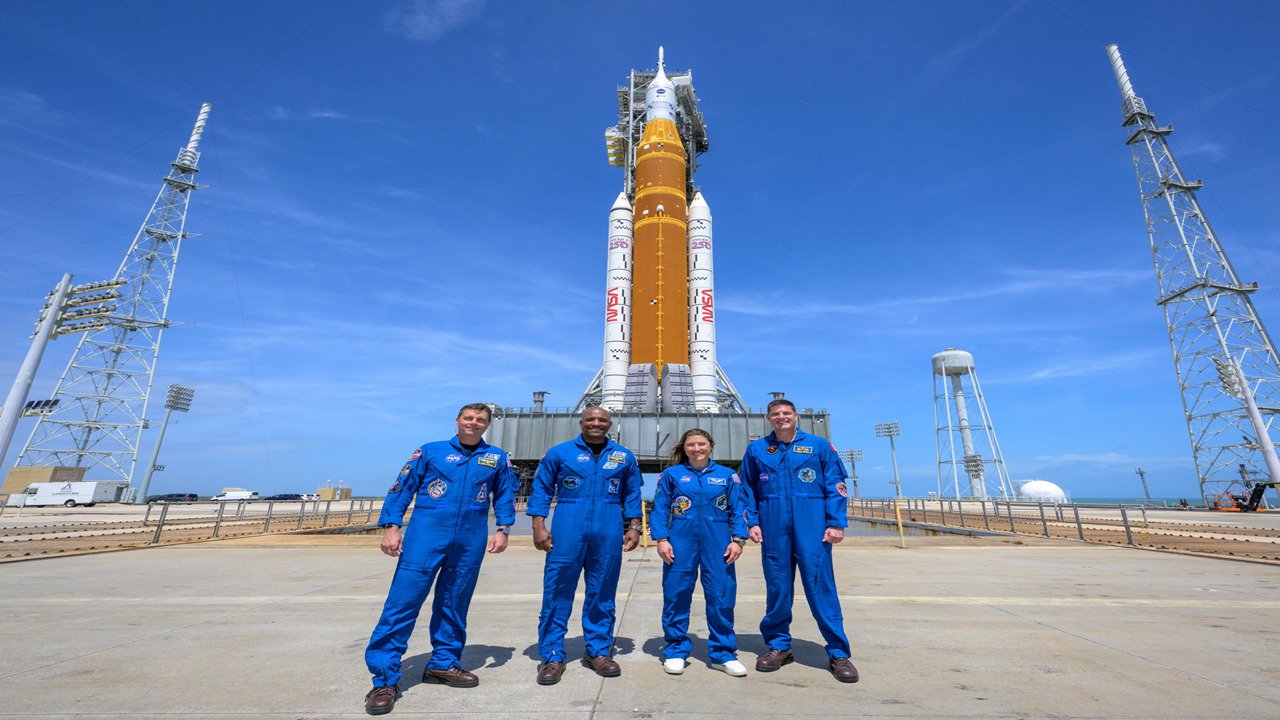
The Artemis II mission, which will mark man’s return to orbit around the Moon after more than 50 years, will feature a crew of four experienced astronauts chosen by NASA and the Canadian Space Agency. The launch of the rocket towards the Moon is scheduled to take place this Wednesday, April 1, from the Kennedy Space Center, in Florida. The mission should last around 10 days and take the team on a flight around the Moon, before returning to Earth.
Meet the crew
The mission commander will be Reid WisemanUnited States Navy veteran with 27 years of service. According to NASA, he was selected as an astronaut in 2009 and participated in the Expedition 41 mission to the International Space Station in 2014, where he remained for 165 days. During this period, he carried out more than 300 scientific experiments and participated in spacewalks that totaled around 13 hours. A fighter pilot and engineer by training, Wiseman also served in military operations in the Middle East and worked on advanced aircraft testing programs, including the F-35. He previously held the position of head of NASA’s Astronaut Office.
The pilot will be Victor Gloveralso a captain in the US Navy and one of the most experienced astronauts of the current generation. According to NASA, Glover has accumulated more than 3,500 flight hours in more than 40 different aircraft and participated in 24 combat missions. He was part of SpaceX’s Crew-1 mission, becoming pilot of the Crew Dragon spacecraft and flight engineer on Expeditions 64 and 65 of the International Space Station (ISS), where he remained for around 168 days. During the mission, it performed four spacewalks. Glover also served as a test pilot and held strategic roles within NASA, including representation on lunar landing systems.
The mission specialist will be Christina Kochengineer with extensive experience in space science and operations in extreme environments. According to NASA, Koch holds the record for the longest continuous stay in space by a woman, with 328 days aboard the International Space Station between 2019 and 2020. During this period, she participated in several scientific researches and carried out six spacewalks. Before joining NASA, Koch worked on developing instruments for space missions and served at scientific bases in Antarctica and the Arctic. She has held technical and leadership roles within the agency.
Completing the crew is Jeremy Hansencolonel in the Canadian Air Force and representative of the Canadian Space Agency (CSA). According to the CSA, Hansen will be the first Canadian to travel to the Moon’s orbit. He has a background in physics and space science and began his career as a fighter pilot, participating in NORAD operations and missions in the Arctic. Selected as an astronaut in 2009, he served as a capsule communicator (CapCom) in NASA mission control and even led the training of a class of astronauts – being the first non-American to perform this role. He also participated in international training and simulation missions in extreme environments, aimed at long-term space exploration.
Mission preparation
NASA announced this Monday (30) that the countdown to the launch of Artemis II has already begun at the Kennedy Space Center. According to the American space agency, technical teams are already carrying out final tests on the rocket’s systems. Space Launch System (SLS) and capsule Orionin addition to preparing the supply of cryogenic fuels.
According to NASA, astronauts participating in the mission remain in quarantine under medical monitoring and follow a controlled schedule of sleep, food and physical preparation to ensure ideal conditions at the time of launch. The initial forecast points to around an 80% chance of favorable weather conditions for the launch on the 1st.
In the Artemis II mission, the astronauts will not yet land on the lunar surface – the objective will be to carry out a flight around the Moon to test essential systems of the Orion spacecraft and the SLS rocket, such as life support, navigation and communication in deep space, in addition to validating maneuvers, emergency procedures and crew performance outside Earth orbit. The mission will also evaluate high-speed reentry into Earth’s atmosphere. The manned landing on the natural satellite is expected to only occur in a future mission of the program, currently planned for 2028.
The last time man was on the Moon was in 1972, during the Apollo 17 mission.
