
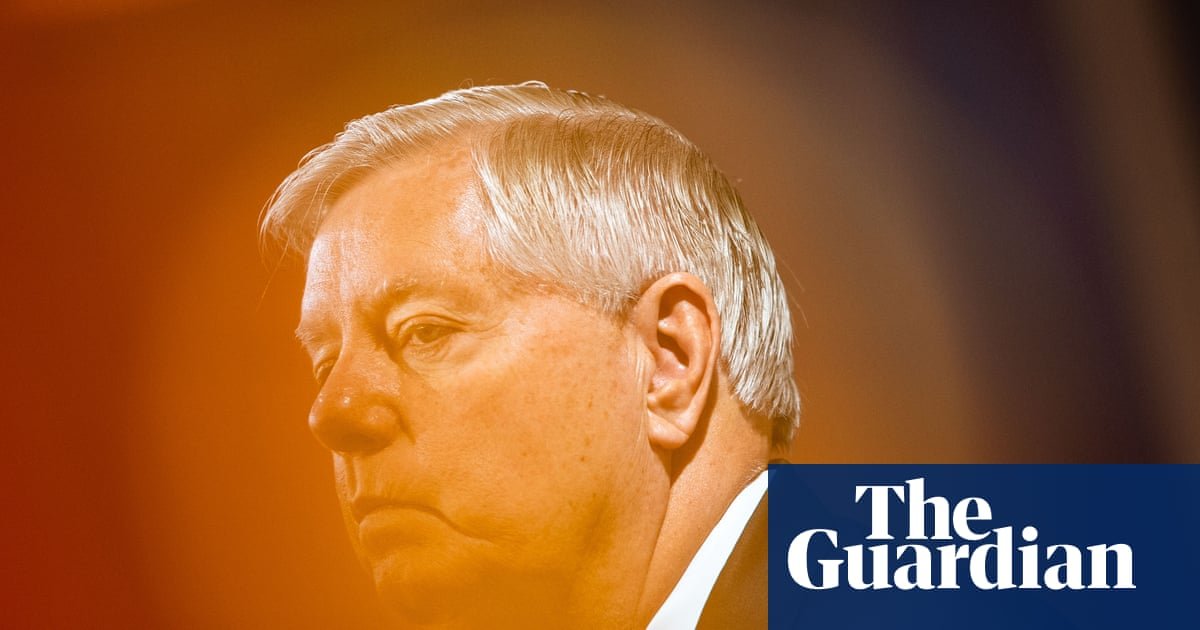
To sceptics, Donald Trump’s war in Iran is a hubristic blunder that could spiral further out of control and bring catastrophe to the world. To Lindsey Graham, it is a dream come true.
The Republican senator from South Carolina spent decades spoiling for a fight with the regime in Tehran. He claimed that its overthrow would give the US president his own “Berlin Wall moment”. Now he is urging further escalation by invoking the bloody battle of Iwo Jima from the second world war.
For Graham’s critics, his sway over Trump, and his seemingly insatiable appetite for war at any cost, might make him the most dangerous man in Washington.
“Lindsey’s probably the most pro-war Republican out there,” said Joe Walsh, a former Republican congressman turned Democrat. “He’s certainly the most visible. We’re talking about a guy who, if he could, would have American troops everywhere on the planet engaged in some sort of a war. He’s a war-hungry dude and he’s got Trump’s ear.”
Graham, 70, a retired air force reserve colonel who specialised as a military lawyer, was hostile to Iran long before Trump arrived on the political scene. Serving in the House of Representatives in the 1990s, he supported attempts to isolate the country and curb its missile and nuclear programmes.
Elected to the Senate in 2002 as the US prepared for war with Iraq, he frequently warned that Iran was exploiting the conflict to expand its regional influence. He opposed the nuclear agreement negotiated under Barack Obama and in 2015 urged the US to act pre-emptively to ensure that Iran’s “air force, their navy and their army is a shell of its former self”.
This muscular approach appeared at odds with Trump’s “America First” instincts, which were suspicious of overseas interventions. It was far from the only difference between the two men. Graham, who periodically worked across the aisle with Democrats, fiercely opposed Trump’s hostile takeover of the Republican party in 2016.
He posted on Twitter: “If we nominate Trump, we will get destroyed … and we will deserve it.” He also dismissed Trump as a “jackass”, “a race-baiting bigot” and “the most flawed nominee in the history of the Republican party”. Trump retorted that the South Carolina senator was an “idiot” and a “lightweight”.
But when it became clear that Trump was unstoppable, Graham fell into line. He was flattered to be invited to fly on the Marine One helicopter, regularly played golf with the president, and became a valued interlocutor between the White House and Congress. In 2018 he was an outspoken defender of Trump’s embattled nominee for the supreme court, Brett Kavanaugh.
That same year witnessed the death of John McCain, a close friend of Graham’s and a bitter rival of Trump. Reed Galenwho was deputy campaign manager for McCain’s presidential campaign, believes this moment was pivotal. “He’s always needed a north star and until John McCain died, it was John McCain,” Galen said.
“I’ve always gotten the sense, having worked for Senator McCain, that after Senator McCain died Graham was searching for who the next star was he was going to hitch his wagon to, and it’s been Trump.”
Graham has been a loyal foot soldier ever since. Except once. After Trump’s supporters rioted at the US Capitol on 6 January 2021 in an effort to overturn his election defeat, Graham delivered an impassioned speech on the Senate floor: “Trump and I, we’ve had a hell of a journey – I hate it to end this way. Oh my God, I hate it. From my point of view, he’s been a consequential president but today, first thing you’ll see. All I can say is count me out. Enough is enough.”
But when seven Republican senators subsequently voted to impeach Trump for “incitement of insurrection”, Graham was not among them. And when the 2024 presidential election came around, he was back on the Trump train. On the golf course, Fox News and elsewhere, he got to work persuading Trump that dealing with Iran could be a vital part of his second-term legacy.
Graham told Politico recently: “We were thinking about this early, early on about how Iran is a spoiler for expanding the Abraham accords and stability in the Mideast. I told him before he took office … if you can collapse this terrorist regime, that’s Berlin Wall stuff.”
This led to a months-long dialogue and a final burst of lobbying “in the last several weeks”, Graham told Politico, with the pair discussing Iran fewer than 48 hours before the war began. Finally, after decades of striving, Graham’s prize was within reach.
Jon Hoffman, a research fellow in defence and foreign policy with the Cato Institute, a libertarian-leaning thinktank in Washington, told the Associated Press: “You’re seeing essentially a child on Christmas morning who has gotten everything that he’s ever dreamed of. And that’s not best for the country, obviously, but it’s best for Lindsey Graham’s ideology.”
But Graham has no intention of resting on his laurels. He continues to try shaping the war as he sees fit. On 8 March he used X to express Washington’s dismay at ally Israel for overreaching by striking 30 Iranian fuel depots, urging Tel Aviv to “please be cautious about what targets you select” lest it cripple Iran’s chance to rebuild.
And even as the war drags on longer than many expected, with Iran blockading the crucial strait of Hormuz, Graham wants more. On Fox News last Sunday he advocated for US marines to seize Kharg Island, Iran’s main oil export hub, lying about 20 miles off the coast of the mainland. He said: “We did Iwo Jima, we can do this.”
Iwo Jima is famous for a photo of marines raising the US flag but was also marked by fierce fighting over 36 days on the heavily fortified Japanese island where nearly 7,000 marines and sailors died, with roughly 20,000 wounded, while more than 18,000 Japanese soldiers died.
Graham’s comments exposed fractures in his own party. Congresswoman Nancy Mace of South Carolina posted on X: “Lindsey Graham needs to be removed from the Situation Room. I don’t want to hear one word from a guy with no kids, desperately sending our sons and daughters into war on the ground in Iran.”
But while some loud “Make America great again” (Maga) voters have decried the Iran intervention, nine in 10 Maga-aligned Republicans still support the war, according to an NBC News poll. Graham also provides reassurance to a Republican establishment that feared Trump would no longer project US power against its enemies.
John Bolton, a national security adviser during Trump’s first term, said: “He is an important voice. If our objective is to overthrow the regime then I think Lindsey’s probably urging Trump in that direction. I think it’s a good thing.”
Voters will have their say. In a South Carolina Senate primary election in June, Graham must see off a challenge from Paul Dans, the former director of Project 2025, who has branded him “essentially anti-Maga”, then in November take on a Democratic candidate sure to be galvanised by public anger at Trump.
Tara Setmayera former Republican communications director who now runs the Seneca Project political action committee, said: “Lindsey Graham has been a warmonger for the majority of his career.
“He is someone who seemingly has no reservations sending our men and women into battle where it suits his political desires. His display – he’s virtually foaming at the mouth to send our troops into harm’s way – is grotesque and I hope that he pays a political price for that in South Carolina as he is up for re-election.”
Antjuan Seawrighta Democratic strategist based in South Carolina, added: “No one believes that we should be at war, including conservatives who campaigned with Donald Trump and his ‘America First’ agenda. Lindsey Graham is doing his best audition for an audience of one, and that’s Donald Trump.”
