
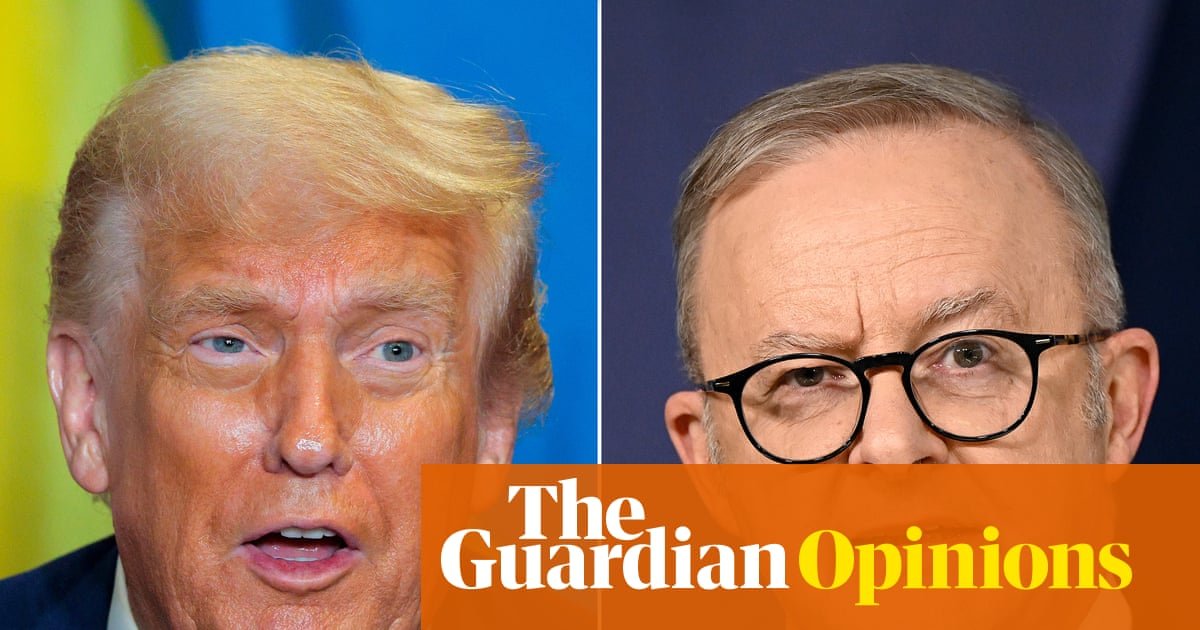
Australians watching fuel prices skyrocket and interest rates surge in the wake of Donald Trump’s “excursion” into Iran are starting to wonder if this is a trip we really want to be on.
Having been all-in on an Aukus treaty that pinkie-promises to deliver long-term national security, the Albanese government has taken on the demeanour of a reluctant passenger gripping the seat with white knuckles as the whacked-out driver takes the corners at speed.
While the prime minister was quick to endorse one of the president’s initial (and highly contested) objectives in destroying Iran’s nuclear capability, he has since been reluctant to commit further to this magical mystery tour.
According to this week’s Guardian Essential report, that reticence is reflective of the national mood, with just a quarter of Australians saying they support the US and Israeli strikes.
These findings are hardly surprising given the lack of clarity on what the operation is, the constant shifts in justification and the president’s whiplash-inducing social media diplomacy.
In a separate question we find the only Australian action with majority support is “to work with international organisations to help with peace talks and prevent further escalation”: in other words, to get Trump out of the driver’s seat.
There is scant support for other interventions, such as naval support to attempt to end Iran’s retaliatory blockade, sending weapons to support third party nations like the United Arab Emirates, or offering troops on the ground.
If this was the end of the story, the PM could sit quietly up the back of the bus, wait for global markets to impose some safety rails and hope like hell the whole thing runs out of petrol.
But where much of Trump’s erratic exercise of power has previously been a compelling diversion best viewed from a distance, the war on Iran and the regime’s heavily flagged response in strangling global oil supply is having material impacts on Australians’ hip pockets.
The economic blowback from the Trump administration’s miscalculations has a real bearing on the ability of the Albanese government to shape its second-term reform agenda where the upcoming budget had loomed as its moment to shine.
Having brought interest rates under control and rebuilt the budget after the Covid deficits, Labor was poised to unveil a package of tax reforms and social investments in a relatively stable environment.
The degree of difficulty on that manoeuvre has substantially increased, as the impact of the blockade on oil drives global inflation, juiced by cynical price-gouging from the companies that dominate these brittle global supply chains.
Making the politics even harder for Labor, just as many people are ready to blame the government for its spending as they do these global headwinds. In other words, the government is copping both the impact and the blame for Trump’s misadventure.
The prime minister has grasped this threat in recent days, making the case that “the stable, predictable world of ever-expanding free trade is gone – and it will not be returning any time soon”.
The depth of the current economic shock may still be determined by how Trump extricates himself from this mess of his own making but, regardless, Australians appear ready to look for a different driver.
Mark Carney’s recent trip to Australia in the days immediately after the strikes on Iran provided a compelling counterpoint to the chaos our largest ally currently offers.
In a carefully reasoned and thoughtful response to US bullying, the Canadian prime minister laid it out for middle powers like Australia: we need to work together to counter the hegemons. In defence, in trade, but also in the development of AI, we need to chart a course that recognises that with the decline of the international rules-based order the only way to respond to the exercise of raw power is to aggregate it.
That is about more than raising the finger to Trump, which is the natural inclination of many. It is about building working alternatives so our leaders do not feel so ensnared by his misadventures.
A final question this week shows overwhelming appetite for this proposition. When given the choice, Australians want our government to work more closely with other middle powers by a factor of almost 2:1.
This sentiment is particularly strong among Labor, Greens and independent voters with those supporting One Nation the most split, providing a potential pain point given the Maga links of the party’s key sponsor, Gina Rinehart.
When this “excursion” is over, there will need to be a global reckoning about whether the US empire is really a self-evident force for good.
If ever there was a moment to seize the wheel, it is now.
-
Peter Lewis is the executive director of Essential, a progressive strategic communications and research company that undertook research for Labor in the last election and conducts qualitative research for Guardian Australia. He is the host of Per Capita’s Burning Platforms podcast
